

TL;DR
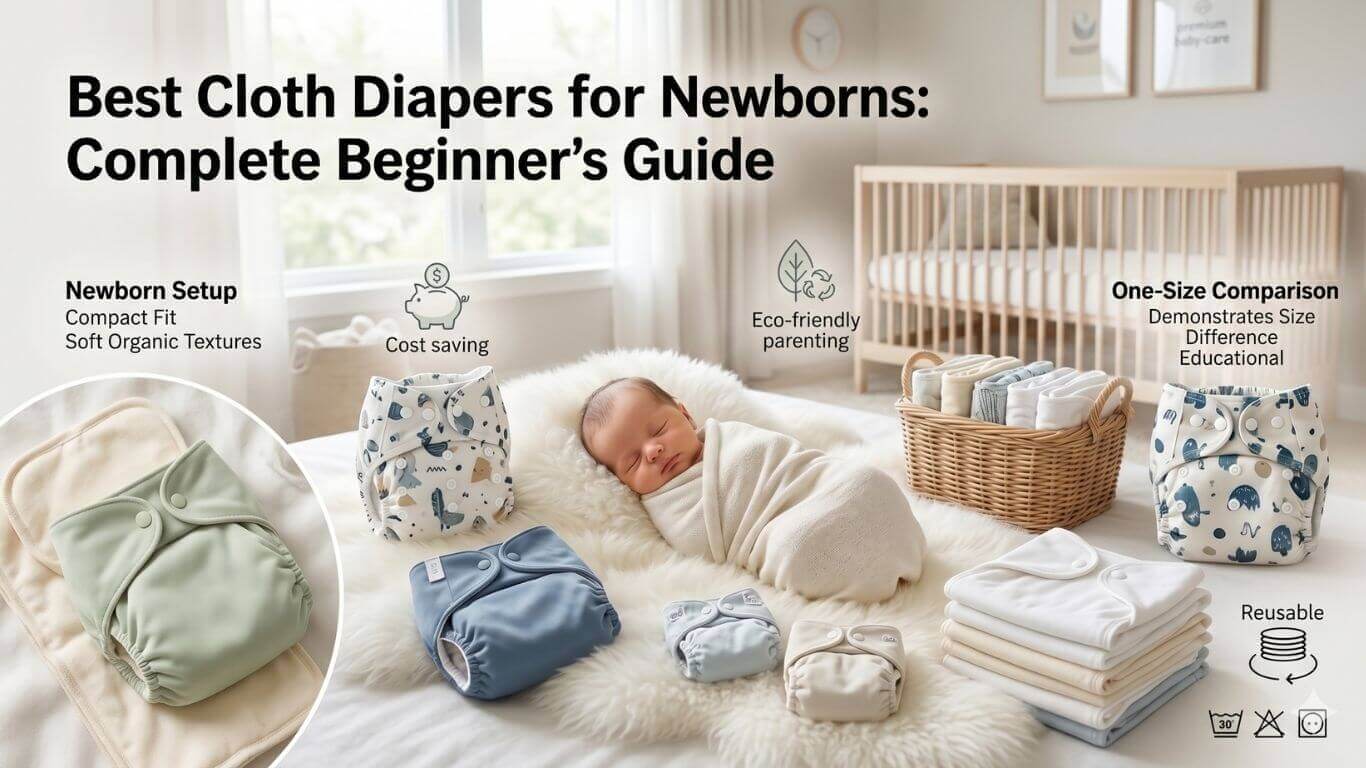
- Best overall: Newborn prefolds + a newborn cover. We chose this system as our overall option because it offers a strong combination of newborn fit, relatively low upfront cost, quick drying, and flexibility. The trade-off is that prefolds require more hands-on diaper changes than all-in-one diapers.
- Best for beginners: Newborn all-in-one (AIO) diapers. AIOs are simpler to put on because the absorbent and waterproof components are combined, although they typically cost more per diaper and may take longer to dry.
- Best for growing with your baby: Adjustable one-size diapers. Some one-size systems can be used for a longer period, but they may be bulky or difficult to fit on very small newborns. Check the manufacturer’s minimum weight and fit guidance rather than assuming “one-size” means newborn-ready.
- Plan for frequent changes. Newborns commonly need many diaper changes throughout the day, so your ideal stash depends on your baby’s changing frequency, how often you wash, and how quickly your diapers dry. For families washing every other day, around 24–36 absorbent diapers can be a practical starting range, rather than a universal requirement.
- Consider the total cost before buying a newborn stash. Newborn-sized diapers may be used for only a limited period, while covers and some diaper components may be reusable for future babies or later stages. Your actual cost will depend on the system you choose, how many diapers you buy, washing expenses, and how long you use them.
Our overall recommendation: For many families starting cloth diapering from birth, newborn prefolds paired with properly sized waterproof covers are a practical starting point. If ease of use is your priority, a newborn AIO may be worth the additional cost.
What to Look for in Cloth Diapers for Newborns
Choosing a cloth diaper for a newborn is different from choosing one for an older baby. Fit, ease of changing, drying time, and the baby’s size can matter just as much as absorbency.
Newborns are smaller than older infants and may need frequent diaper changes. During the first weeks, the umbilical cord stump may also still be healing, so a diaper that sits comfortably below or away from the cord area can be particularly useful.
Rather than looking for a diaper that is simply marketed as “newborn,” consider these factors when comparing different systems:
| What to look for | Why it matters for a newborn |
|---|---|
| Newborn-specific fit | A properly sized diaper can reduce gaps around the waist and thighs and help create a better seal against leaks. |
| Minimum weight range | Check the manufacturer’s stated weight range. A “one-size” diaper may still be too bulky or loose for a small newborn. |
| Umbilical-cord-friendly design | A low-rise or snap-down design can help keep the diaper from rubbing against the healing cord stump during the early weeks. |
| Absorbency | Newborns need frequent changes, so the diaper needs enough absorbency for the time between changes without becoming unnecessarily bulky. |
| Drying time | Faster-drying diapers can be easier to keep in rotation when you’re washing frequently. |
| Ease of use | Simple systems can be particularly helpful when you’re changing diapers frequently, including during overnight feeds. |
| Cost | Newborn-sized diapers may have a shorter usable period, so price per diaper and the possibility of reusing covers or other components can affect overall value. |
| Wash routine | Choose a system that fits your washing frequency, available drying space, and the care instructions provided by the manufacturer. |
| Leg and waist adjustability | Multiple snaps, fold options, or adjustable closures can help you achieve a better fit as your newborn grows. |
Our editorial approach
We don’t consider one cloth-diaper system to be universally “best” for every newborn.
Instead, we evaluate each option according to specific use cases—such as newborn fit, ease of use, budget, absorbency, drying time, and suitability for very small babies.
For example, newborn prefolds with a separate cover are our overall pick because of their combination of fit, affordability, drying speed, and flexibility. But a parent who values convenience above cost may reasonably prefer a newborn AIO.
That’s an important distinction: the best cloth diaper for your newborn depends on what matters most to your family.
The 5 Main Types of Cloth Diapers Explained
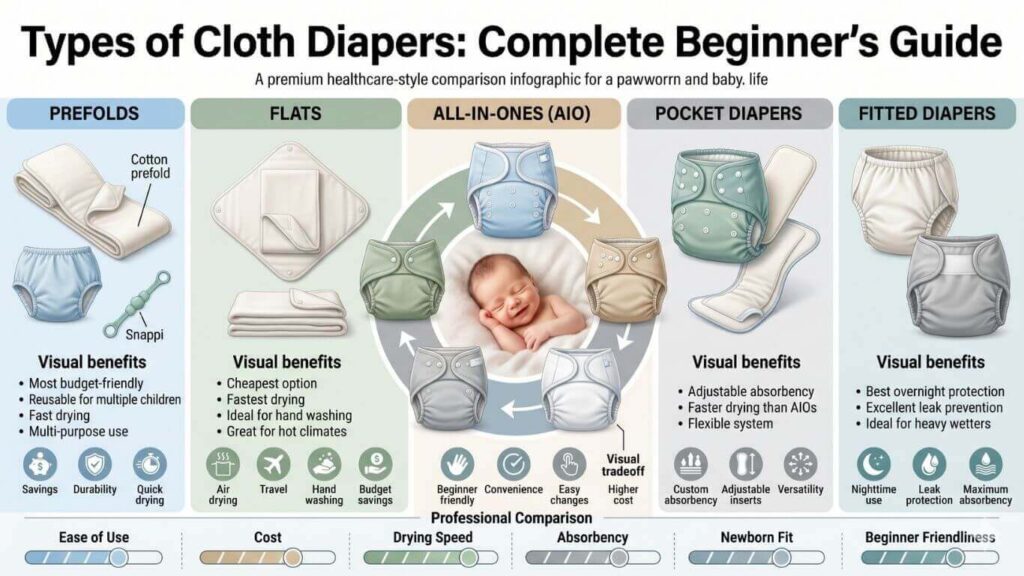
Before choosing a specific newborn cloth diaper, it helps to understand how the main diaper systems work. There isn’t one design that is ideal for every family. The right choice depends on your baby’s size, how often you want to wash, your budget, how much convenience you want, and whether you’ll be using cloth diapers overnight or away from home.
For newborns, these are the five systems you’ll encounter most often.
1. Prefolds With Covers
A prefold is a rectangular piece of absorbent fabric with extra layers sewn into the center. You can fold it around your baby and fasten it with a diaper fastener, or use a simpler pad fold inside a waterproof cover.
Why parents choose them: Prefolds are relatively inexpensive, washable, versatile, and generally quick to dry compared with more heavily layered diapers. Because the waterproof cover is separate, you can often reuse a cover for another wet-only change if it remains clean and dry.
Best for: Budget-conscious families, parents willing to learn a two-piece system, and families who prioritize quick drying.
Trade-offs: They require more hands-on changing than an AIO, and getting the fold and fit right can take some practice.
Newborn note: A newborn-sized prefold and cover can provide a more secure fit on a small baby than many one-size systems.
2. Flats With Covers
A flat is a single large, thin piece of absorbent fabric. Unlike a prefold, it doesn’t have additional layers sewn into the middle, so parents fold it into the desired shape before putting it on the baby.
Why parents choose them: Flats are simple, inexpensive, and particularly easy to wash and dry. Their relatively thin construction can be useful for families who have limited drying space or need diapers to dry quickly.
Best for: Families on a tight budget, hand-washing situations, and parents who prioritize fast drying.
Trade-offs: Flats require more folding than prefolds, and some parents find the learning curve less convenient during frequent newborn changes.
Newborn note: A flat can be folded to fit a small newborn, but you’ll need to find a fold that provides enough absorbency without creating excessive bulk.
3. All-in-One (AIO) Diapers
An all-in-one, or AIO, combines the absorbent material and waterproof outer layer into one diaper. You put it on the baby much like a disposable diaper, without separately assembling a cover and insert.
Why parents choose them: AIOs are among the simplest cloth systems to use. They’re particularly convenient when grandparents, babysitters, childcare providers, or other caregivers aren’t familiar with cloth diapering.
Best for: Beginners, caregivers who want a familiar diapering process, and families who value convenience over the lowest possible cost.
Trade-offs: AIOs generally cost more per diaper than prefolds, and their sewn-in layers can take longer to dry. The exact drying time varies considerably by design.
Newborn note: A newborn AIO can be convenient during the first weeks, but buying enough AIOs for every newborn change can become expensive. Some families use a small number of AIOs alongside a larger prefold stash to balance convenience and cost.
4. Pocket Diapers
A pocket diaper consists of a waterproof outer layer and an inner lining with an opening, or “pocket.” An absorbent insert is placed inside the pocket before the diaper is used.
Why parents choose them: The removable insert allows you to adjust absorbency. You can use one insert for a newborn or add additional absorbency as your baby grows and their needs change.
Best for: Parents who want adjustable absorbency and a system that can continue to work as their baby’s output increases.
Trade-offs: The inserts need to be removed before washing and stuffed back into the pocket afterward. That extra preparation may not appeal to parents who want the simplest possible newborn system.
Newborn note: Fit is especially important. Some pocket diapers are designed primarily for older babies, so check the manufacturer’s minimum weight and newborn fit before buying a large stash.
5. Fitted Diapers With Covers
A fitted diaper is shaped like a conventional diaper and is made entirely from absorbent material. It doesn’t have a waterproof outer layer, so it needs to be paired with a separate cover.
Why parents choose them: Because the entire diaper is absorbent and the elasticized shape surrounds the baby’s legs and waist, fitteds can provide useful containment for families dealing with frequent leaks or messy newborn stools.
Best for: Parents who prioritize containment, overnight use, or a highly absorbent two-piece system.
Trade-offs: Fitted diapers can cost more than basic prefolds and may take longer to dry because they contain more layers of absorbent material.
Newborn note: A fitted diaper can be particularly useful when containment is a priority, but you don’t necessarily need one for every change. Many families use fitteds selectively for overnight or heavier-wet periods.
Which Cloth Diaper Type Is Best for a Newborn?
There isn’t a single winner for every family.
If your priority is low cost and fast drying, prefolds with newborn covers are a strong starting point.
If your priority is simplicity, a newborn AIO may be worth the additional cost.
If your priority is maximum flexibility and adjustability, pocket diapers may make more sense.
If your priority is containment and overnight absorbency, fitted diapers with covers are worth considering.
And if your priority is the lowest-cost, fastest-drying system, flats are another option.
For this guide, we selected products based on specific newborn use cases rather than assuming one diaper system is universally superior.
Newborn Prefolds With Covers — Best Overall for Budget and Flexibility
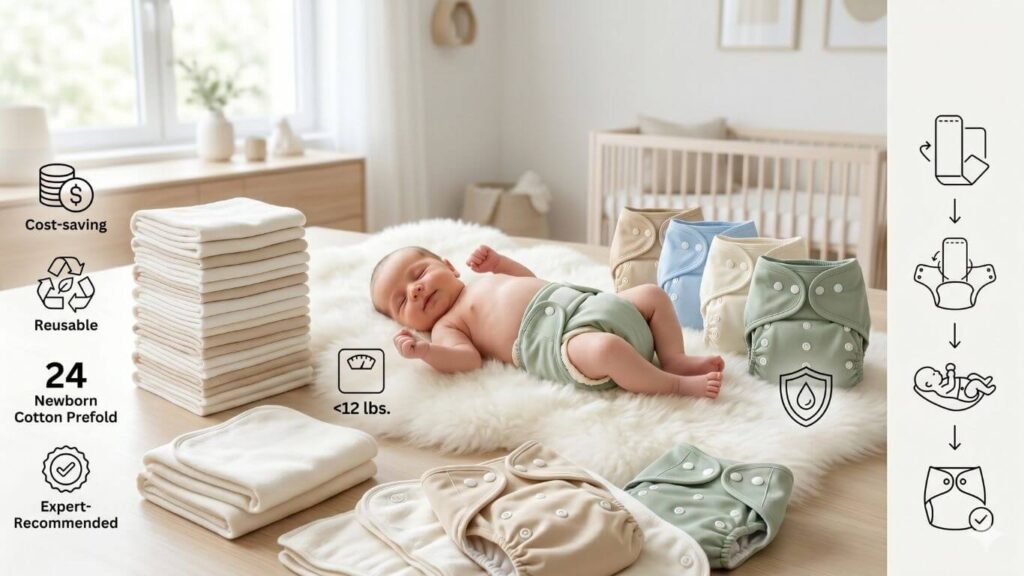
Best for: Families who want a relatively affordable newborn system that dries quickly and can be used in different ways
Why we chose it: Newborn prefolds paired with appropriately sized waterproof covers offer a practical combination of fit, affordability, flexibility, and drying speed. They’re not the easiest system to master, but the relatively low cost makes them a reasonable starting point for families willing to learn.
A prefold system also lets you buy the absorbent portion and waterproof cover separately. That gives you more flexibility when building a newborn stash and allows you to replace one component without replacing the entire diaper.
Why we like this system
The biggest advantage is versatility.
You can use a prefold with a traditional diaper fold and fastener, or use a simpler pad fold inside the cover. As your baby grows, the same prefolds may also have uses outside the newborn diapering stage, depending on their size and condition.
They also tend to dry relatively quickly because the absorbent material can be opened or separated from the waterproof cover during washing and drying.
What to consider
Prefolds aren’t completely hands-off.
Parents need to learn how to fold and position them correctly, and a separate waterproof cover adds another step to the diaper change.
The exact number of prefolds and covers you’ll need depends on your washing schedule, baby’s changing frequency, and drying conditions.
A practical starting setup
For a family washing every other day, you might consider starting with approximately:
- 24–36 newborn prefolds
- 6–8 newborn covers
- Several fasteners if you plan to use a secured fold
- A small number of disposable diapers as backup
This is a planning example, not a required stash size. Families who wash daily may need fewer diapers, while families who wash less frequently may need more.
How to use a prefold with a cover
- Choose a fold appropriate for your baby’s size.
- Place the folded prefold around or underneath the baby.
- Fasten it if you’re using a diaper fastener.
- Position the waterproof cover over the absorbent diaper.
- Check the waist and leg openings for a comfortable, gap-free fit.
- Make sure the diaper isn’t rubbing against the healing umbilical cord area.
Pros
- Relatively affordable
- Quick-drying design
- Flexible folding options
- Covers can sometimes be reused between wet changes
- Easy to replace individual components
- Useful beyond the newborn stage in some cases
Cons
- Requires more hands-on setup
- Separate cover adds another step
- Parents need to learn an appropriate fold
- Newborn sizes may have a relatively short usable period
Our verdict: Our overall pick for families who prioritize value, flexibility, and drying speed and don’t mind learning a two-piece diaper system.
Newborn All-in-One — Best for Convenience
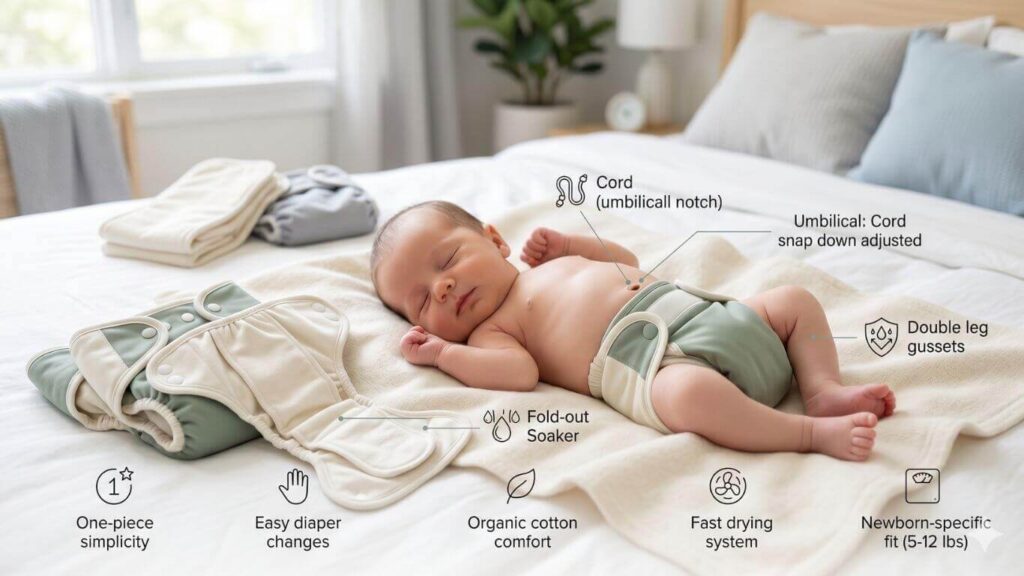
Best for: First-time cloth-diapering parents and caregivers who want the simplest possible cloth system
Why we chose it: A newborn AIO can make cloth diapering easier to learn because there are no separate inserts or covers to assemble. The convenience comes at a higher upfront cost, however.
A newborn AIO combines absorbency and waterproofing into a single diaper. That makes it particularly useful when several different people will be changing the baby.
Why we like this system
The learning curve is relatively small.
Instead of figuring out which insert belongs with which cover or how to fold a prefold, you simply adjust the diaper around the baby and fasten it.
That can be valuable during the newborn period, when diaper changes are frequent and parents are already dealing with interrupted sleep.
The trade-off: price
Convenience usually comes with a higher cost.
If a newborn AIO costs substantially more per diaper than a prefold, buying enough AIOs for your entire rotation can require a significantly larger upfront investment.
For that reason, a hybrid stash can make sense:
- Use several AIOs for daytime or caregiver changes.
- Use prefolds and covers at home.
- Keep a few AIOs available for outings.
This lets you get some of the convenience of an AIO without paying for an entire newborn stash in the more expensive format.
What to check before buying
Don’t assume that every newborn AIO has the same fit.
Check:
- Manufacturer’s minimum and maximum weight
- Umbilical-cord design
- Closure system
- Number and placement of absorbent layers
- Whether the absorbent portion can be opened for easier drying
- Care and washing instructions
Pros
- Simple to put on
- Familiar diapering process
- Convenient for caregivers
- No separate cover required
- Useful for outings
Cons
- Higher upfront cost
- Some designs take longer to dry
- Newborn sizing may only be useful for a limited period
- Buying a complete AIO stash can become expensive
Our verdict: A good choice when ease of use is more important than minimizing upfront cost.
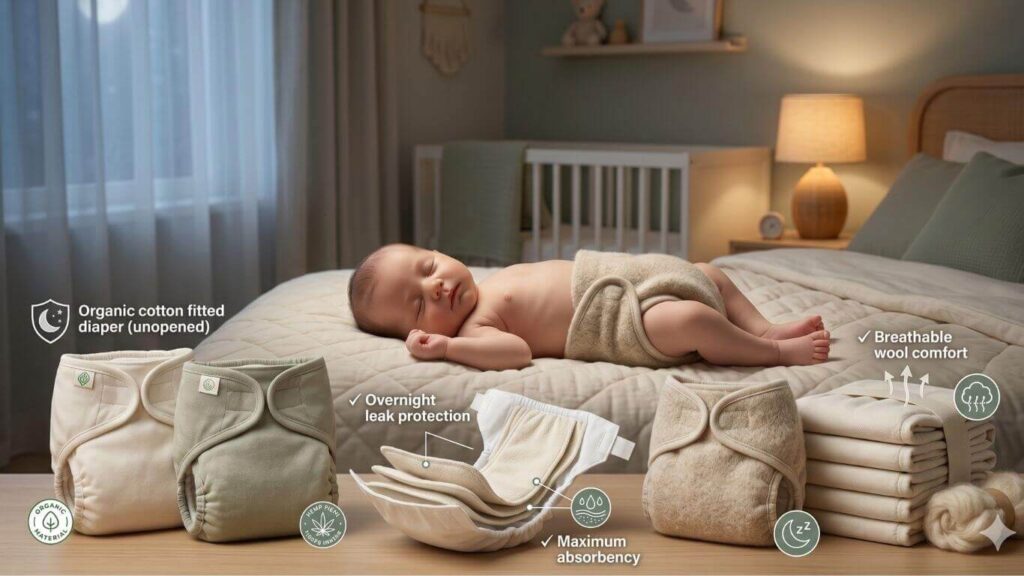
Newborn Fitted Diaper With a Waterproof or Wool Cover — Best for Containment and Overnight Use
Best for: Families who need more absorbency or containment, particularly during longer stretches between changes
Why we chose it: Fitted diapers surround the baby with absorbent material and can provide useful containment when a basic prefold isn’t meeting your needs. They’re particularly worth considering for nighttime or babies who regularly have leaks or messy stools.
A fitted diaper is not waterproof by itself. It must be paired with an appropriate waterproof cover.
Why fitteds can be useful overnight
The shaped design allows absorbent material to extend around the baby’s body rather than relying entirely on a folded rectangle.
For some babies, that can help with containment.
However, newborns generally still require frequent diaper changes, so an overnight cloth setup should not be interpreted as a reason to leave a wet or soiled diaper on a baby for an extended period.
What about wool covers?
Wool covers are one option for families interested in a breathable, reusable cover system. They require more care than standard waterproof covers and aren’t necessary for everyone.
If you choose wool, follow the manufacturer’s care and lanolizing instructions rather than assuming every wool cover requires the same maintenance schedule.
Pros
- Good containment
- High absorbency potential
- Useful for nighttime setups
- Can be paired with different cover types
- Shaped design may provide a secure fit
Cons
- More expensive than basic prefolds
- More absorbent layers can increase drying time
- Requires a separate cover
- Wool covers require additional care
Our verdict: Worth considering when containment or nighttime absorbency is a higher priority than keeping the diaper system as inexpensive and simple as possible.
Hybrid Diaper System — Best for Flexible Cloth Use
Best for: Families who want to combine reusable cloth inserts with disposable options for travel, childcare, or particularly difficult days
Why we chose it: A hybrid system can reduce the pressure of maintaining a completely cloth routine. Parents can use reusable inserts at home and choose a compatible disposable option when washing, travel, or childcare makes cloth less convenient.
Hybrid systems vary significantly by brand, so don’t assume that a cover or insert from one system will work with another.
Why a hybrid system can be practical
One of the biggest barriers to cloth diapering isn’t the diaper itself—it’s the routine.
A family may be comfortable washing cloth diapers at home but prefer something simpler while traveling.
A hybrid approach can provide that flexibility.
Newborn fit matters
Some hybrid systems use adjustable covers designed to fit a broad range of sizes. Others are available in dedicated newborn sizes.
Before buying, check the manufacturer’s minimum weight and newborn fit guidance.
A cover that technically fits a small baby may still be bulky or leave gaps around the legs.
Pros
- Flexible cloth/disposable approach
- Useful for travel
- Convenient for childcare
- Can reduce the size of your reusable stash
- Easier transition for families new to cloth
Cons
- Disposable inserts create ongoing costs
- Compatibility varies by system
- Some one-size covers may not fit the smallest newborns
- May be less economical than an all-cloth system over a long period
Our verdict: A practical option for families who want the benefits of reusable cloth without committing to cloth for every diaper change.
Budget Prefolds — Best for Keeping Upfront Costs Low
Best for: Families who want to try cloth diapering without making a large initial investment
Why we chose it: Basic cotton prefolds can provide a relatively inexpensive way to test whether cloth diapering works for your family before investing in more specialized systems.
Instead of buying dozens of premium diapers immediately, parents can start with a smaller stash and expand it if the system works well.
Why budget prefolds make sense
The biggest advantage is simple: you don’t need an expensive diaper to get started with cloth.
A basic cotton prefold can be paired with a suitable newborn cover and used as part of a complete diapering system.
Some prefolds require multiple preparation washes before reaching their expected absorbency. Always follow the manufacturer’s preparation and care instructions because requirements vary by fabric and product.
What to consider
The cheapest option isn’t necessarily the best value if the fit is poor or the diaper doesn’t suit your washing routine.
When comparing budget prefolds, look at:
- Fabric
- Size
- Layer construction
- Manufacturer’s recommended weight range
- Washing instructions
- Shrinkage expectations
- Number of diapers per package
Pros
- Low initial cost
- Simple construction
- Quick drying compared with many multilayer systems
- Easy to replace
- Can be used with different covers
Cons
- Requires folding
- May feel less convenient than AIOs
- Newborn sizes can be outgrown relatively quickly
- Some products need preparation washes before first use
Our verdict: A sensible entry point for families who want to test cloth diapering while keeping the initial investment relatively low.
Rumparooz Lil’ Joey Newborn All-in-One — Best for Premature and Very Small Newborns
Best for: Premature babies and very small newborns who need a smaller cloth diaper fit
Size range: Approximately 4–12 lbs
Format: All-in-one (AIO)
Our rating: ★★★★½
If your baby is born especially small, finding a cloth diaper that fits securely can be more difficult than choosing one for an average-size newborn. The Rumparooz Lil’ Joey Newborn AIO is designed specifically for this early stage, with a smaller stated weight range than many newborn cloth diapers.
We consider it a strong option for families who want one-piece convenience while prioritizing a smaller newborn fit.
Why it stands out
The main advantage is its small-baby sizing.
The Lil’ Joey is designed for babies from approximately 4 to 12 pounds and includes a snap-down umbilical opening. Its double inner gussets are also designed to provide additional containment, which can be useful during the frequent, loose bowel movements common in the early newborn period.
Because it is an AIO, parents don’t need to pair it with a separate waterproof cover or assemble an absorbent insert before each change.
What parents should consider
A specialized newborn diaper can have a relatively short useful period because babies gain weight quickly during the first few months.
If your baby is born at an average weight, another newborn-sized AIO may provide a better balance of fit, availability, and cost. For a premature or particularly small newborn, however, the Lil’ Joey’s smaller sizing may make it worth considering.
Always check the manufacturer’s current weight range, fit guidance, materials, and care instructions before purchasing.
Pros
- Designed for very small newborns
- Approximately 4–12 lb stated weight range
- Snap-down umbilical opening
- Double inner gussets for additional containment
- One-piece AIO design
- No separate cover or insert required
Cons
- Babies may outgrow the newborn size relatively quickly
- Higher upfront cost than a basic prefold system
- May not offer the best value for average-size newborns
- Product specifications and availability can change
Our verdict: A specialized AIO worth considering for premature or very small newborns. For an average-size full-term baby, compare its fit and cost with other newborn-specific options before building a complete stash.
Absolutely. For this final section, I would make the same editorial shift we made in the earlier sections: fewer absolute “best” claims, more use-case-based recommendations, fewer unsupported numbers, and clearer practical guidance. I would also remove claims such as “sanitizes,” “kills bacteria,” “does not leak more than disposables,” and “the only mainstream AIO,” unless you have strong current manufacturer or authoritative evidence for them.
Here is the rewritten final section in the same style as the revised article.
Comparison Table: Best Cloth Diapers for Newborns at a Glance
The right newborn cloth diaper depends on what matters most to your family. A prefold system can keep the initial cost low and dry quickly, while an AIO can make diaper changes simpler. A fitted diaper may be worth considering when containment is your priority.
| Diaper system | Type | Approx. fit | Typical cost | Best for |
|---|---|---|---|---|
| Newborn prefolds + cover | Prefold + cover | Depends on brand | Lower upfront cost | Best overall balance |
| GroVia Newborn AIO | All-in-one | 5–12 lbs | Higher per diaper | Beginners and caregivers |
| Fitted + wool cover | Fitted + cover | Depends on brand | Moderate to high | Overnight and containment |
| Flip system | Hybrid | Brand-dependent | Moderate | Part-time cloth and travel |
| OsoCozy prefolds | Prefold | Newborn size available | Low | Budget-conscious families |
| Rumparooz Lil’ Joey | All-in-one | 4–12 lbs | Moderate to high | Premature and very small newborns |
Important: Prices, sizing, and product specifications can change. Check the manufacturer’s current information before purchasing, particularly for newborn-size diapers where a few pounds can make a significant difference in fit.
How Many Cloth Diapers Do You Need for a Newborn?
Newborns often need frequent diaper changes, so your stash needs to account for daily changes plus washing and drying time.
A practical starting point for a full-time cloth-diapering newborn is around 24–36 absorbent diapers, particularly if you plan to wash every day or every other day.
Your exact number depends on your baby’s changing frequency, your washing routine, and how quickly your diapers dry.
| Approx. daily changes | Washing schedule | Practical stash size |
|---|---|---|
| 8–10 | Daily | About 24–30 diapers |
| 8–10 | Every 2 days | About 30–36 diapers |
| 10–12 | Daily | About 28–36 diapers |
| 10–12 | Every 2 days | About 36+ diapers |
For a prefold or flat system, you will also need separate waterproof covers. Around 6–8 covers can be a reasonable starting point because a cover may not need to be replaced after every wet-only change.
However, follow the manufacturer’s cleaning and reuse instructions, particularly if a cover becomes soiled.
Don’t forget drying time
Your local climate and drying setup can make a surprisingly large difference.
If you air-dry your diapers, you may want a larger stash than a family using a dryer because you need enough clean diapers available while another batch is drying.
This is one reason fast-drying systems such as flats and prefolds can be practical for newborns.
Washing Cloth Diapers: A Simple Newborn Routine
A good washing routine is one of the most important parts of successful cloth diapering. The exact routine should follow your diaper manufacturer’s instructions and your washing machine’s capabilities, but a typical routine has several stages.
1. Remove the diaper and handle stool appropriately
Breastfed newborn stool can often be handled differently from the stool of a baby who has started solids. Once a baby begins eating solid foods, follow an appropriate routine for removing solid waste before washing.
Don’t simply assume every dirty diaper should go directly into the washing machine.
2. Use a prewash
A short prewash or rinse helps remove urine and stool residue before the main wash.
The goal is to prevent the main wash from becoming a heavily contaminated rinse cycle.
3. Run the main wash
Use a suitable detergent and water temperature according to the diaper manufacturer’s care instructions and your washing machine.
The exact detergent amount depends on factors such as your machine, water hardness, load size, and detergent concentration.
Rather than recommending one brand or a universal amount for every household, follow the detergent and diaper manufacturer’s guidance and adjust the routine if your diapers are not getting clean.
4. Rinse if needed
If your washing routine leaves noticeable detergent residue or the manufacturer recommends an additional rinse, run an extra rinse cycle.
5. Dry completely
Dry diapers according to their care instructions.
Some materials tolerate machine drying well, while others may benefit from air drying. Always check the manufacturer’s recommendations for elastics, waterproof layers, wool, and other specialized materials.
How often should you wash newborn cloth diapers?
Because newborns go through diapers quickly, washing every day or every other day is a practical approach for many families.
Leaving dirty diapers sitting for extended periods can create odor and cleaning problems, so don’t build a routine around storing a large amount of soiled laundry for several days.
What about fabric softener?
Avoid fabric softeners unless the diaper manufacturer specifically says they are compatible with the product.
Fabric softeners can affect the performance of absorbent materials and waterproof components.
Common Mistakes Parents Make With Newborn Cloth Diapers
1. Buying one-size diapers expecting a perfect newborn fit
A diaper that eventually fits from infancy through toddlerhood may still be too large for a small newborn.
If you want to cloth diaper from birth, look for newborn-specific sizing or carefully check the manufacturer’s minimum weight and fit guidance.
2. Buying a complete stash before testing the fit
This is one of the easiest mistakes to avoid.
Newborns grow quickly, and cloth diaper preferences are highly individual. Instead of immediately purchasing 30 or 36 diapers of one type, consider starting with a small trial collection.
For example, you might try a few prefolds, an AIO, and a fitted diaper to see which system works best for your baby and your routine.
3. Not preparing absorbent diapers correctly
Some cotton diapers require several washes before they reach their full absorbency.
Always follow the manufacturer’s preparation instructions before judging a new diaper’s performance.
4. Choosing a diaper based only on price
A $2 prefold and a $20 AIO serve very different purposes.
The cheaper option may require a separate cover and more hands-on work, while the AIO costs more but may save time during changes.
Consider total cost, convenience, drying time, and expected use, rather than looking only at the price of one diaper.
5. Ignoring the umbilical cord area
During the early newborn period, look for a diaper that sits comfortably below the healing umbilical cord area.
Some newborn diapers include a snap-down or cut-out design for this purpose. If the diaper does not have one, make sure its fit and positioning do not rub against the cord stump.
6. Assuming one diaper system will work for every situation
You don’t necessarily have to choose only one type.
Some families use prefolds at home, AIOs for caregivers, and fitted diapers when additional containment is useful.
A mixed stash can sometimes be more practical than trying to make one diaper style do everything.
FAQ’s
What are the best cloth diapers for newborns?
There isn’t one universally best cloth diaper for every newborn.
For families prioritizing cost, quick drying, and flexibility, newborn prefolds paired with a waterproof cover are a strong starting point.
For parents who prioritize one-piece convenience, a newborn-sized AIO may be a better fit.
For babies who need additional containment, a fitted diaper with a waterproof cover may be worth considering.
The most important factors are your baby’s size, the diaper’s fit, your washing routine, and how much hands-on work you are comfortable with.
Can you use cloth diapers on a newborn from birth?
Yes. Cloth diapers can be used from birth when the diaper is appropriately sized and used according to the manufacturer’s instructions.
The key issue is fit.
Many one-size diapers are designed for babies who have reached a larger minimum weight, so a newborn-specific diaper may provide a better fit during the first weeks.
A diaper with a newborn-friendly umbilical design can also make the early weeks more convenient.
How many cloth diapers do I need for a newborn?
For full-time cloth diapering, 24–36 absorbent diapers is a practical range for many newborn families.
You may need more if:
- Your baby needs frequent changes
- You wash every two days rather than daily
- Your diapers take a long time to dry
- You want extra diapers available for emergencies
For prefolds and flats, remember to include enough waterproof covers in your setup.
Are cloth diapers worth it for the newborn stage?
They can be, but the answer depends on how you value cost, time, laundry, and convenience.
A low-cost prefold system can require considerably less upfront spending than a newborn AIO stash. However, newborns outgrow their smallest diapers relatively quickly, so the economics are different from using a reusable diaper system throughout infancy and toddlerhood.
The best way to decide is to consider both the purchase price and how long you expect to use the diapers.
If you’re uncertain, a small trial stash can reduce the financial risk.
What is the easiest cloth diaper system for newborns?
A newborn-sized AIO is generally the simplest system to learn.
Everything is contained in one diaper, so there is no separate cover or insert to assemble.
The trade-off is that AIOs typically cost more per diaper and may take longer to dry than flats or prefolds.
If you want a lower-cost option, a prefold placed inside a waterproof cover is relatively straightforward once you’ve learned the basic fold.
Do cloth diapers leak more than disposables for newborns?
Leakage is usually more closely related to fit, absorbency, and correct use than to whether a diaper is cloth or disposable.
Common causes of cloth diaper leaks include:
- The diaper is too large or too small
- Leg elastics are not positioned correctly
- The diaper does not contain enough absorbent material
- The absorbent material has not been properly prepared
- The waterproof cover is damaged or incorrectly positioned
If your newborn’s cloth diaper is leaking repeatedly, check the fit first rather than immediately assuming you need a different diaper system.
When should I switch from newborn cloth diapers to the next size?
Switch when your baby reaches the manufacturer’s upper weight range or when the diaper no longer provides a comfortable, reliable fit.
Signs that it may be time to size up include:
- The diaper looks unusually tight
- The closure tabs are reaching their limit
- The diaper leaves significant marks
- You are experiencing repeated leaks despite correct use
- The baby’s body is extending beyond the diaper’s intended fit
Don’t switch based on age alone. Weight and fit are more useful indicators than a specific number of weeks.
Our Final Recommendation
For most families starting cloth diapering from birth, newborn prefolds paired with a newborn-sized waterproof cover are the strongest overall starting point.
We recommend this combination because it offers a useful balance of:
- Newborn-friendly sizing
- Lower upfront cost
- Relatively fast drying
- Flexible folding options
- Easy replacement if one component becomes soiled or damaged
- A system that can be reused for future children
However, that doesn’t make prefolds the right choice for everyone.
Choose newborn prefolds + covers if:
You want a budget-conscious system that dries relatively quickly and don’t mind using a two-piece diaper.
Choose a newborn AIO if:
You want the simplest possible cloth diaper change and are comfortable paying more for convenience.
Choose a fitted + cover system if:
Your priority is containment and absorbency, particularly for situations when leaks are a recurring problem.
Consider a hybrid system if:
You want the flexibility to use cloth at home while having a simpler option for travel, childcare, or other situations.
Consider the Rumparooz Lil’ Joey if:
Your baby is premature or particularly small and you need a one-piece diaper designed for a smaller newborn fit.
Most importantly, don’t buy a complete newborn stash before you know which system works for your baby. A small trial set can tell you far more about fit, absorbency, drying time, and ease of use than a product description can.
Final Thoughts
Choosing cloth diapers for a newborn is less about finding one universally “best” product and more about finding the right combination of fit, absorbency, drying time, convenience, and cost for your family.
For many families, newborn prefolds and covers are a practical place to start because they keep the system relatively simple and affordable while offering flexibility during a stage when babies grow quickly.
AIOs can be a better choice when convenience is the priority. Fitted diapers may make more sense when containment is the biggest concern, while specialized newborn AIOs such as the Rumparooz Lil’ Joey can be useful for particularly small babies.
If you’re new to cloth diapering, start small. Try several diaper types before investing in a full newborn stash, pay attention to how your baby’s body fits each system, and adjust your routine based on what actually works in your home.
The best newborn cloth diaper isn’t necessarily the one with the strongest marketing claim or the highest rating. It’s the one that fits your baby comfortably, meets your family’s needs, and is practical enough that you’ll actually want to use it every day.