

[Published: June 2026 | Last updated: June 2026] | 8 min read
TL;DR
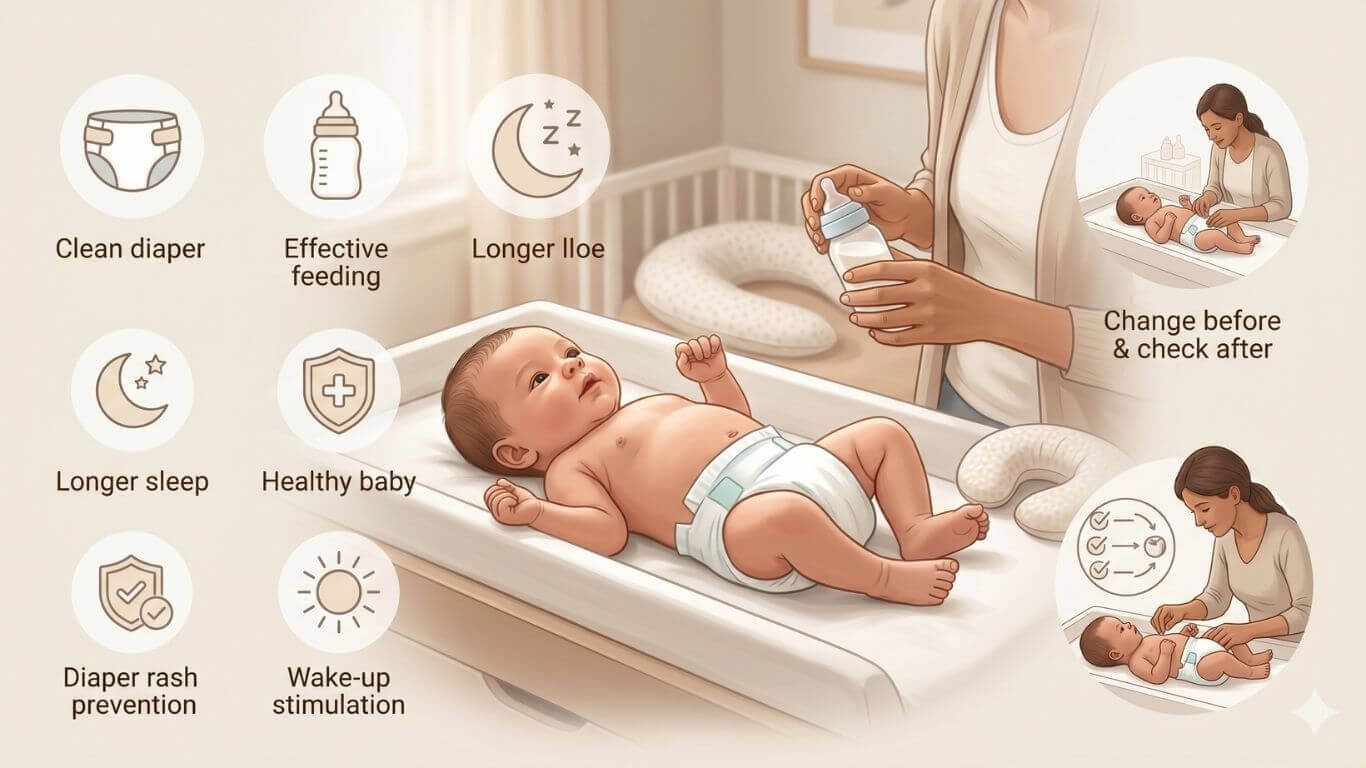
- Change the diaper before feeding in most situations – a clean, dry
baby feeds more calmly and stays awake longer during the feed,
which leads to a fuller feed and longer sleep afterward. - Change after feeding only when the baby has a dirty diaper during
or immediately after the feed, or when the baby is too drowsy
to feed effectively and needs waking. - Never skip a diaper change to avoid waking a sleeping newborn –
leaving a soiled diaper too long causes diaper rash, which develops
on newborn skin within 1-2 hours of stool contact (AAP, 2023). - The most practical approach for most families is a before-and-after
routine: change before the feed to settle the baby, then check
and change again after if needed. - Diaper changes act as a natural wake-up tool for sleepy newborns
who are not feeding effectively – a pre-feed change stimulates
alertness better than undressing alone.
Should You Change a Newborn Before or After Feeding?
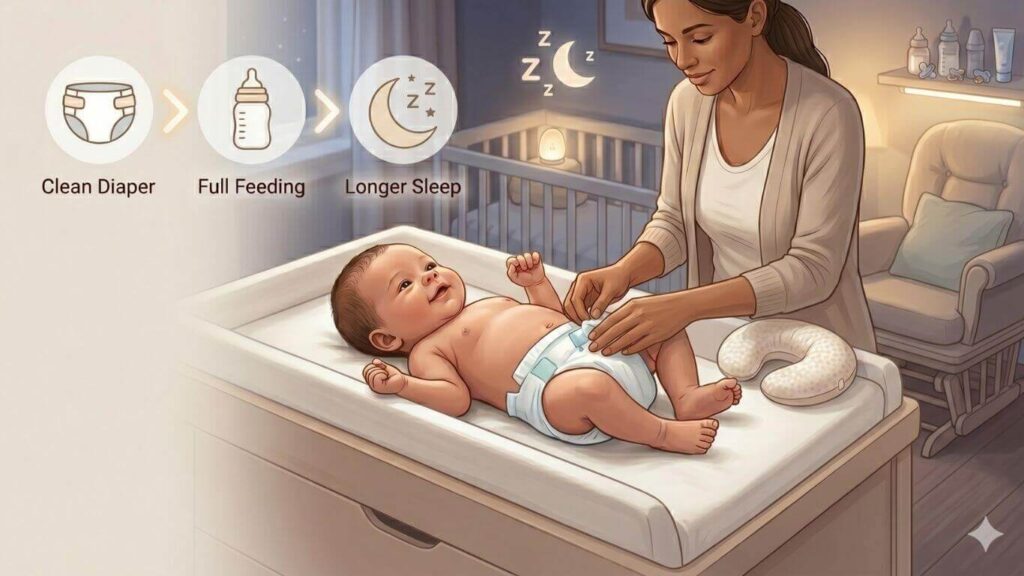
There is no single universal answer – but there is a clear default
that works for most babies in most situations: change before feeding.
A clean, dry baby settles into a feed more calmly, stays awake
more reliably during the feed, and takes a fuller feed than a baby
put to breast or bottle while wet or uncomfortable. A fuller feed
means a longer sleep stretch afterward. That sequence – clean diaper,
full feed, longer sleep – is the foundation of the most effective
newborn feeding routine.
The before-feeding change is the default. The exceptions are
specific and worth knowing, but they are exceptions rather than
the standard approach.
This guide explains the reasoning behind the default, covers every
situation where the order should change, and gives a practical
routine that accounts for the unpredictability of the newborn stage.
Why Changing Before Feeding Works Better in Most Cases
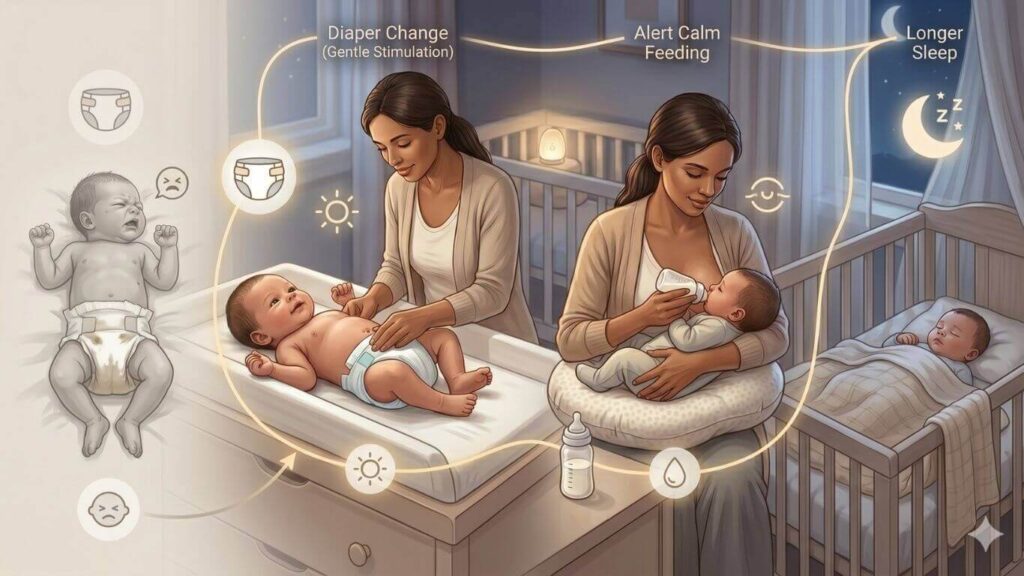
A Clean Baby Feeds More Calmly
A wet or soiled diaper is uncomfortable. A newborn sitting in
discomfort during a feed is distracted, fussy, and harder to
latch or position correctly. Starting the feed with a clean, dry
baby removes one source of discomfort before it can interfere
with the feeding process.
This matters most for breastfed babies, where latch quality
directly affects how much milk the baby transfers. A fussy,
distracted baby lashes a shallower latch, transfers less milk,
and feeds for longer without getting as full – which means
waking sooner for the next feed (Academy of Breastfeeding
Medicine, 2023).
A Pre-Feed Change Keeps Sleepy Babies Awake
Newborns are notoriously difficult to keep awake during feeds.
The warmth, closeness, and sucking rhythm of a feed are deeply
soporific – many newborns fall asleep within the first few minutes
before completing a full feed. A baby who consistently takes short,
incomplete feeds wakes more frequently and gains weight more slowly.
A diaper change before the feed acts as a mild physical stimulant.
The undressing, wipe, and re-dressing process increases alertness
in a drowsy newborn reliably enough that pediatric nurses and
lactation consultants routinely recommend it as a wake-up technique
before feeding (Academy of Breastfeeding Medicine, 2023).
It Establishes a Predictable Routine
A consistent before-feed change builds a predictable sequence the
baby learns over weeks. Change, feed, burp, sleep becomes the
recognizable pattern that makes the newborn stage more manageable
for both baby and caregivers. Predictability reduces the time
spent deciding what to do next at 3 AM when decision-making
capacity is at its lowest.
When to Change After Feeding Instead
The before-feeding default has specific exceptions. In these
situations, changing after the feed is the better approach.
The Baby Has a Dirty Diaper During or After the Feed
Newborns frequently have a bowel movement during or immediately
after a feed. The gastrocolic reflex – the digestive response
triggered by food entering the stomach – stimulates bowel activity
in newborns, making during-feed and post-feed dirty diapers
extremely common in the first 6-8 weeks (Cleveland Clinic, 2022).
Leaving stool against newborn skin for the duration of a feed
is not appropriate. Stool causes diaper rash on newborn skin
significantly faster than urine – within 1-2 hours in some cases.
If the baby has a dirty diaper during the feed, pause the feed,
change, and return to feeding.
If the baby consistently dirties their diaper within minutes of
a feed ending – which many newborns do – build a post-feed change
into the routine as standard rather than treating it as an
interruption.
The Baby Is Already Fully Awake and Hungry
If the baby wakes hungry and alert – showing active hunger cues
like rooting, sucking on hands, and fussing before crying – feed
first. A fully awake, actively hungry baby does not need a diaper
change to become alert enough to feed well. Delaying the feed to
change the diaper first in this situation increases frustration,
makes latching harder as the baby becomes more distressed, and
can interfere with the feed quality.
The distinction is between a drowsy baby who needs stimulating
to feed effectively and an alert baby who is ready to feed
immediately. Drowsy: change first. Alert and hungry: feed first.
The Baby Falls Asleep Immediately After Feeding
If the baby falls fully asleep at the end of a feed and the
diaper is only wet – not soiled – changing them will wake them
unnecessarily. A wet diaper is far less likely to cause rash
than a soiled one. If the baby is in a clean wet diaper, fed,
and asleep, the diaper change can wait until the next natural
wake-up.
If the diaper is soiled after the feed, change it regardless
of whether the baby is asleep. Gently and efficiently – keeping
the room dim and avoiding unnecessary interaction – change the
diaper and resettle the baby without fully waking them.
Nighttime Feeds: Minimize Disruption
At night, the priority shifts from feeding optimization to
minimizing disruption to sleep. The goal at a 2 AM feed is
to complete the feed and return the baby to sleep as quickly
and with as little stimulation as possible.
The most practical nighttime approach:
- Check the diaper before the feed by feel or by the wetness
indicator strip – do not turn on overhead lights - If wet only: feed first, skip the pre-feed change to reduce
stimulation, then check again after the feed - If soiled: change before the feed – stool cannot be left
during an extended feed without causing rash - After the feed: check again; change only if soiled or very
heavily wet
Changing a wet-only diaper before every nighttime feed adds
unnecessary stimulation and extends the time before the baby
resettles. Saving unnecessary nighttime changes while never
skipping soiled diaper changes is the most effective balance.
How to Tell Whether a Diaper Needs Changing
In the first days, newborn urine output is small and a wet
diaper can be difficult to detect. By day 5 onward, wet diapers
are easier to identify and most mainstream disposable diapers
include a wetness indicator strip that changes from yellow to
blue when wet.
Quick diaper check method:
- Look at the wetness indicator if present – yellow means dry,
blue means wet - Press gently on the outside of the front panel – a wet diaper
feels noticeably heavier and slightly firm compared to a dry one - Smell – a soiled diaper is identifiable without opening
- If uncertain, open the diaper briefly at the front to check
without fully undressing the baby
Always change if:
- The diaper is soiled – no exceptions, day or night
- The wetness indicator has fully changed color
- The diaper has been on for more than 2-3 hours even if it
appears dry – newborns output frequently enough that 3 hours
is a reliable maximum interval regardless of indicator status
The Diaper Change as a Wake-Up Tool
Using a diaper change to increase newborn alertness before a
feed is one of the most practical and underused techniques in
the newborn stage. Many parents try undressing the baby, blowing
gently on their face, or tickling their feet to keep them awake
during feeds – with mixed results. A full diaper change – which
involves undressing, wiping, and re-dressing – provides enough
sustained physical stimulation to raise alertness more reliably
than any of these alternatives.
Why it works:
The physical sensations of a diaper change – cool air on skin,
wipe contact, position changes – activate the newborn’s sensory
system and raise cortisol slightly, increasing wakefulness for
the 15-20 minutes of a full feed.
When it is most useful:
- Sleepy newborns under 4 weeks who consistently fall asleep
within the first few minutes of a feed before taking a full
feed - Jaundiced newborns, who are often very drowsy and require
active encouragement to feed adequately - Nighttime feeds where the baby is difficult to rouse to
full wakefulness
What the Academy of Breastfeeding Medicine recommends:
The Academy of Breastfeeding Medicine (2023) protocol for
sleepy newborns includes diaper changing as a first-line
wake-up technique before a feed, alongside skin-to-skin contact
and gentle undressing, specifically because it is more effective
than passive stimulation methods.
Diaper Changing Frequency in the Newborn Stage
Regardless of whether changes happen before or after feeds,
the total number of diaper changes per day in the newborn stage
is high. Newborns use 8-12 diapers per day in the first month
(Cleveland Clinic, 2022). Building changes into the feed routine
rather than treating them as separate events is the most efficient
way to manage this frequency.
A practical change-and-feed routine by situation:
| Situation | Recommended Order |
|---|---|
| Drowsy newborn at feed time | Change first, then feed |
| Alert, actively hungry baby | Feed first, check after |
| Baby with soiled diaper before feed | Always change first |
| Nighttime feed, wet diaper only | Feed first, skip pre-feed change |
| Nighttime feed, soiled diaper | Change first, keep lights dim |
| Baby falls asleep mid-feed | Check diaper; change only if soiled |
| After a full feed with post-feed output | Change after, then resettle |
How Often to Change a Newborn Diaper
The AAP recommends changing a newborn diaper every 2-3 hours
during the day and whenever the diaper is soiled, regardless
of time (AAP, 2023). This frequency aligns naturally with the
2-3 hour feeding schedule of the newborn stage – a change at
every feed covers the required frequency without additional
standalone change sessions.
Minimum diaper change frequency:
- Soiled diaper: change immediately, always
- Wet diaper: change at every feed, minimum every 3 hours
- Overnight: change soiled diapers immediately; wet-only
diapers can wait until the next feed if the baby is asleep
and the diaper has been on less than 4 hours
Signs a diaper needs changing regardless of schedule:
- The baby is crying after a recent feed for no other obvious
reason – check the diaper before attempting any other
soothing technique - The diaper feels significantly heavy when picked up
- Redness is visible at the leg openings or waist – this
indicates the diaper has been on too long or is too full
Diaper Rash Prevention: Why the Change Order Matters
Diaper rash is directly related to how long stool and urine
remain in contact with newborn skin. Newborn skin is thinner
and more permeable than older infant skin, which means rash
develops faster and more severely in the first weeks than it
does at 6 months.
The enzymes in stool are the primary cause of diaper rash –
more damaging than urine alone. A soiled diaper left for
more than 1-2 hours on newborn skin consistently causes rash
in the first weeks, regardless of diaper brand or barrier
cream use (AAP, 2023).
This is why the change order matters for rash prevention:
- Changing before a feed ensures the baby is not sitting in
a wet or soiled diaper for the entire duration of a 20-40
minute feed plus any post-feed settling time - Checking after every feed catches the post-feed gastrocolic
output before it has time to cause rash - Never skipping a soiled diaper change at night, regardless
of how settled the baby appears
Diaper rash prevention at every change:
- Apply a thin layer of zinc oxide barrier cream (Desitin,
Balmex, or equivalent) at every change in the first weeks –
not only when rash appears - Allow 30-60 seconds of air-dry time before fastening the
new diaper if rash is already present or developing - Use fragrance-free wipes – fragranced wipes are a common
rash trigger on newborn skin (AAP, 2023)
Practical Newborn Diaper Change Routine: Day and Night
Daytime Routine
A simple, repeatable routine removes the before-or-after
decision entirely by making it automatic.
Every feed cycle:
- Baby wakes or is roused for a feed
- Check diaper – soiled or heavily wet: change now; lightly
wet: proceed to step 3 - If drowsy: change diaper to increase alertness before the
feed begins - Feed – breast or bottle, full feed
- Burp thoroughly after the feed
- Check diaper again – change if soiled or wet
- Resettle for sleep
This routine covers both the pre-feed and post-feed check
without requiring a decision at every feed. The only variable
is whether a drowsy baby needs the change before the feed or
whether an alert baby can feed first.
Nighttime Routine
The nighttime routine prioritizes minimal stimulation while
maintaining the non-negotiable rule of changing soiled diapers
immediately.
Every nighttime feed cycle:
- Baby wakes or is roused – check diaper by feel or indicator
in dim light only - Soiled: change first, quietly, with minimal light and
interaction; then feed - Wet only: feed first without changing – this reduces
stimulation and keeps the baby in a semi-drowsy state - Feed in dim light with minimal eye contact and talking
- Burp gently
- Check diaper again – change only if soiled or very heavily
wet; otherwise return to sleep directly - Resettle without extended interaction
Using a dim red or amber nightlight for nighttime changes
and feeds maintains the dark environment that supports
circadian rhythm development. Bright overhead lights fully
wake both baby and caregiver, extending the time before
everyone returns to sleep.
Common Mistakes Parents Make About When to Change Diapers
- Skipping the pre-feed change to avoid waking the baby.
A drowsy baby who is not fully awake takes an incomplete
feed and wakes again sooner. The short-term disruption of
a pre-feed change produces a better feed and a longer sleep
stretch. The trade-off consistently favors changing first. - Always changing after the feed regardless of the situation. Post-feed changing works well when the baby
dirties their diaper after eating. It does not work well
when the baby is drowsy and needs stimulating to feed
effectively. Match the approach to the situation rather
than applying one rule regardless of context. - Skipping nighttime soiled diaper changes to preserve sleep. A soiled diaper cannot be left overnight regardless
of how settled the baby is. The rash that develops from
extended stool contact is more disruptive to sleep over
the following days than the 5 minutes of a quiet nighttime
change. - Using the diaper change as an opportunity for extended interaction at night. Nighttime changes should be quick,
dim, and quiet. Talking, making eye contact, and playing
with the baby during a nighttime change stimulates
wakefulness and extends the time before the baby resettles. - Not checking the diaper after every feed. The
gastrocolic reflex means many newborns produce a bowel
movement during or within minutes of completing a feed.
Skipping the post-feed check leaves these soiled diapers
in place until the next scheduled change.
Frequently Asked Questions About Changing a Newborn
Before or After Feeding
Should you change a newborn before or after feeding?
Change before feeding in most situations. A clean, dry baby
feeds more calmly, stays awake more reliably during the feed,
and takes a fuller feed than a baby left in a wet or soiled
diaper. The exception is when the baby is fully alert and
actively hungry – in that case, feed first and check the
diaper after.
Should I change my newborn’s diaper at night?
Change a soiled diaper at every nighttime feed without
exception. For wet-only diapers at night, the approach
depends on the situation: if the baby is drowsy and the
diaper is lightly wet, skip the pre-feed change to minimize
stimulation; if the diaper is very wet or has been on for
more than 3-4 hours, change it. Always check again after
the feed.
Does changing a diaper before a feed help the baby
stay awake?
Yes. A diaper change before a feed provides enough physical
stimulation to increase alertness in a drowsy newborn for
15-20 minutes – long enough to complete a full feed. The
Academy of Breastfeeding Medicine (2023) recommends pre-feed
diaper changing as a first-line technique for rousing sleepy
newborns who are not feeding effectively.
How long can a newborn stay in a wet diaper?
A wet diaper should be changed at least every 2-3 hours
during the day (AAP, 2023). Most newborn feeding schedules
naturally produce a change at every feed, which meets this
frequency. Overnight, a wet-only diaper can remain for one
feed cycle (2-3 hours) if the baby is asleep, but should
be changed at the next natural waking. Soiled diapers must
be changed immediately regardless of time.
What if my newborn always falls asleep during a feed?
A newborn who consistently falls asleep before completing
a full feed needs more stimulation at the start of the feed.
Try changing the diaper immediately before the feed, even
if it is not very wet, to use the physical stimulation to
raise alertness. If the baby still falls asleep mid-feed,
try undressing to the vest, switching the feeding position,
or gently walking two fingers up the spine – all techniques
that increase stimulation without fully disrupting the feed.
Should I wake my newborn to change their diaper?
Wake a newborn for a diaper change if the diaper is soiled –
stool against skin causes rash within 1-2 hours. Do not
wake a sleeping newborn solely for a wet diaper change
unless the diaper has been on for more than 4 hours or
the skin appears red or irritated. The sleep a newborn
gets between feeds is more valuable than the minimal rash
risk of a moderately wet diaper over a normal sleep period.
Does the order of changing and feeding matter for
diaper rash?
Yes, indirectly. A pre-feed change prevents the baby from
sitting in a wet or soiled diaper for the full duration of
a feed plus any post-feed settling time. A post-feed check
catches the common gastrocolic output before it sits against
the skin. Together, these two checks minimize the total time
stool or urine is in contact with newborn skin across each
feed cycle, which is the primary driver of diaper rash
prevention.
Key Takeaways
- Change before feeding as the default – a clean baby feeds
more calmly, stays awake longer during the feed, and takes
a fuller feed, producing a longer sleep stretch afterward. - Change after feeding when the baby is fully alert and
actively hungry, when the baby dirties their diaper during
or after the feed, or when the baby falls asleep mid-feed
in a wet-only diaper. - At night, skip the pre-feed change for wet-only diapers
to minimize stimulation – but always change a soiled
diaper immediately regardless of the time. - A pre-feed diaper change is one of the most effective
techniques for rousing a drowsy newborn to feed more
effectively – more reliable than undressing or tickling alone. - Check the diaper after every feed to catch the common
post-feed gastrocolic output before it causes rash – this
check takes 10 seconds and prevents hours of rash treatment.