

[Published: June 2026 | Last updated: June 2026] | 9 min read
TL;DR
- A baby uses approximately 2,500-3,000 diapers in the first year
across all sizes (Cleveland Clinic, 2022). - A full cloth diaper stash for the first year requires 24-36 diapers
in rotation, washed every 1-2 days. - You do not need 2,500 cloth diapers – you need enough to rotate
through while washing. 24-36 diapers cover the full first year
when laundered regularly. - The total cost of a full cloth diaper stash for year one averages
$300-$800 depending on the system chosen, compared to $800-$1,200
in disposables for the same period (Real Diaper Association, 2023). - One-size cloth diapers cover most babies from 8-10 lbs through
potty training, making the year-one stash the same stash used
through the entire diapering period.
How Many Cloth Diapers Do You Need in a Year?
The answer most parents expect is a large number – something close
to the 2,500-3,000 disposables a baby goes through in year one.
The actual answer is 24-36 cloth diapers in rotation, washed every
1-2 days.
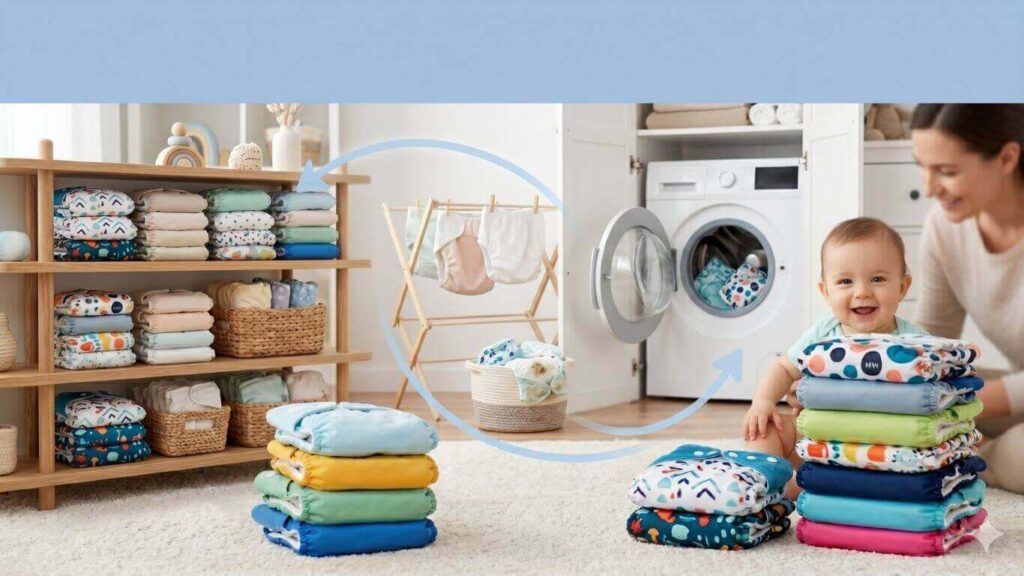
Cloth diapers work on a rotation system, not a single-use system.
The same 24-36 diapers cycle through use, washing, drying, and
reuse continuously across the year. You are not buying a new diaper
for every change – you are buying enough diapers to cover the gap
between washes.
This distinction is the most important thing to understand before
planning a cloth diaper stash. The number of diapers you need is
determined by how often you wash, not by how many changes your
baby has per day.
How Diaper Use Changes Across the First Year
Daily diaper changes drop significantly as the baby grows. A
newborn using 10-12 diapers per day at week one is using 5-6
diapers per day by month nine. This change affects how large a
rotation you need at each stage.
| Age | Changes Per Day | Rotation Needed (Wash Every 2 Days) |
|---|---|---|
| 0-4 weeks (newborn) | 10-12 | 28-36 diapers |
| 1-3 months | 8-10 | 24-30 diapers |
| 3-6 months | 6-8 | 20-24 diapers |
| 6-9 months | 5-6 | 18-22 diapers |
| 9-12 months | 4-5 | 16-20 diapers |
Sources: Cleveland Clinic (2022); AAP (2023)
The newborn stage has the highest daily diaper use and therefore
requires the largest rotation. After 3 months, most families find
that 24 diapers is more than sufficient for a 2-day wash cycle.
How to Calculate Your Cloth Diaper Stash Size
The stash size calculation is straightforward:
Daily changes × days between washes + buffer = stash size
Example for a 2-month-old:
- Daily changes: 10
- Days between washes: 2
- Buffer (diapers in use or drying): 4-6
- Stash size: (10 × 2) + 6 = 26 diapers
Example for a 6-month-old:
- Daily changes: 6
- Days between washes: 2
- Buffer: 4
- Stash size: (6 × 2) + 4 = 16 diapers
The buffer accounts for diapers currently on the baby, diapers
that are air-drying after washing, and a small reserve for
unexpectedly heavy use days – illness, teething, or a growth
spurt can temporarily increase daily diaper changes.
Wash frequency and stash size:
| Wash Frequency | Stash Size Needed (Newborn Stage) | Stash Size Needed (6 Months+) |
|---|---|---|
| Every day | 16-20 diapers | 10-14 diapers |
| Every 2 days | 24-36 diapers | 16-20 diapers |
| Every 3 days | 36-48 diapers | 22-28 diapers |
Most cloth diapering families wash every 1-2 days. Washing less
frequently than every 3 days allows ammonia and bacteria to build
up in soiled diapers, which causes diaper rash and requires a
deep-cleaning strip wash to resolve.
Newborn Stage: Do You Need a Separate Newborn Stash?
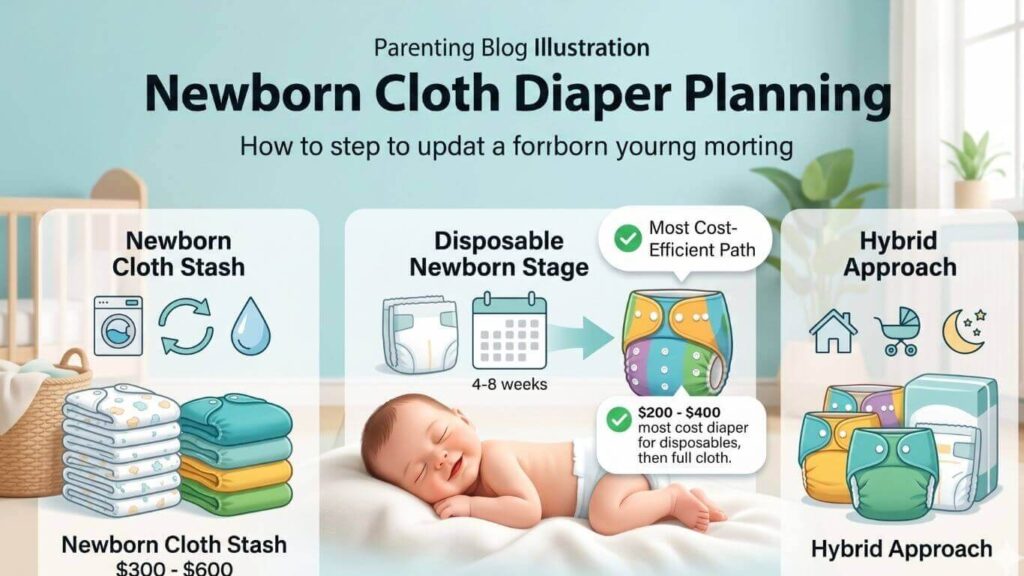
The newborn stage presents a specific planning challenge: most
one-size cloth diapers do not fit reliably below 8-10 lbs, and
newborns are only in the newborn size for 4-8 weeks. Buying 24-36
newborn-specific cloth diapers for a stage that lasts 6 weeks is
a significant cost for a short window.
Three practical approaches to the newborn stage:
Option 1: Buy a Small Newborn Cloth Stash
Buy 12-18 newborn-specific cloth diapers and wash daily. This
covers the newborn stage at lower cost than a full rotation,
using the diapers more intensively while accepting daily laundry.
Cost: $80-$200 for 12-18 newborn prefolds and 6 covers, or
$200-$350 for 12-18 newborn AIOs.
Best for: Families committed to cloth from birth who want
to avoid disposables entirely.
Option 2: Use Disposables for the Newborn Stage
Use disposable diapers for the first 4-8 weeks until the baby
fits one-size cloth diapers. This avoids the cost of a separate
newborn cloth stash that will only be used for weeks.
Cost: $50-$80 in disposables for the newborn stage.
Best for: Families who want to start cloth diapering but
want to avoid the newborn-specific sizing challenge.
Option 3: Use a Hybrid Approach
Use a small number of newborn cloth diapers at home and
disposables when out or overnight. 8-10 newborn cloth diapers
with daily washing covers daytime home use.
Cost: $60-$140 in newborn cloth diapers plus $25-$40 in
disposables for overnight and outings.
Best for: Families who want to reduce disposable use without
committing to a full newborn cloth stash.
The most cost-efficient approach for the full year is Option 2:
use disposables for the first 6-8 weeks, then transition to a
one-size cloth stash that covers month 2 through potty training.
One-Size vs Sized Cloth Diapers: Which Covers More of the Year?
The choice between one-size and sized cloth diapers affects how
many diapers you buy and how much you spend across the year.
One-Size Cloth Diapers
One-size diapers adjust via snaps or rise settings to fit babies
from approximately 8-10 lbs through 35 lbs – covering most babies
from 2-3 months through potty training without needing to buy
a new stash at each size.
Advantages:
- Buy once, use for the full diapering period
- If diapering a second child, the same stash is used again
at near-zero additional cost - Lower long-term cost than sized systems
Disadvantages:
- Do not fit newborns under 8-10 lbs reliably
- Bulkier on small babies than sized diapers
- Rise settings require adjustment every few weeks in the
early months
One-size stash for year one: 24-36 diapers, purchased once.
Sized Cloth Diapers
Sized diapers come in small, medium, and large, fitting a specific
weight range more precisely than one-size diapers. They fit
better at each stage but require buying a new set as the baby
grows.
| Size | Approximate Weight Range | Approximate Age |
|---|---|---|
| Newborn / XS | Up to 12 lbs / 5.5 kg | Birth to 8 weeks |
| Small | 8-18 lbs / 3.6-8.2 kg | 2-6 months |
| Medium | 16-26 lbs / 7.3-11.8 kg | 4-18 months |
| Large | 22-35 lbs / 10-16 kg | 12 months to potty training |
Advantages:
- Better fit at each stage – less bulk, fewer gaps
- More reliable leak containment because the fit is precise
Disadvantages:
- Buying 24-36 diapers per size across three or four sizes
multiplies the total cost significantly - Sized systems cost more per year than one-size systems for
most families
Sized stash for year one: 24-36 diapers in newborn size,
then 24-36 in small, then 24-36 in medium – three purchases
across the year.
Recommendation: For most families, one-size cloth diapers
with a small disposable or newborn cloth bridge in the first
6-8 weeks give the best combination of fit, cost, and simplicity
across the full year.
How Many Cloth Diapers by Type: A System-by-System Breakdown
The type of cloth diaper affects how many you need in rotation
because drying time varies significantly between systems.
Prefolds and Flats
Prefolds and flats dry faster than any other cloth diaper type –
60-90 minutes in a dryer, 2-4 hours on a line. Fast drying means
a smaller rotation is sufficient because diapers return to the
stash faster.
Stash size for prefolds/flats: 24 diapers + 6-8 covers for
a 2-day wash cycle. Can reduce to 18 diapers with daily washing.
Pocket Diapers
Pocket diapers dry faster than AIOs because the insert is removed
for washing and drying separately. Insert dry time: 45-75 minutes
in a dryer. Shell dry time: 60-90 minutes.
Stash size for pocket diapers: 24-30 diapers for a 2-day
wash cycle.
All-in-One Diapers (AIO)
AIOs have the longest drying time of any cloth diaper because
all absorbent layers are sewn together. A fully sewn AIO can take
3-5 hours in a dryer and 8-12 hours on a line. This longer drying
time means a larger rotation is needed to keep diapers available
while others dry.
Stash size for AIOs: 30-36 diapers for a 2-day wash cycle.
Some families with AIOs wash daily to keep the rotation manageable.
Fitted Diapers with Covers
Fitted diapers are fully absorbent and take 2-4 hours to dry in
a dryer. Covers can be wiped and air-dried between uses, reducing
the number of covers needed in the rotation.
Stash size for fitteds: 24-30 fitted diapers + 8-10 covers
for a 2-day wash cycle.
How Many Cloth Diapers Do You Need for the Full Year: By Month
Planning by month rather than by year makes the stash easier to
manage and reduces unnecessary upfront spending.
Months 1-2 (Newborn Stage)
- Daily changes: 10-12
- Diaper size: Newborn specific or disposables
- Recommended stash: 12-18 newborn cloth diapers (if using
cloth) or disposables - Wash frequency: Daily if using a small newborn stash
Months 2-6 (Early Infant Stage)
- Daily changes: 8-10 reducing to 6-8
- Diaper size: One-size on smallest setting, or small sized
- Recommended stash: 24-30 one-size diapers
- Wash frequency: Every 1-2 days
This is the stage to invest in the main one-size stash if you
have not already. The baby will be in this stash for the
remainder of the diapering period.
Months 6-12 (Older Infant Stage)
- Daily changes: 5-6 reducing to 4-5
- Diaper size: One-size on middle settings
- Recommended stash: Same 24-30 diapers from months 2-6
- Wash frequency: Every 2 days – the reduced daily count
makes 2-day washing comfortable with the same stash
No new diapers are needed at this stage if a full one-size
stash was purchased at month 2. The same 24-30 diapers continue
through month 12 and beyond.
The True Cost of Cloth Diapering for Year One
The financial case for cloth diapering is most clearly seen
when cost is calculated across the full year, not just the
upfront purchase.
Cloth Diaper Year-One Cost by System
| System | Upfront Cost | Annual Laundry Cost | Year-One Total |
|---|---|---|---|
| Prefolds + covers (one-size) | $120-$200 | $100-$150 | $220-$350 |
| Pocket diapers (one-size) | $200-$400 | $100-$150 | $300-$550 |
| All-in-one diapers (one-size) | $350-$600 | $120-$180 | $470-$780 |
| Fitted diapers + covers | $250-$450 | $100-$150 | $350-$600 |
Source: Real Diaper Association (2023); laundry costs based on
average US utility rates for 3-4 additional loads per week.
Disposable Diaper Year-One Cost
| Brand Tier | Cost Per Diaper | Estimated Year-One Total |
|---|---|---|
| Budget (store brand, Luvs) | $0.14-$0.22 | $350-$660 |
| Mid-range (Huggies, Pampers) | $0.26-$0.35 | $650-$1,050 |
| Premium (Coterie, Pampers Pure) | $0.38-$0.65 | $950-$1,950 |
Source: Based on 2,500-3,000 diapers per year (Cleveland Clinic,
2022) at 2026 US retail pricing.
Year-One Savings: Cloth vs Disposable
| Cloth System | vs Budget Disposables | vs Mid-Range Disposables | vs Premium Disposables |
|---|---|---|---|
| Prefolds + covers | -$130 to +$130 | $300-$700 savings | $600-$1,600 savings |
| Pocket diapers | $0-$250 savings | $100-$750 savings | $400-$1,650 savings |
| All-in-one | -$430 to +$190 | -$130 to +$580 savings | $170-$1,480 savings |
The financial advantage of cloth diapering is strongest when:
- Comparing to mid-range or premium disposable brands
- Using a second child in the same stash (year-two cloth cost
drops to laundry costs only – approximately $100-$180 per year) - Using a prefold or pocket system rather than AIOs
The financial advantage is smallest when comparing cloth AIOs
to budget disposable brands. For families whose primary goal is
maximum cost savings, prefolds with covers give the strongest
return.
How Cloth Diaper Costs Change in Year Two and Beyond
The financial case for cloth diapering becomes much stronger from
year two onward. A well-maintained one-size stash purchased in
year one continues through potty training with no additional diaper
purchases. Year-two cost drops to laundry costs only.
Year-two cloth diaper cost: $100-$180 (laundry only)
Year-two disposable cost: $600-$1,800 (same 2,000-2,500
diapers per year at year-two change frequency)
Over two years of diapering, the total savings of cloth over
mid-range disposables typically reaches $800-$1,500 for a single
child. If the same stash is used for a second child, the cumulative
saving over both children’s diapering periods reaches $1,500-$3,000
(Real Diaper Association, 2023).
Building a Cloth Diaper Stash Without Overspending
The most common cloth diaper buying mistake is purchasing too many
diapers of one type before confirming they work for the specific
baby. Cloth diaper fit is individual – a diaper that contains
blowouts perfectly on one baby leaks consistently on another
because of differences in body shape, build, and stool consistency.
A practical stash-building approach:
Step 1: Buy a trial set first
Before buying 24-36 of any one diaper, buy 3-5 of a type and
test them for 1-2 weeks. Test for:
- Fit around the legs – no gaps at the thigh
- Absorbency at the baby’s current change frequency
- Ease of use at night and during fast changes
- Drying time in your specific laundry setup
Step 2: Build the main stash based on trial results
Once a type and brand confirms it works, buy the remaining
diapers to complete the rotation. Buy in one purchase rather
than gradually – prices are typically lower in bundles, and
having a full rotation from the start prevents the constant
partial-stash scramble.
Step 3: Add overnight diapers separately
Overnight absorbency needs are different from daytime needs.
Many families use a different diaper at night – typically a
fitted diaper with a wool cover or a boosted pocket diaper –
rather than relying on the daytime stash. Budget 4-6 overnight
diapers separately from the main rotation.
Step 4: Buy secondhand where possible
Used cloth diapers in good condition cost 40-70% less than new.
Prefolds and covers are particularly good secondhand purchases
because they have no mechanical parts to wear out. Pocket and
AIO diapers are acceptable secondhand if the elastic is still
firm and the waterproof layer has not delaminated.
What to check when buying secondhand:
- Leg and waist elastic: should snap back firmly when stretched
- Waterproof layer: hold up to light – any pinholes or thin
patches will leak - Velcro or snap closures: must fasten securely without fraying
- Staining: surface staining is cosmetic and does not affect
function; deep staining may indicate inadequate washing history
How to Make a Cloth Diaper Stash Last the Full Year
A cloth diaper stash that is well maintained lasts not just the
first year but multiple children’s diapering periods. The main
factors that shorten diaper lifespan are incorrect washing,
incorrect drying, and elastic degradation.
Washing rules that extend stash life:
- Wash at 60°C (140°F) maximum. Higher temperatures degrade
elastic and delaminate waterproof layers faster. - Use the full recommended amount of a mainstream detergent –
Tide Original or Persil. Under-dosing leaves residue in the
fabric that causes ammonia buildup and rash. - Run an extra rinse cycle after every wash to remove all
detergent residue. - Never use fabric softener – it coats fibers and permanently
reduces absorbency. - Never use bleach routinely – it degrades elastic rapidly.
Occasional oxygen bleach for sanitizing is acceptable; chlorine
bleach is not.
Drying rules that extend stash life:
- Tumble dry on medium heat rather than high. High heat is the
fastest way to degrade elastic and delaminate waterproof shells. - Line dry in sunlight when possible – UV light naturally bleaches
stains, kills bacteria, and is the gentlest drying method for
all diaper components. - Dry covers and shells on low heat or air-dry – the waterproof
layer degrades faster than the absorbent components under heat.
Elastic maintenance:
Elastic is the component most likely to wear out before the
fabric does. Signs elastic is failing: the leg cuffs no longer
spring back after stretching; gaps appear at the legs despite
a correct fit. Some diaper brands sell replacement elastic kits;
others can be repaired by a seamstress for $3-$8 per diaper –
still cheaper than replacing the diaper.
Common Mistakes Parents Make When Planning a Cloth Diaper Stash
- Buying a full stash of one type without trialing first.
Cloth diaper fit varies by brand and baby body shape. A full
stash of a diaper that does not work for the specific baby
is an expensive lesson. Always trial before buying in bulk. - Buying too many newborn-specific diapers. The newborn
stage lasts 4-8 weeks for most babies. A stash of 36 newborn
cloth diapers for a stage this short rarely makes financial
sense. Use a small newborn stash or disposables for this window. - Not accounting for drying time when sizing the stash.
A family with an AIO stash of 24 diapers and a slow dryer
may find diapers are not ready when needed. Match stash size
to diaper type and realistic drying time in the specific
laundry setup. - Washing less frequently than every 3 days. Leaving soiled
cloth diapers for more than 2-3 days allows ammonia and
bacteria to build up in the fabric. This causes persistent
rash and requires a strip wash to resolve – which is harder
on the diapers and on the parent’s time than regular washing. - Using the wrong detergent. Specialty cloth diaper
detergents are rarely more effective than mainstream detergents
and are often less so. Tide Original powder or liquid is the
most widely recommended detergent by cloth diaper manufacturers
(Fluff Love University, 2023). Avoid enzyme-free, fragrance-free
specialty formulas – they under-clean.
Frequently Asked Questions About How Many Cloth Diapers
in a Year
How many cloth diapers do I need for a year?
You need 24-36 cloth diapers in rotation, washed every 1-2 days,
to cover the full first year. You do not need a new cloth diaper
for every change – the same 24-36 diapers cycle through use and
washing continuously. The exact stash size depends on how often
you wash and which diaper type you use.
Do I need to buy different cloth diapers as my baby grows?
Not if you buy one-size cloth diapers. One-size diapers adjust
via snaps from approximately 8-10 lbs through 35 lbs, covering
most babies from 2-3 months through potty training with one
purchase. Sized diapers fit better at each stage but require
buying new diapers as the baby grows, which increases year-one
cost significantly.
How many cloth diapers do I need for a newborn?
For a full newborn cloth rotation, 12-18 newborn-specific diapers
washed daily is sufficient. Most families either use disposables
for the 4-8 week newborn stage or buy a small newborn cloth stash
and transition to one-size cloth at 2-3 months, rather than buying
a full 24-36 diaper rotation in newborn size.
Is it cheaper to use cloth diapers for a year?
Yes, in most comparisons. A full cloth diaper stash for year one
costs $220-$780 depending on the system. A year of mid-range
disposables costs $650-$1,050 for the same period (Real Diaper
Association, 2023). The saving is largest when using a prefold
or pocket system and comparing against mid-range or premium
disposable brands.
How often do I need to wash cloth diapers?
Every 1-2 days for most families with a standard 24-36 diaper
rotation. Washing every day allows a smaller stash; washing every
2 days requires a full 24-36 diaper rotation. Do not go longer
than 3 days between washes – soiled diapers left longer than
this develop ammonia and bacteria buildup that causes rash and
requires a deep strip wash to resolve.
Can I use the same cloth diapers for a second child?
Yes. A well-maintained one-size cloth diaper stash typically
lasts through two to three children’s diapering periods. Year-two
cost for a second child drops to laundry costs only – approximately
$100-$180 per year – making the cumulative saving of cloth over
two children’s diapering periods $1,500-$3,000 compared to
mid-range disposables (Real Diaper Association, 2023).
How many cloth diapers do I need overnight?
Budget 4-6 dedicated overnight diapers separately from the main
daytime rotation. Overnight diapers need more absorbency than
daytime diapers because the baby goes 8-12 hours without a change.
Fitted diapers with wool covers or boosted pocket diapers with
a hemp or bamboo insert are the most commonly used overnight
solutions.
Key Takeaways
- A cloth diaper stash for year one requires 24-36 diapers in
rotation – not 2,500. The same diapers cycle through use and
washing continuously across the year. - The newborn stage is the trickiest planning window – most
one-size cloth diapers do not fit below 8-10 lbs. Using
disposables or a small newborn cloth stash for the first
6-8 weeks, then transitioning to one-size cloth, is the most
cost-efficient approach for year one. - Stash size depends on wash frequency: washing every day
allows 16-20 diapers; washing every 2 days requires 24-36. - AIOs need a larger stash than prefolds because they take
significantly longer to dry – match stash size to diaper
type and realistic drying time in the home. - The financial advantage of cloth diapering grows significantly
from year two onward, when the same stash continues at laundry
cost only – and grows further still when used for a second child.