

Choosing the best breast pump for twins depends on how often you pump, whether your babies breastfeed directly, and whether they were born prematurely or need extra feeding support. Parents who pump frequently for two babies typically need a pump that is comfortable, efficient, reliable, and practical for everyday use.
For most parents who need a personal-use double electric pump, the Spectra S1 Plus is the best overall choice. It combines strong adjustable suction, a rechargeable battery, closed-system protection, and double-pumping capability, making it a practical option for frequent pumping.
If your twins are premature, in the NICU, separated from you, or unable to breastfeed effectively, the Medela Symphony may be a better choice during the early supply-establishment period. For other situations, the Motif Luna is a strong Spectra alternative, while the Willow 360 and Elvie Pump can provide useful hands-free flexibility when mobility is a priority.
The best pump ultimately depends on your situation. Your needs may be different if you are breastfeeding and pumping occasionally, pumping frequently, exclusively pumping, separated from premature babies, or looking for a secondary wearable pump.
Quick answer: For most parents who need a high-performance personal-use double electric pump, the Spectra S1 Plus is our top overall pick. If your twins are premature or cannot breastfeed effectively, ask your hospital or lactation consultant whether a Medela Symphony rental would be appropriate.
TL;DR:
- Best overall: Spectra S1 Plus
- Best hospital pump: Medela Symphony
- Best Spectra alternative: Motif Luna
- Best wearable: Willow 360
- Best compact wearable: Elvie Pump
- Best passive collection tool: Haakaa
- Best setup for frequent pumping: Double electric pump + correct flange size + hands-free pumping bra
How to Choose the Best Breast Pump for Twins
Having twins does not automatically mean you need a hospital-grade breast pump. The best choice depends on how often you pump, whether your babies breastfeed directly, and how portable or hands-free you need the pump to be.
When comparing pumps, focus on the features that affect milk removal, comfort, efficiency, and everyday practicality.
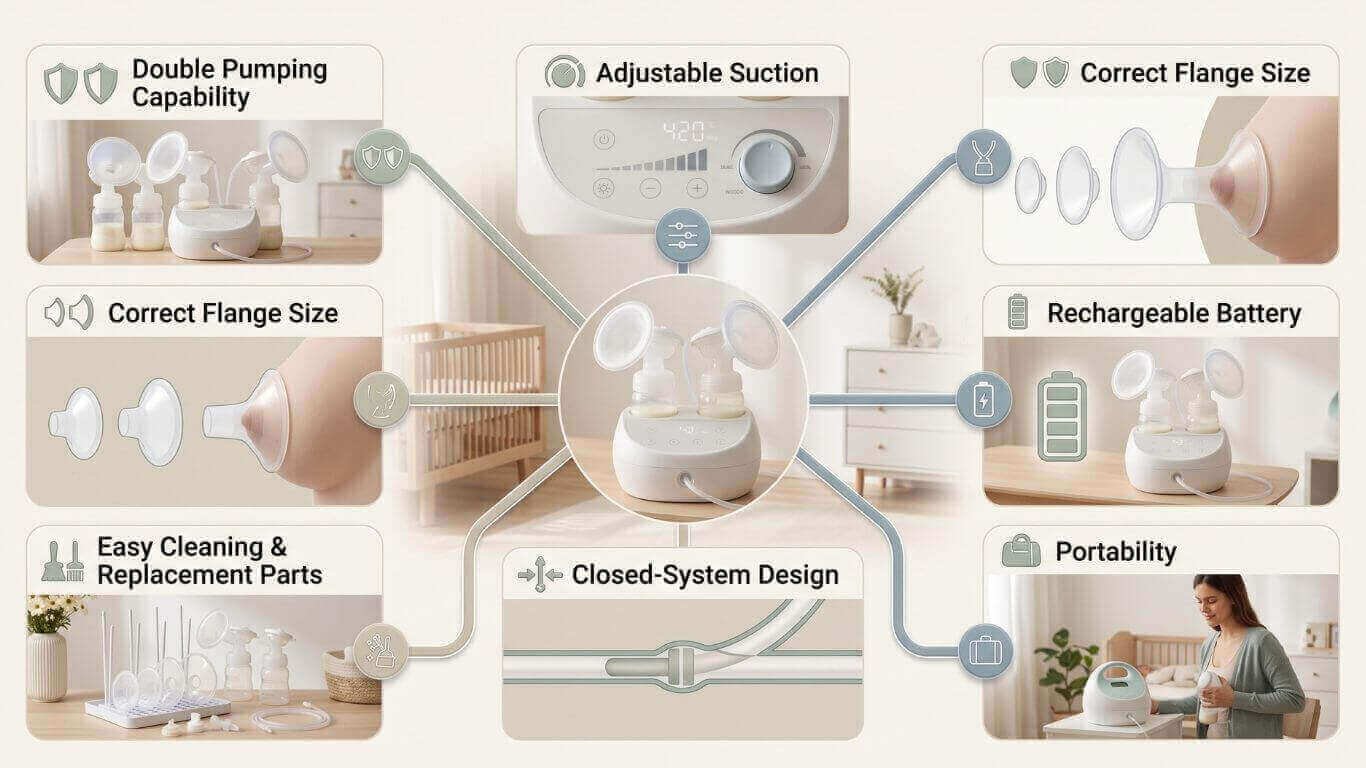
1. Double Pumping Capability
A double electric pump allows you to express milk from both breasts at the same time.
For parents pumping frequently, simultaneous pumping can save significant time compared with pumping one breast at a time. That extra efficiency can make a big difference when you’re caring for two babies.
2. Comfortable, Adjustable Suction
Higher suction does not automatically mean more milk.
Look for a pump with adjustable suction and cycle settings so you can find a level that is both comfortable and effective. Pumping should not be painful, and increasing suction simply to chase a higher mmHg number can make pumping less comfortable.
The goal is effective milk removal at the highest comfortable setting, not maximum suction.
3. Correct Flange Size
The right flange—or breast-shield—size is essential for comfortable and effective pumping.
Your nipple should move freely inside the tunnel without excessive rubbing or pulling in too much of the surrounding tissue. Your ideal size may also change during your breastfeeding journey, and each breast may require a different flange size.
4. Rechargeable Battery
A rechargeable battery can be especially useful when you’re caring for twins.
Instead of staying next to an electrical outlet, you can move around the house, pump while caring for one baby, or use the pump in different locations. For parents who pump several times a day, that added flexibility can make the routine much easier.
5. Closed-System Design
A closed-system pump uses backflow protection to help prevent breast milk from entering the tubing and motor.
This can simplify cleaning and help keep the pump’s internal components protected during frequent use. The Spectra S1 Plus and Motif Luna, for example, use closed-system designs.
6. Cleaning and Replacement Parts
Frequent pumping means frequent cleaning, so consider how easy it is to maintain the pump before buying.
Look for readily available:
- Replacement valves
- Membranes
- Tubing
- Extra bottles
- Additional flange sets
Having spare parts can also prevent a worn valve or missing bottle from disrupting your pumping routine.
7. Portability and Wearability
Think about where and how you plan to pump before choosing a pump.
- Traditional double electric pumps: Usually offer strong performance and more control, but require tubing, bottles, and a dedicated pumping setup.
- Hospital-grade pumps: Designed for frequent use and are particularly useful in hospitals or situations where babies cannot breastfeed effectively. They are often larger and less portable.
- Wearable pumps: Fit inside a bra and provide hands-free mobility, making them convenient when caring for two babies or pumping away from home. However, they may not be the best primary pump for everyone.
For many twin parents, the most practical setup may be a high-performance double electric pump as the primary pump, with a wearable pump added later for convenience.
5 Best Breast Pumps for Twins
We evaluated these breast pumps based on double-pumping capability, suction adjustability, comfort, portability, battery life, cleaning requirements, intended use, and suitability for frequent pumping. Because twin-feeding situations vary, the best pump for you may depend on whether you pump occasionally, pump frequently, exclusively pump, or need a hospital pump for premature or NICU babies.
1. Spectra S1 Plus — Best Overall Breast Pump for Twins
Verdict: Best personal-use choice for most parents.
The Spectra S1 Plus is our top overall pick for parents who need a dependable double electric pump for regular or frequent pumping. It combines strong adjustable suction, a rechargeable battery, closed-system backflow protection, and double-pumping capability in a relatively practical personal-use design.
Spectra currently lists the S1 Plus with up to 270 mmHg of suction, a built-in rechargeable battery, closed-system protection, and 24 mm and 28 mm breast shields included.
Why We Recommend It for Twins
The S1 Plus is particularly practical when you’re pumping several times a day.
- Double electric pumping saves time by expressing from both breasts simultaneously.
- Rechargeable battery lets you pump without staying beside an outlet.
- Adjustable suction and cycle settings allow you to find a comfortable pumping pattern.
- Closed-system design helps prevent milk from entering the tubing and motor.
- Night light can be useful during nighttime pumping sessions.
- Multiple flange sizes make it easier to find a more comfortable fit.
For many twin parents, the biggest advantage isn’t any single specification. It’s the combination of performance, portability, and everyday usability.
What Could Be Better
The S1 Plus is still a traditional pump with external tubing and collection bottles, so it isn’t as discreet or mobile as an in-bra wearable.
Flange fit also needs to be individualized. The included 24 mm and 28 mm breast shields may not be the right size for every parent, and each breast can require a different size.
Best For
Parents who want one strong personal-use double electric pump for frequent pumping.
2. Medela Symphony — Best Hospital Pump for Premature or NICU Twins
Verdict: Best when establishing milk production is especially important because the babies cannot breastfeed effectively.
The Medela Symphony is a multi-user hospital-grade double electric breast pump designed for frequent pumping and situations where additional lactation support may be needed.
Medela describes the Symphony as a hospital and home-rental pump with INITIATE and MAINTAIN programs designed for different stages of lactation.
Why It May Be Better Than a Personal Pump
Having twins alone does not mean that every parent needs a hospital-grade pump.
The Symphony becomes particularly relevant when:
- The twins are premature or admitted to the NICU
- Mother and babies are temporarily separated
- One or both babies cannot breastfeed effectively
- The parent is temporarily dependent on pumping
- Milk production needs to be established or maintained with frequent expression
In these situations, the ability to use a pump designed specifically for frequent, hospital-based pumping may be more important than portability.
What Could Be Better
The Symphony isn’t designed to be the most convenient pump for moving around the house.
Its main drawbacks are:
- Large and less portable
- Usually more practical as a rental than an everyday personal pump
- Rental availability varies by location
- Purchasing one is considerably more expensive than a personal-use pump
If your twins are premature or experiencing feeding difficulties, ask your NICU team or lactation consultant whether a Symphony rental is appropriate for your situation.
Best For
Premature twins, NICU situations, mother-baby separation, medically fragile babies, or parents who need hospital-level pumping support.
3. Motif Luna — Best Alternative to Spectra S1
Verdict: Strong traditional double-electric alternative.
The Motif Luna is a compelling alternative to the Spectra S1 Plus for parents who want strong suction, double pumping, and a relatively lightweight design.
Current Motif information lists the Luna with up to 280 mmHg of hospital-strength suction, along with adjustable settings and a battery option.
Why It’s Good for Twins
The Luna offers several features that can make frequent pumping easier:
- Double electric pumping
- Strong adjustable suction
- Rechargeable battery option
- Lightweight design
- Adjustable suction and cycle settings
- Closed-system design
- Multiple flange-size options
Its combination of power and portability makes it a good fit for parents who don’t want to be tied to an electrical outlet during every pumping session.
It’s also important to distinguish hospital-strength from hospital-grade. The Luna is a personal-use, single-user pump; it should not be presented as equivalent to a multi-user hospital pump such as the Medela Symphony.
What Could Be Better
The Luna is available in different versions and bundles, so pricing and included accessories can vary.
Insurance availability also depends on your specific plan and supplier. Check exactly which Luna version your insurance covers before purchasing.
Best For
Parents who want a strong Spectra alternative with portability and a battery option.
4. Willow 360 — Best Wearable Pump for Mobility
Verdict: Best for parents who prioritize hands-free mobility.
The Willow 360 is designed for parents who want to pump without external tubing or bottles getting in the way.
The pump fits inside a bra and is designed for hands-free use, making it particularly appealing when you’re trying to care for two babies while expressing milk.
Willow currently lists the 360 with up to 245 mmHg of suction, seven smart-suction levels, rechargeable batteries, and a leak-proof design when used with its compatible bags.
Why It’s Good for Twins
The biggest advantage is mobility.
A wearable pump can be useful when you need to:
- Care for one baby while pumping
- Move around the house
- Travel
- Return to work
- Pump when traditional tubing and bottles are inconvenient
- Handle other tasks during a pumping session
For a twin parent, being able to move around without being connected to a traditional pump can make certain parts of the day considerably easier.
What Could Be Better
A wearable pump isn’t automatically better or worse than a traditional pump. Milk-removal performance varies from person to person.
If you’re primarily pumping to establish or maintain your milk supply, choose a pump based on your actual milk removal, comfort, and consistency, rather than portability alone.
A wearable can be an excellent primary or secondary pump for some parents, while others may get better results from a traditional double electric pump.
Best For
Parents who prioritize hands-free mobility and already know a wearable pump works well for them.
5. Elvie Pump — Best Compact Wearable Pump
Verdict: Best for discreet, tube-free pumping.
The Elvie Pump is another popular wearable option for parents who want a compact pump that fits inside a bra without external tubing.
Elvie offers app-controlled features, customizable SmartRhythm pumping, multiple sizing options, and a slim in-bra design. Its current manual lists a vacuum range of approximately 40–220 mmHg.
Why It’s Good for Twins
The Elvie’s main advantage is discreet convenience.
It can be useful for:
- Pumping while caring for a baby
- Traveling
- Returning to work
- Pumping when a traditional pump is inconvenient
- Shorter or more mobile pumping sessions
- Parents who dislike external tubing and bottles
For a parent who already has a reliable primary pump, the Elvie can provide useful flexibility when sitting at a traditional pump isn’t practical.
What Could Be Better
The Elvie’s compact design comes with some trade-offs.
- It can be relatively expensive.
- Fit can have a significant effect on comfort and performance.
- Milk removal varies between users.
- Wearable components still require regular cleaning.
- It may not be the best choice for every parent as a primary pump.
If you’re relying heavily on pumping, pay attention to milk output, comfort, and breast emptying rather than choosing a wearable simply because it is convenient.
Best For
Parents who prioritize discreet, hands-free pumping and want a compact wearable option.
Best Breast Pumps for Twins at a Glance
| Pump | Type | Key Strength | Battery | Best For |
|---|---|---|---|---|
| Spectra S1 Plus | Double electric | Strong suction + portability | Rechargeable | Best overall |
| Medela Symphony | Hospital pump | Supply establishment | Plug-in | NICU / premature twins |
| Motif Luna | Double electric | Strong suction + portability | Battery option | Spectra alternative |
| Willow 360 | Wearable | Mobility + leak-proof design | Rechargeable | Hands-free pumping |
| Elvie Pump | Wearable | Compact in-bra design | Rechargeable | Discreet pumping |
Price note: Prices, insurance coverage, and available bundles can change, so verify current pricing before purchasing.
Which Breast Pump Is Best for Your Twin-Pumping Situation?
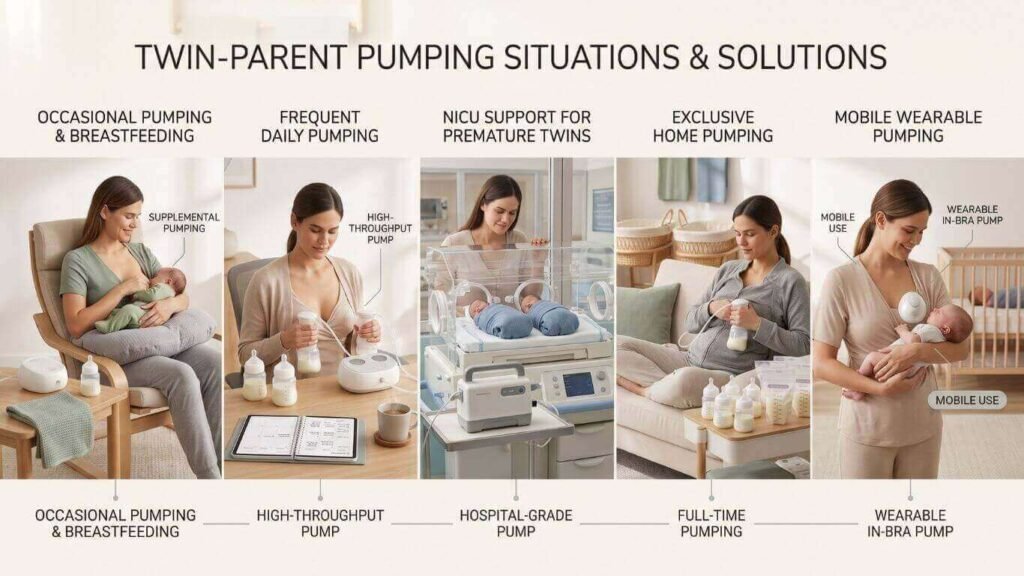
The best breast pump for twins depends on how often you pump, whether your babies breastfeed directly, and whether there are medical or feeding challenges. Having twins does not automatically mean you need a hospital-grade pump.
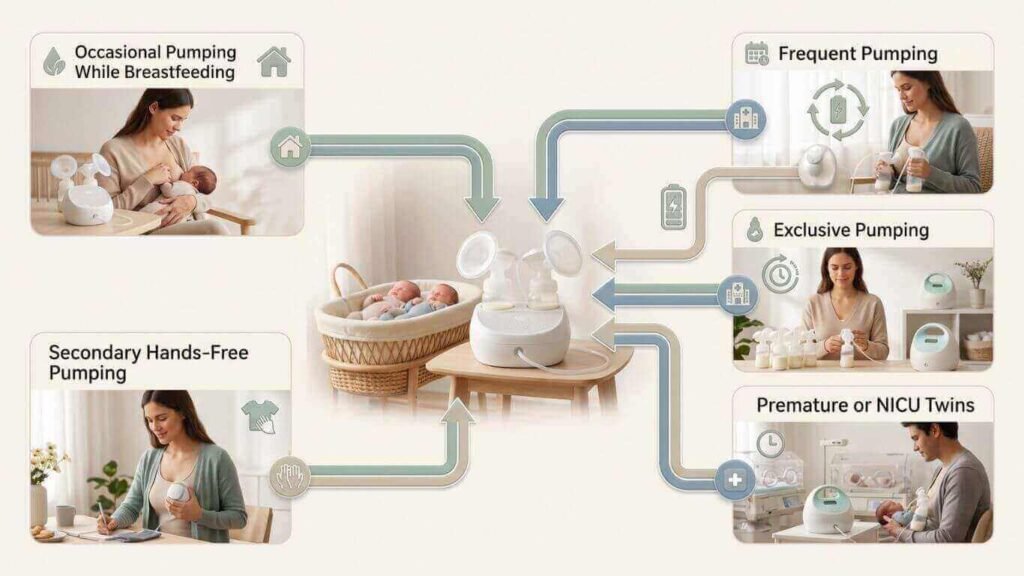
If You’re Pumping Occasionally
A personal-use double electric pump may be all you need. Look for a comfortable pump that is easy to set up, clean, and store.
If You’re Pumping Frequently
Prioritize:
- Double pumping
- Comfortable flange fit
- Adjustable suction
- Rechargeable battery
- Easy cleaning
- Readily available replacement parts
For frequent pumping, saving a few minutes during each session can make a significant difference over the course of a day.
If Your Twins Are Premature or in the NICU
Talk with your NICU team or lactation consultant about whether a hospital-grade rental such as the Medela Symphony is appropriate.
This can be particularly relevant when babies are premature, separated from the mother, or unable to breastfeed effectively.
If You’re Exclusively Pumping
Prioritize reliable milk removal, comfort, durability, easy cleaning, and a setup that you can realistically maintain several times a day.
A pump that works well for your body and fits your daily routine is more important than simply choosing the pump with the highest suction specification.
If you’re exclusively pumping or regularly feeding expressed milk, an efficient feeding routine is just as important as choosing the right pump. Learning how to bottle feed twins at the same time can make feeding two babies more manageable, especially during those busy early weeks.
If You Want a Secondary Pump
A wearable such as the Willow 360 or Elvie Pump can provide additional mobility when a traditional pump is inconvenient.
For parents who depend heavily on pumping, however, it’s worth evaluating how well the wearable actually removes milk before making it your primary pump.
How to Increase Breast Milk Supply for Twins
A breast pump cannot guarantee an increase in milk supply. When breastfeeding is not possible or milk production is lower than expected, frequent and effective milk removal is an important part of maintaining or establishing supply.
Your pumping equipment also matters. Flange fit, comfortable suction, functioning pump parts, and an appropriate pumping routine can all affect how effectively milk is removed.
Pump or Breastfeed Frequently
When breastfeeding is not possible, frequent milk expression can help provide regular stimulation and milk removal.
The Academy of Breastfeeding Medicine’s guidance supports frequent expression, with at least eight pumping sessions per day commonly recommended when breastfeeding is not possible, particularly during early supply establishment.
Your individual needs may differ depending on:
- Whether your twins breastfeed directly
- Whether you combination-feed
- Whether you exclusively pump
- Whether either baby was premature
- Your milk production
- Your babies’ intake and growth
- Any medical circumstances affecting feeding
Double Pump When Appropriate
Double pumping allows you to express milk from both breasts simultaneously, which can save time compared with pumping one breast at a time.
It may also improve milk removal for some parents, but results vary. The goal is effective, comfortable milk removal rather than simply pumping for a longer period.
Check Your Flange Fit
Flange fit can affect both comfort and milk removal.
If your nipple rubs against the tunnel, you experience significant pain, or milk removal seems poor, your flange may not be the right size.
Don’t increase suction simply to compensate for a poor fit. If you’re unsure about sizing or pumping technique, an IBCLC or other qualified lactation professional can help.
Use Comfortable Suction
Higher suction does not automatically mean more milk.
Use a setting that is comfortable and effective for you. Pumping should not be painful, and maximum suction is not necessarily the best setting.
Replace Worn Pump Parts
Valves, membranes, tubing, and other components can wear out with frequent use.
If your pump suddenly feels weaker or your milk output changes, inspect the pump parts before assuming your milk supply has changed. Replace worn or damaged components according to the manufacturer’s recommendations.
Get Professional Help for Persistent Low Supply
If you’re consistently concerned about milk production, seek help rather than simply switching to a stronger pump.
Depending on your situation, useful sources of support include:
- IBCLC
- Pediatrician
- Obstetric provider
- NICU lactation team
Professional support is particularly important when a baby is premature, has difficulty latching, isn’t gaining weight appropriately, or requires supplementation.
If milk production remains persistently low, or if either baby has difficulty latching, clicking during feeds, prolonged feeding sessions, nipple pain, or poor weight gain, talk with an IBCLC or healthcare provider. Feeding difficulties can have several causes, including positioning, latch problems, or conditions such as a baby lip tie.
What Is the Best Pumping Schedule for Twins?
There is no single pumping schedule that works for every twin family.
A parent who breastfeeds both babies and pumps occasionally has very different needs from someone who exclusively pumps for premature twins.
Your schedule may depend on:
- Direct breastfeeding
- Combination feeding
- Exclusive pumping
- Premature birth
- Milk production
- Babies’ milk intake
- Weight gain
- Medical circumstances
As your twins get older, their feeding and sleep patterns will change. If you’re eventually working toward reducing overnight feeds, our guide to stopping nighttime feedings explains how this transition can affect breastfeeding and milk supply.
If Breastfeeding Is Not Possible
When babies cannot breastfeed effectively, frequent expression is generally important during milk-supply establishment.
ABM guidance commonly recommends at least eight pumping sessions per day when breastfeeding is not possible, but your healthcare team may recommend a different schedule based on your circumstances.
If You’re Exclusively Pumping
An exclusive-pumping schedule should provide enough regular milk removal to maintain your production and meet your babies’ needs.
Rather than following a rigid schedule from the internet, monitor your overall milk production and discuss adjustments with a lactation professional when necessary.
If Your Twins Are Premature
Follow the individualized pumping plan provided by your NICU or lactation team.
Premature babies may have different feeding requirements, and the mother’s pumping routine may need to change as the babies mature and begin breastfeeding more effectively.
Breast Pump Insurance Coverage for Twins
If you’re in the United States, health insurance may significantly reduce the cost of a breast pump.
HealthCare.gov states that most Marketplace plans and many other health plans must provide breastfeeding equipment and support, although individual plans can have different rules regarding which pumps are covered, whether a pump is rented or purchased, and when it can be obtained.
Before purchasing a pump, contact your insurance provider and ask:
- Which double electric pumps are fully covered?
- Is the Spectra S1 Plus covered?
- Is the Motif Luna covered?
- Is a hospital-grade rental covered?
- Is prior authorization required?
- Which DME supplier must I use?
- Are replacement parts covered?
- Is there an upgrade fee for a rechargeable pump?
Does Having Twins Mean You Get Two Breast Pumps?
No.
Having twins does not automatically mean your insurance plan will cover two pumps. Coverage depends on your specific insurance plan and its breastfeeding-equipment benefits.
Pumping Accessories Every Twin Parent Should Consider
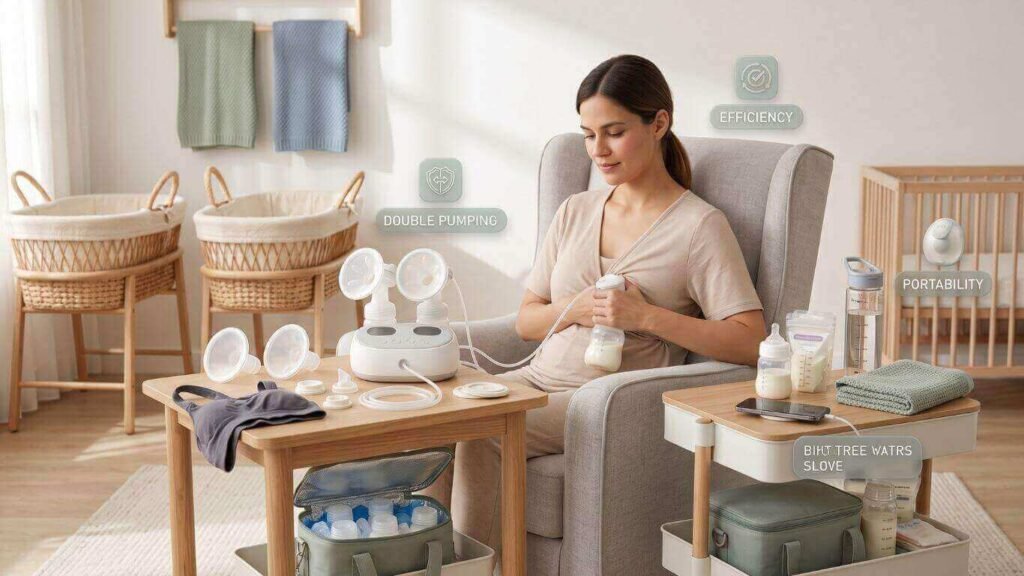
The right accessories can make frequent pumping considerably easier, especially when you’re caring for two babies.
Hands-Free Pumping Bra
A hands-free pumping bra keeps both breast shields in position while you pump.
This can be particularly useful when you need to feed, hold, or care for one baby while pumping for both.
Correctly Sized Flanges
Don’t assume the standard flange included with your pump will fit you correctly.
A properly fitted flange can improve comfort and support effective milk removal. Some parents may also need different sizes for each breast.
Spare Pump Parts
If you’re pumping frequently, having spare parts can save time and prevent interruptions.
Consider keeping extras of:
- Valves
- Membranes
- Tubing
- Bottles
- Breast shields or flange sets
Breast Milk Storage Bags
Twin parents who pump regularly may need to store larger quantities of expressed milk.
Use containers or bags designed for breast milk and follow current storage and handling recommendations.
Pumping Station
A simple pumping station can keep everything you need within reach.
Consider keeping:
- Pump
- Flanges
- Spare parts
- Bottles
- Storage bags
- Water
- Burp cloth
- Phone
- Cooler and ice packs
in one convenient location.
How to Keep Breast Pump Parts Clean
Frequent pumping means frequent cleaning, so choose a pump with parts that are easy to wash and replace.
The CDC recommends washing your hands before handling pump equipment, inspecting the pump kit and tubing, separating parts that come into contact with breast milk, and cleaning those parts according to the manufacturer’s instructions.
After cleaning, allow pump parts to air-dry completely before storing them. Damaged or moldy tubing should be replaced.
For additional sanitizing guidance, follow the CDC’s recommendations and your pump manufacturer’s instructions.
Common Mistakes Twin Parents Make When Choosing a Breast Pump
Choosing a Pump Based Only on Suction Number
A higher mmHg rating does not automatically mean better milk removal.
Comfort, flange fit, pumping technique, and how effectively the pump works for your body are more important than chasing the highest specification.
Assuming Twins Automatically Require a Hospital-Grade Pump
They don’t.
The need for a hospital-grade pump depends more on factors such as premature birth, NICU admission, ineffective breastfeeding, mother-baby separation, milk-supply concerns, and how heavily you depend on pumping.
Choosing a Wearable Only Because It’s Convenient
Wearables can be extremely convenient, but portability should not be the only consideration.
If you’re relying on pumping for most of your babies’ milk, make sure the pump provides comfortable and effective milk removal for you.
Using the Wrong Flange Size
An incorrectly sized flange can cause discomfort and may interfere with milk removal.
Don’t assume that the standard flange is automatically the correct size.
Buying Only One Set of Pump Parts
Frequent pumping means frequent washing.
A spare set of valves, membranes, bottles, and flange parts can make your routine easier and reduce interruptions when parts need cleaning or replacement.
Waiting Until After Delivery to Make a Pumping Plan
If you’re expecting twins, consider discussing your potential pumping needs with your healthcare team before delivery.
This is especially useful if there is a possibility of premature birth, NICU admission, or difficulty with breastfeeding after delivery.
Having a basic plan—and knowing who to contact for lactation support—can make the first days much less stressful.
FAQs
What is the best breast pump for twin moms?
For most parents who want a personal-use double electric pump, the Spectra S1 Plus is our top overall choice. It combines adjustable suction, a rechargeable battery, closed-system backflow protection, and double-pumping capability, making it practical for frequent pumping.
If your twins are premature, in the NICU, separated from you, or unable to breastfeed effectively, a Medela Symphony may be more appropriate for establishing or maintaining milk production, particularly during the early pumping period.
Do I need a hospital-grade breast pump for twins?
No—not automatically.
Having twins does not by itself mean you need a hospital-grade pump. A hospital pump may be particularly useful when:
- Your babies are premature or in the NICU
- One or both babies cannot breastfeed effectively
- You are separated from your babies
- You are primarily dependent on pumping
- You need additional support while establishing milk production
Talk with your NICU team or lactation consultant if you’re unsure which type of pump is appropriate for your situation.
Can I use a wearable breast pump for twins?
Yes.
A wearable pump can be useful when you want more freedom to move around while pumping. It may work well as a primary or secondary pump depending on how comfortably and effectively it removes milk for you.
Wearables such as the Willow 360 and Elvie Pump can be particularly convenient when you’re caring for two babies, traveling, or returning to work.
If you’re primarily pumping to establish or maintain milk production, pay attention to your actual milk removal, comfort, and overall supply rather than choosing a pump based on portability alone.
How can I increase breast milk for twins?
Frequent and effective milk removal is an important part of establishing and maintaining milk production.
If you’re concerned about low supply, consider:
- Pumping or breastfeeding frequently
- Using a properly fitted flange
- Choosing comfortable suction
- Double pumping when appropriate
- Checking valves, membranes, and other pump parts for wear
- Getting professional lactation support when needed
If milk production remains persistently low, speak with an IBCLC, pediatrician, obstetric provider, or NICU lactation team rather than simply switching to a pump with higher suction.
What are the top 5 breast pumps for twins?
Our top five picks are:
- Spectra S1 Plus — Best overall
- Medela Symphony — Best hospital pump for premature or NICU twins
- Motif Luna — Best Spectra alternative
- Willow 360 — Best wearable for mobility
- Elvie Pump — Best compact wearable
Is the Spectra S1 better than the Motif Luna for twins?
Both are strong personal-use double electric pumps, so the better choice depends on your individual needs.
| Factor | Spectra S1 Plus | Motif Luna |
|---|---|---|
| Pump type | Double electric | Double electric |
| Suction | Up to 270 mmHg | Up to 280 mmHg hospital-strength |
| Battery | Rechargeable | Battery option |
| Portability | Good | Good |
| Comfort | Highly individual | Highly individual |
| Flange fit | Must be individualized | Must be individualized |
| Price | Varies | Varies |
| Insurance | Depends on plan | Depends on plan |
The slightly higher suction specification of the Luna does not automatically make it better. Comfort, flange fit, milk-removal performance, portability, price, and insurance coverage may matter more in everyday use.
Is a Haakaa enough for pumping for twins?
No—not as a replacement for a primary electric pump when you’re intentionally expressing milk.
A Haakaa-style silicone pump is better viewed as a passive milk-collection tool. It can be useful for collecting milk from the opposite breast while nursing, but it does not provide the same function as a double electric pump designed for regular milk expression.
If you’re primarily pumping for your twins, choose a pump designed for your intended frequency and milk-removal needs.
How long should I pump for twins?
There is no universal pumping duration that works for every parent.
Session length can depend on:
- Your pump
- Milk flow
- Whether you’re double pumping
- How quickly your breasts respond to the pump
- Your comfort
- Whether you’re establishing or maintaining supply
- Your healthcare professional’s recommendations
For example, Medela’s Symphony guidance generally recommends approximately 15 minutes of double pumping in its maintenance program, but individual needs can vary.
Follow your pump’s instructions and your individualized lactation plan rather than trying to reach a specific number of minutes every time.
Does insurance cover a breast pump for twins?
Many U.S. health insurance plans provide breastfeeding equipment and support, but the exact coverage varies.
Your plan may have different rules about:
- Which pumps are covered
- Whether the pump is purchased or rented
- Hospital-grade pump rentals
- When you can obtain the pump
- Replacement parts
- Prior authorization
- Required suppliers
- Upgrade fees
Having twins does not automatically mean your insurance will cover two pumps.
Before purchasing, contact your insurance provider and confirm exactly what your plan covers.
Final Verdict
For most parents who want one personal-use breast pump for twins, the Spectra S1 Plus is our top overall choice. Its rechargeable battery, adjustable suction, closed-system design, and double-pumping capability make it a practical option for frequent pumping.
For premature twins, NICU situations, or parents who are temporarily dependent on pumping, ask your healthcare or lactation team whether a Medela Symphony rental is appropriate for establishing or maintaining milk production.
For parents who prioritize mobility and hands-free pumping, the Willow 360 or Elvie Pump can provide useful wearable options, depending on how well they work for your body and routine.
The key takeaway is simple:
The best breast pump for twins isn’t necessarily the pump with the highest suction or the most features. It’s the pump that removes milk effectively, fits comfortably, and is practical enough for you to use consistently.
If pumping is painful, milk production remains persistently low, or either baby is having difficulty feeding or gaining weight, don’t simply switch to a stronger pump. Seek help from a qualified lactation professional or healthcare provider to identify the underlying issue.