


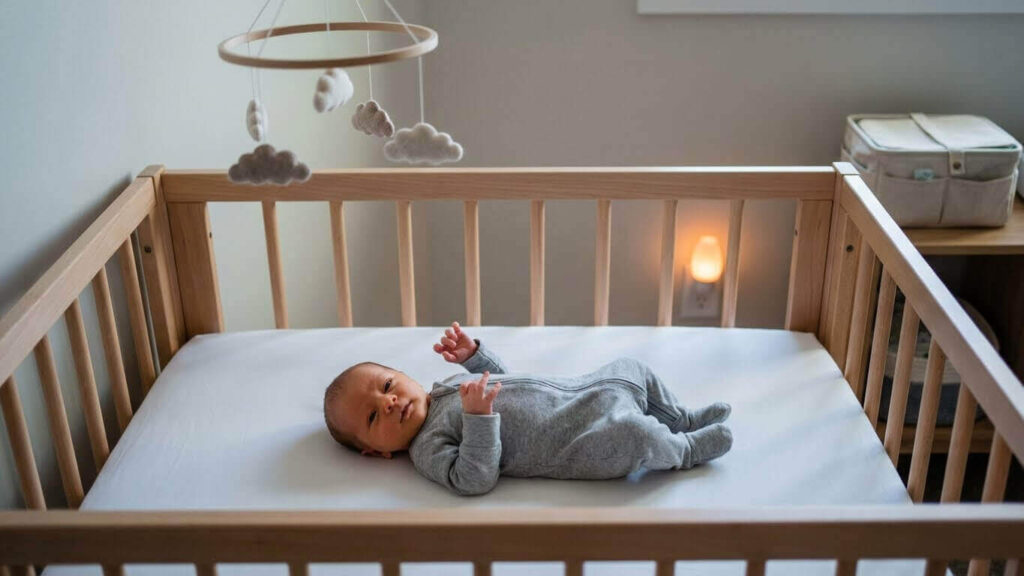
Walking in and seeing your newborn baby awake in the crib not crying can feel… unsettling. You expect crying. You expect a clear signal. Instead you get wide eyes, tiny kicks, and complete silence.
Here’s what this really means: in many cases, it’s normal. Newborns often wake between sleep cycles and sit in a quiet, alert state where they simply look around and reset. Children’s Hospital of Philadelphia describes this “quiet alert” period as a normal phase when newborns wake and calmly take in their surroundings.
Your job isn’t to “fix” the moment. It’s to quickly confirm your baby is comfortable and safe, then decide whether to wait or step in.
Is it normal for a newborn to be awake but not crying?
Yes. A calm, awake newborn can be perfectly fine.
Newborn sleep is made of short cycles (often around 20–50 minutes depending on the source), and babies can partially wake as they transition between lighter and deeper sleep. In those in-between moments, some babies fuss and cry, but many don’t. They might stare, stretch, wiggle fingers, or quietly watch a mobile.
If your baby is calm, breathing normally, and safe in their sleep space, quiet wakefulness is usually not an emergency.
The most common reasons your newborn is awake and quiet
1) They’re between sleep cycles
Newborns move through sleep cycles quickly and can pop fully awake for a short time without distress.
2) The “quiet alert” phase
This is a real developmental state: awake, still, observant. It’s when babies take in faces, light, sound, and movement without getting upset.
3) They’re learning early self-settling skills
Not “sleep training.” Not forcing anything. Just small moments where a baby stays calm and may drift back off on their own—especially if the room is quiet and boring.
4) Day–night rhythm is still developing
Newborns aren’t born with a mature circadian rhythm. Their sleep becomes more predictable as their body clock develops over the first months. Exposure to light and dark helps that process.
5) A small comfort issue that hasn’t reached crying level
A slightly wet diaper, a cool room, mild gas, or being a little hungry can show up first as “awake and looking around” before it turns into fussing.
Should you leave your baby in the crib if they’re awake but not crying?
If they’re calm, yes—often the best first move is to wait a bit.
What you’re watching for is whether this is a short transition or a growing need.
A simple rule that works for most parents
If calm: wait and observe quietly.
If escalating fuss: intervene gently before full crying.
If clearly hungry: feed.
Some sleep consultants suggest limiting long “awake but happy” crib time because too much can reduce sleep pressure over time; the key is whether it’s occasional and brief or happening for long stretches regularly.
What to do in the moment (step-by-step)
Keep this boring and calm. The goal is to avoid turning wake-ups into “play time.”
Step 1: Do a quick safety/comfort check (10 seconds)
- Baby is on their back in a safe sleep space
- Breathing looks normal
- No signs of distress (struggling, persistent coughing, unusual color changes)
Step 2: Pause before you act (2–10 minutes)
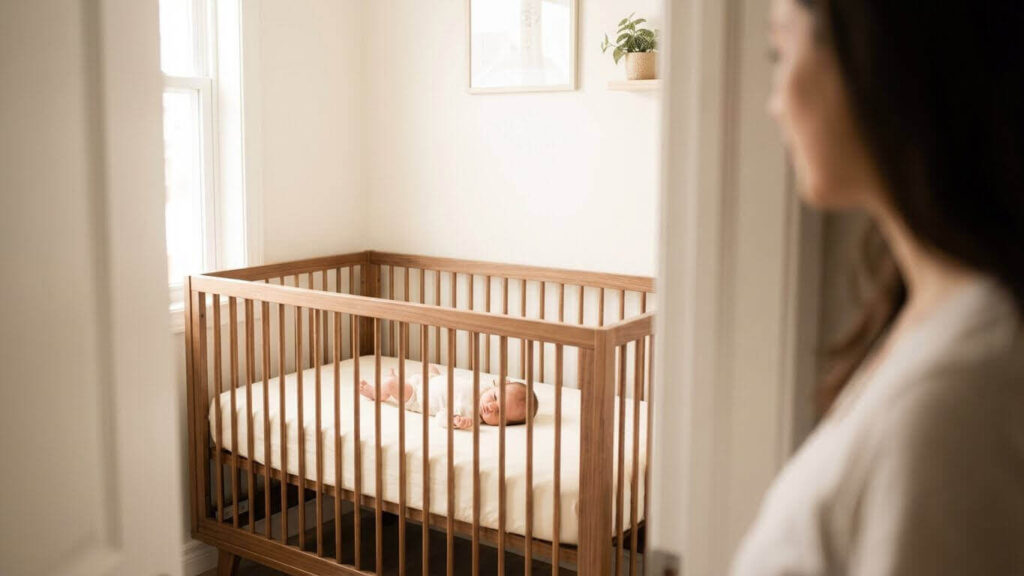
Stand at the door or watch the monitor. If your baby is:
- staring quietly
- stretching
- softly moving legs/arms
- making light coos
…let them be. Many babies drift back to sleep.
Step 3: Keep the environment sleepy
- Lights dim
- No bright phone screen near the crib
- No animated talking
- No toys introduced at night
Step 4: If they don’t settle, try “low-input” help
Pick one:
- a gentle hand on the chest for a few seconds
- soft shushing
- pacifier (if you already use one safely)
Step 5: If hunger is likely, feed
If it’s been a while since the last feed and your baby is starting to root, lick lips, or get fussy, feeding is reasonable. (When in doubt with a newborn, your pediatrician’s feeding guidance matters most.)
How long is “too long” to be awake quietly?
There isn’t one perfect number because it depends on age, time of day, and the baby’s overall sleep.
A practical approach:
- Occasional 5–20 minutes of calm wakefulness is typically fine.
- Regular long stretches (like 45–90+ minutes) can signal a schedule mismatch, overtiredness, or too much daytime sleep—especially as babies get older.
If this becomes frequent, zoom out and look at wake windows and sleep cues.
Wake windows (quick guide you can use
Newborns tire fast. Many babies do best when they’re back asleep before they get overtired.
A commonly used range:
- 0–4 weeks: about 30–60 minutes
- 4–12 weeks: about 60–90 minutes
Don’t treat this like a strict timer. Use it as a guardrail. If your baby is quietly awake in the crib a lot, it can be a sign they weren’t quite sleepy enough when put down, or they got overtired and “popped awake.”
When you should be concerned
Quiet wakefulness alone usually isn’t a problem. But you should check in with your pediatrician if you notice patterns like:
- Your newborn is awake for very long stretches repeatedly and sleep is deteriorating
- Feeding issues: weak feeding, fewer wet diapers, poor weight gain
- Your baby is unusually hard to rouse or seems abnormally lethargic when awake
- You’re seeing breathing concerns or anything that feels off
Trust your instincts. If you’re worried, it’s worth calling.
Safe sleep reminders (keep this section tight and correct)
If you’re going to let a baby lie calmly awake, the sleep environment needs to be safe.
The American Academy of Pediatrics’ guidance emphasizes:
- Back to sleep for every sleep
- Firm, flat sleep surface
- Keep soft items out of the crib (no pillows, blankets, bumpers, toys)
- Use a crib/bassinet that meets safety standards.
This matters whether your baby is asleep or quietly awake.
A calmer mindset that helps
If your baby is awake and not crying, you don’t have a problem to solve right away. You have a moment to observe.
Sometimes your baby will fall back asleep. Sometimes they’ll signal they need you. Either outcome is normal. Your win is responding based on cues instead of anxiety.
FAQs
Why is my newborn baby awake in crib not crying?
Often because they’re between sleep cycles or in a quiet alert phase where they calmly observe their environment.
Should I leave my baby if they’re awake but calm?
Usually yes. Keep the room dim and boring and give them a few minutes. If they start to fuss or show hunger cues, step in.
Is quiet wakefulness a sign of a healthy baby?
It can be. Calm alertness is a normal newborn state and can be part of typical sleep-wake development.
When does the day–night rhythm get better?
Newborn circadian rhythm develops over time. Many sources note melatonin release and more predictable rhythms emerge around the early months, which helps sleep consolidate.