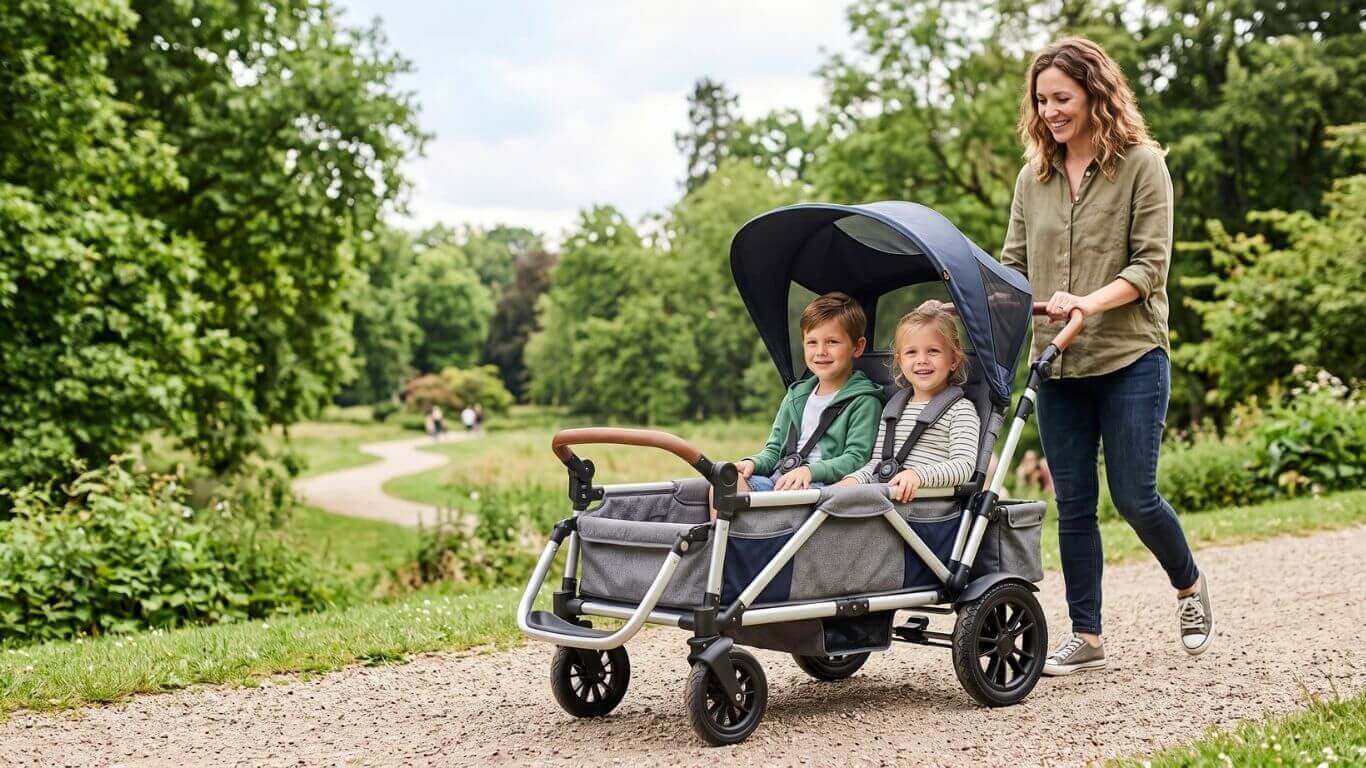


Finding the best wagon for older kids can be more difficult than choosing a wagon for a toddler. As children grow, weight is only one part of the equation. Height, legroom, interior space, individual passenger limits, restraints, wagon weight, and the terrain you use it on all become important.
For families with several children, a four-seat stroller wagon can provide more room and flexibility than a traditional stroller. But a large advertised capacity does not automatically mean the wagon is suitable for one large child.
For example, the Radio Flyer Voya 2.0 XT has a 300-pound total wagon capacity, but Radio Flyer’s comparison chart lists a 50-pound capacity per seat.
Our main advice: choose based on your child’s actual size and your family’s needs—not simply the biggest number on the product page.
Editor’s Tip: A 300-pound total capacity does not mean one child can weigh 300 pounds. Always check the manufacturer’s individual passenger or seat limit, height requirements, and intended use.
Quick Answer
The best wagon for older kids is one that gives your child enough room to sit comfortably while staying within the manufacturer’s current weight, height, seating, and restraint requirements.
For larger families, the Radio Flyer Voya 2.0 XT 4-Seat is a strong all-around option because it offers four seats, a 300-pound total capacity, raised seats, all-terrain tires, a UV-protection canopy, and push/pull functionality. Its individual seat limit, however, is 50 pounds.
Other options stand out for different needs:
- WonderFold W4 Luxe: spacious four-passenger design
- Keenz XC+: high total capacity and generous interior space
- Keenz VIVA 4: compact four-seat configuration
- Evenflo Pivot Xplore: lighter and easier to lift
- Jeep Wrangler Deluxe: outdoor-oriented two-child wagon
- Radio Flyer Pathfinder: simpler two-seat option
Because manufacturers can change specifications, prices, and product configurations, verify the current manufacturer’s information before purchasing.
Best Wagons for Older Kids at a Glance
| Best for | Recommended option | Why consider it? |
|---|---|---|
| Best overall for larger families | Radio Flyer Voya 2.0 XT 4-Seat | 4 seats and 300-lb total capacity |
| Best spacious 4-seater | WonderFold W4 Luxe | Deep carriage and raised seating |
| Best high-capacity option | Keenz XC+ | 326-lb total capacity and 55-lb passenger limit |
| Best compact 4-seater | Keenz VIVA 4 | Four seats with a relatively compact footprint |
| Best lightweight option | Evenflo Pivot Xplore | 34.7-lb wagon and 55-lb child limit |
| Best outdoor option | Jeep Wrangler Deluxe | All-terrain tires and 55-lb-per-seat limit |
| Best value 2-seater | Radio Flyer Pathfinder | 180-lb total capacity and lower listed price |
Specifications and prices can change. Always verify current information on the manufacturer’s product page before purchasing.
How We Chose the Best Wagons
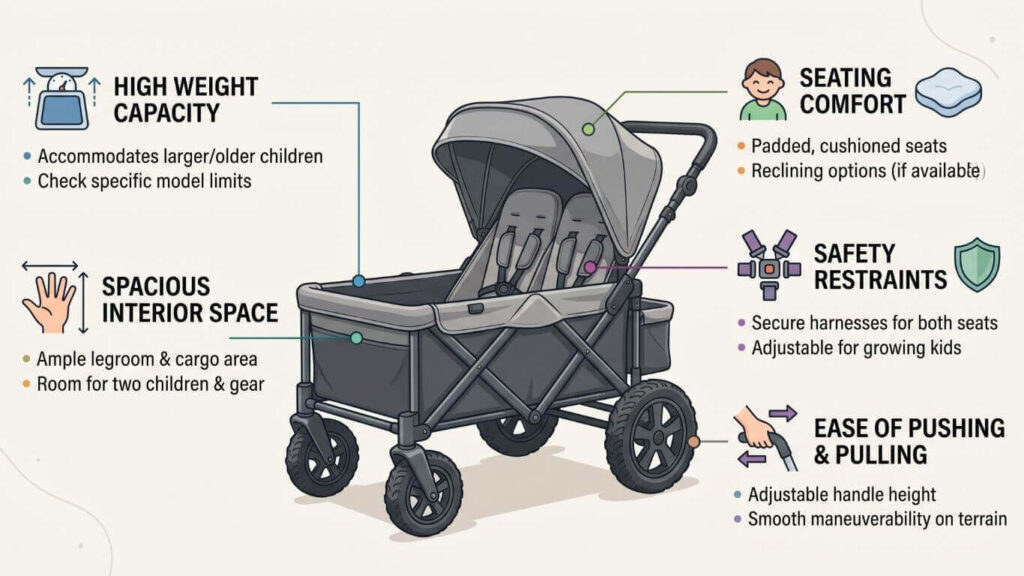
We did not rank these wagons simply by their advertised weight capacity.
For growing children, we considered the factors that are most likely to affect real-world usefulness:
- Individual passenger or seat limits
- Total wagon capacity
- Child height requirements
- Interior dimensions
- Seating and legroom
- Harness or restraint system
- Wagon weight
- Wheel design
- Maneuverability
- Folded size
- Intended terrain
- Storage and everyday convenience
We also prioritized manufacturer specifications rather than relying solely on retailer descriptions.
This matters because stroller-wagon specifications can be easy to misunderstand. A manufacturer may list a total wagon capacity separately from an individual passenger limit, and those numbers should never be treated as interchangeable.
Our “best for” categories are therefore based on different family needs rather than a simple 1-to-7 ranking.
7 Best Wagons for Older Kids
1. Radio Flyer Voya 2.0 XT 4-Seat — Best Overall for Larger Families
Best for: Families transporting three or four children
The Radio Flyer Voya 2.0 XT 4-Seat is a particularly compelling choice for larger families because it combines four-passenger seating with a 300-pound total wagon capacity.
Radio Flyer currently lists:
- 4 seats
- 300-lb total capacity
- 50-lb individual seat limit
- 6+ months
- 43.8-lb wagon weight
- 49.8 lb with accessories
- 40.5 × 29 × 50.5 inches assembled
- All-terrain tires
- Raised, foldable seats
- UV-protection canopy
- Rear storage
- Parking brake
The manufacturer also says the wagon folds with its accessories attached and can be used in push or pull mode.
Why it stands out
The combination of four seats, raised seating, high total capacity, storage, and all-terrain tires makes the Voya 2.0 XT practical for families with several children.
Raised seats can also give children a better view while creating additional storage space underneath.
The important limitation
The headline 300-pound capacity can be misleading if you don’t look at the passenger limit.
Radio Flyer’s comparison chart lists a 50-pound weight capacity per seat.
So while the Voya 2.0 XT is a strong choice for multiple children, it may not be appropriate for a single particularly large child who exceeds the individual passenger limit.
Our verdict: A strong all-around choice for larger families, provided every passenger meets the manufacturer’s individual requirements.
2. WonderFold W4 Luxe — Best for Spacious Four-Child Seating
Best for: Families who prioritize interior space and four-child seating
The WonderFold W4 Luxe is designed for up to four passengers and focuses heavily on space, raised seating, and a deeper carriage.
WonderFold lists:
- 4-passenger capacity
- 300-lb total wagon capacity
- 99-lb limit per bench
- 59.8-lb wagon weight with seats
- 6+ months
- 30-inch maximum width
- Raised seats
- Reclining seats
- XL all-terrain wheels
- Magnetic harnesses
- One-step foot brake
- Deep carriage
A specification parents should understand
WonderFold describes the W4 Luxe’s limit as 99 pounds per bench, with two seats on each bench.
That does not mean a 99-pound child can automatically ride in an individual seat.
Parents should follow the manufacturer’s seating configuration, harness instructions, and current product guidance rather than converting the bench capacity into an individual-child limit.
Pros
- Spacious four-passenger design
- Deep carriage
- Raised seating
- Reclining seats
- Magnetic harnesses
- XL all-terrain wheels
- Brake
- Good storage
Cons
- Heavy
- Larger than many two-seat wagons
- Bench-based capacity requires careful interpretation
Our verdict: An excellent candidate when space for several children is more important than keeping the wagon light.
3. Keenz XC+ 4-Passenger — Best High-Capacity Option
Best for: Families needing high total capacity and generous interior space
The Keenz XC+ is one of the most interesting options for growing children because Keenz provides unusually specific information about both passenger weight and child height.
The manufacturer lists:
- 4 passengers
- 326-lb total capacity
- 55-lb maximum per passenger
- 48-inch maximum child height
- 32 × 22 × 18-inch interior
- 54-lb wagon weight
- 20-lb cargo bin/bag limit
- 6+ months
- All-terrain wheels
Keenz also states that the XC+ is JPMA certified and meets applicable stroller safety requirements.
Why it stands out for older children
The 48-inch height limit is particularly useful when evaluating a wagon for a growing child.
It demonstrates why parents should look beyond weight capacity. A child can be below the weight limit but still be too tall for a particular wagon.
The 32-inch interior length and 18-inch depth also give parents useful information when considering whether a growing child will have enough room.
Pros
- 326-lb total capacity
- 55-lb passenger limit
- 48-inch height limit
- Deep interior
- Four-passenger design
- Large all-terrain wheels
- Reclining seats
Cons
- 54 lb before considering the load
- Individual passenger limit remains 55 lb
- Large total capacity does not mean one child can use it
Our verdict: One of the strongest choices for families who need high capacity and clearly stated child-fit specifications.
4. Keenz VIVA 4 — Best Compact Four-Seater
Best for: Families who want four seats without the largest possible footprint
The Keenz VIVA 4 takes a different approach. It is designed as a compact four-passenger stroller wagon for families who want additional seating without moving to an especially wide design.
Current manufacturer specifications include:
- 4 passengers
- 326-lb total capacity
- 55-lb passenger limit
- 55.12-lb wagon weight
- 32.5 × 21.5 × 18-inch interior
- 6+ months
- Five-point harnesses
- Foot brake
- EVA wheels
- Fold-flat design
- Canopy with mosquito netting
Why it stands out
The VIVA 4 combines a four-child configuration with a relatively compact folded design. Keenz describes it as suitable for urban adventures, family events, parks, and everyday errands.
Pros
- Four-passenger design
- 326-lb total capacity
- Deep padded seats
- Five-point harnesses
- Compact fold
- Canopy with mosquito netting
- Push/pull handle system
Cons
- More than 55 lb
- 55-lb passenger limit
- EVA wheels may be better suited to everyday surfaces than demanding terrain
Our verdict: A practical choice for families who want four seats with a more storage-friendly design.
5. Evenflo Pivot Xplore — Best Lightweight Option
Best for: Families who frequently lift, fold, transport, or store their wagon
The Evenflo Pivot Xplore is considerably lighter than most of the four-seat models in this comparison.
Evenflo lists:
- Up to 55 lb per child
- Up to 39 inches tall
- 34.7-lb product weight
- 27.5 × 39 × 45 inches assembled
- 27.5 × 16 × 39 inches folded
- Push and pull modes
- Rubber wheels
- 3-point harness
- UPF 50+ canopy
- 6+ months
Why it may work well
At 34.7 pounds, the Pivot Xplore is much easier to lift than a 54-, 55-, or nearly 60-pound wagon.
That can matter if you regularly:
- Load the wagon into a vehicle
- Carry it short distances
- Store it indoors
- Fold it after every outing
The important limitation
The 39-inch maximum child height is the biggest consideration for older children.
A child may be under the 55-pound weight limit but still exceed the manufacturer’s height limit.
Our verdict: A good lightweight option, but it is better suited to smaller children than genuinely tall older kids.
6. Jeep Wrangler Deluxe Stroller Wagon — Best for Outdoor Trips
Best for: Two children and families who frequently visit parks or outdoor events
The Jeep Wrangler Deluxe Stroller Wagon from Delta Children is built around outdoor use.
The manufacturer lists:
- 2 seats
- 110-lb total capacity
- 55 lb per seat
- 46.6-lb weight
- 46 × 26.7 × 46 inches with canopy
- 38 × 29 × 25 inches folded
- All-terrain puncture-proof airless tires
- Rear-wheel suspension
- Parking brake
- UV-blocking canopy
- Push/pull handles
- Five-point harnesses
Why it stands out
The airless all-terrain tires and suspension make it an interesting choice for families who spend a lot of time in parks, outdoor events, and other less-than-perfect surfaces.
It is also designed for two children rather than four, which can make sense when your family normally travels with only two passengers.
Pros
- 55-lb-per-seat limit
- Airless all-terrain tires
- Suspension
- Parking brake
- UV-blocking canopy
- Storage
- Push/pull design
- Five-point harnesses
Cons
- Heavy for a two-seat wagon
- Lower total capacity than four-seat alternatives
Our verdict: A solid choice for two children when outdoor terrain and durable wheels are high priorities.
7. Radio Flyer Pathfinder 2-Seat — Best Value Two-Seater
Best for: Families who want a simpler two-child stroller wagon
The Radio Flyer Pathfinder 2-Seat is a straightforward alternative for families who do not need four seats.
Radio Flyer’s current comparison chart lists:
- 2 seats
- 180-lb total capacity
- 50-lb capacity per bench
- 36.4-lb wagon weight
- 44.3 × 26 × 42 inches unfolded
- 16.1 × 26 × 35.6 inches folded
- $369 listed price on the current comparison chart
Pros
- Lower listed price than many premium models
- Relatively light
- 180-lb total capacity
- Two-child configuration
- Compact width
Cons
- 50-lb bench limit
- Fewer premium features
- May not be the best fit for larger older children
Our verdict: A sensible choice for families looking for a simpler two-seat wagon without the size of a four-passenger model.
What Matters Most When Choosing a Wagon for an Older Child
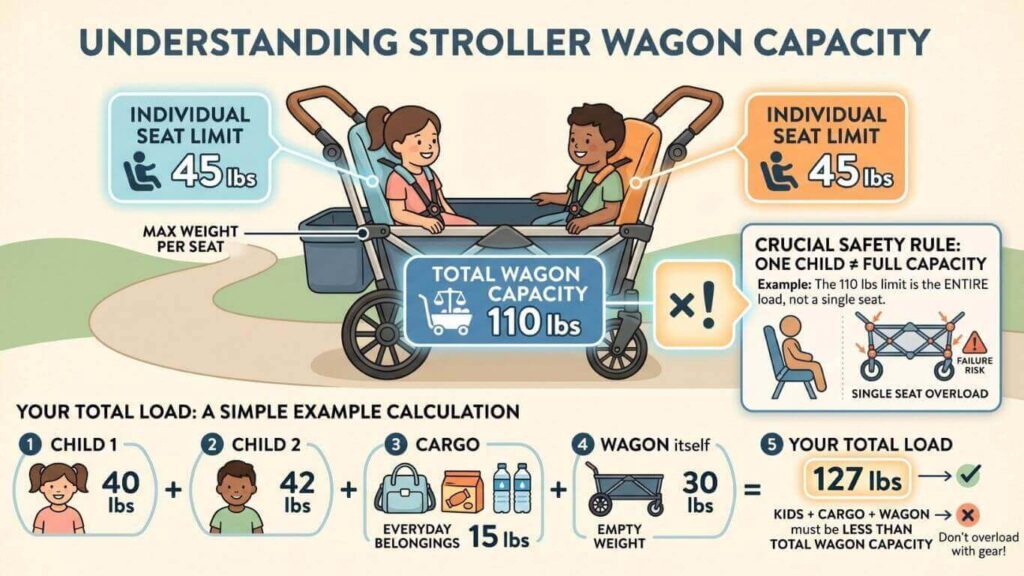
This is the point I would emphasize throughout the article.
A wagon advertised as having a 300- or 326-pound capacity does not necessarily accommodate a very large individual child.
Consider the differences:
| Wagon | Total capacity | Individual/seat limit | Height limit |
|---|---|---|---|
| Radio Flyer Voya 2.0 XT | 300 lb | 50 lb | Check manufacturer guidance |
| WonderFold W4 Luxe | 300 lb | Bench-based limit | Check manufacturer guidance |
| Keenz XC+ | 326 lb | 55 lb | 48 in |
| Keenz VIVA 4 | 326 lb | 55 lb | Check manufacturer guidance |
| Evenflo Pivot Xplore | — | 55 lb | 39 in |
| Jeep Wrangler Deluxe | 110 lb | 55 lb | Check manufacturer guidance |
| Radio Flyer Pathfinder | 180 lb | 50-lb bench | Check manufacturer guidance |
What Matters Most When Choosing a Wagon for an Older Child
1. Individual Passenger Weight Limit
Start here—not with the headline capacity.
If your child weighs 48 pounds and the manufacturer sets a 50-pound passenger limit, there is very little room before the child reaches the stated maximum.
Do not assume that a wagon’s total capacity can be divided between its seats.
A 300-pound wagon is not automatically a 75-pound-per-child wagon.
Always use the manufacturer’s stated individual passenger limit.
2. Child Height
Height becomes increasingly important as children get older.
A wagon may have enough weight capacity but still be uncomfortable—or outside its stated limits—because the child is too tall.
Check for:
- Maximum child height
- Canopy clearance
- Seat height
- Legroom
- Shoulder room
- Interior depth
For example, Evenflo lists a 39-inch maximum child height for the Pivot Xplore, while Keenz lists 48 inches for the XC+.
3. Interior Space and Legroom
Do not judge comfort from exterior dimensions alone.
For a growing child, ask:
- Can the child sit upright comfortably?
- Are the legs cramped?
- Is there enough shoulder room?
- Does the child have enough headroom?
- Can the child get in and out without difficulty?
- Does the canopy interfere with the child’s head?
A larger wagon is not automatically more comfortable, but interior dimensions can provide a useful starting point.
4. Individual Passenger Limit vs. Total Capacity
This deserves repeating because it is the most important buying distinction.
Suppose a wagon has:
- 300-lb total capacity
- 4 seats
- 50-lb individual passenger limit
You cannot assume four 75-pound children can ride in it.
The individual limit still applies.
This is why the best wagon for growing children should be evaluated using both capacity numbers, along with height and seating requirements.
5. Harnesses and Restraints
If the wagon has a harness, use it according to the manufacturer’s instructions.
Do not assume that every wagon uses the same restraint system. The products in this comparison vary in their seating and harness designs.
The U.S. Consumer Product Safety Commission identifies stability, brakes, restraint systems, latches, folding mechanisms, structural integrity, wheels, and openings among the safety concerns addressed by federal stroller requirements.
6. Wagon Weight and Maneuverability
Parents sometimes focus so heavily on the child that they forget who has to move the wagon.
A 55- or 60-pound wagon can become difficult to:
- Lift into a vehicle
- Carry upstairs
- Fold
- Store
- Maneuver through narrow spaces
For comparison, the Evenflo Pivot Xplore weighs 34.7 pounds, while the Keenz XC+ weighs 54 pounds and the WonderFold W4 Luxe weighs 59.8 pounds with seats.
That difference can have a major impact on everyday convenience.
7. Wheels and Terrain
Choose the wagon according to where you actually use it.
| Where you use it | What to look for |
|---|---|
| Sidewalks | Smooth-rolling wheels |
| Neighborhoods | Easy steering |
| Grass | Larger wheels and clearance |
| Gravel | Durable wheels and stable steering |
| Parks | All-terrain design |
| Beach | Check manufacturer guidance |
Remember:
“All-terrain” does not mean “suitable for every terrain.”
Deep sand, mud, steep slopes, and rough trails can be substantially more difficult than sidewalks or packed grass.
8. Folded Size
Before purchasing a wagon, measure:
- Your vehicle’s trunk
- Garage or closet
- Storage area
- Doorways
- Available lifting space
Pay particular attention to the folded dimensions, not just the assembled dimensions.
A wagon that fits your child perfectly is not useful if you cannot transport or store it.
This distinction is extremely important.
Before buying a wagon for an older child, check these four areas
Best Wagon for Tall Kids: What Parents Should Know
If your child is tall for their age, don’t start by searching for the highest weight capacity.
Start with height.
The Keenz XC+, for example, lists a maximum child height of 48 inches, while the Evenflo Pivot Xplore lists 39 inches.
This illustrates an important point:
A higher weight capacity does not automatically mean a taller child will fit.
For a tall child, prioritize:
- Manufacturer’s maximum height
- Interior length
- Seat depth
- Legroom
- Shoulder room
- Canopy clearance
- Individual passenger limit
If your child is close to the manufacturer’s maximum height or weight, don’t rely on photographs or general age recommendations. Check the current specifications directly.
Best Wagon for Two Older Kids
Families with two children do not necessarily need a four-seat wagon.
A two-seat model may be preferable if you value:
- Lower weight
- Smaller footprint
- Easier storage
- Easier vehicle loading
- Simpler maneuverability
The Jeep Wrangler Deluxe, for example, holds up to 110 pounds total with a 55-pound limit per seat. The Radio Flyer Pathfinder provides two seats and a 180-pound total capacity.
If your children are approaching the individual limits, however, check the manufacturer’s current specifications carefully before purchasing.
Best Wagon for Three or Four Kids
For families regularly transporting three or four children, a four-seat stroller wagon can be much more practical.
The Voya 2.0 XT, WonderFold W4 Luxe, Keenz XC+, and Keenz VIVA 4 all offer four-passenger configurations, but they differ significantly in weight, interior design, and passenger limits.
The trade-off is size.
More seating generally means:
- More weight
- More storage space required
- More effort to load into a car
- More space needed to maneuver
So don’t buy a four-seat wagon simply because it has the largest capacity. Buy one because your family actually needs the extra seating.
Stroller Wagon vs. Utility Wagon
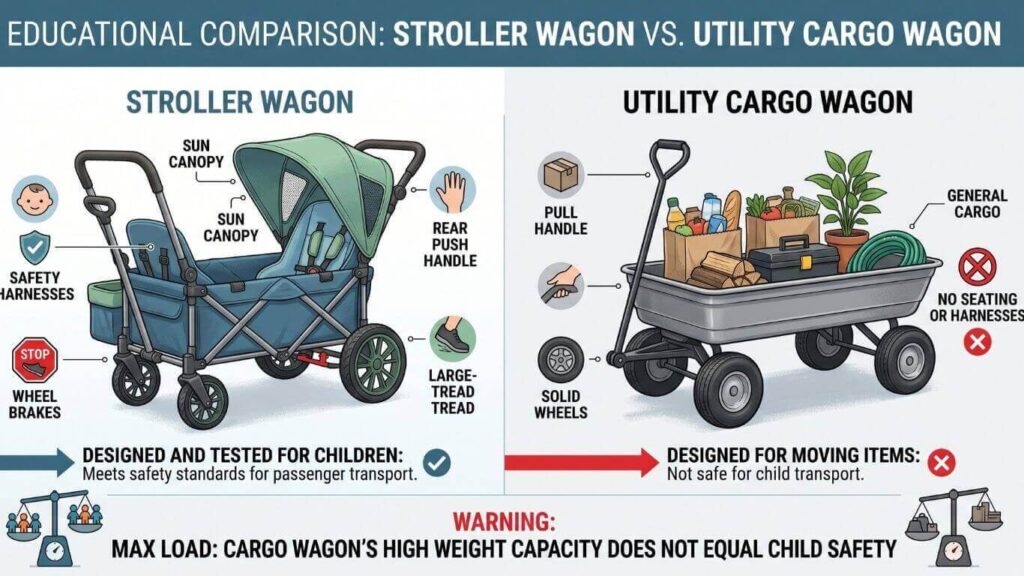
A stroller wagon is designed to transport children.
It may include:
- Child seating
- Restraints
- Canopy
- Brakes
- Push/pull handles
- Child-specific safety features
A utility wagon is designed primarily for cargo.
A high cargo weight rating does not automatically make a utility wagon safe for a child.
In 2025, the CPSC recalled the Olympia Tools Pack-N-Stroll Premium Folding Utility Wagon because of an entrapment hazard and because its lack of a restraint system posed a fall risk to children.
That is a useful reminder that cargo capacity and child-carrying suitability are two different things.
If you want to transport a child, choose a product specifically designed and labeled for child transportation.
Are Wagons Safe for Older Kids?
A properly designed stroller wagon can be useful for family outings, but safety depends on the specific product and how it is used.
Before each outing:
- Check the manufacturer’s current age and weight limits.
- Check the individual passenger limit.
- Check any height restriction.
- Use the provided restraint system as instructed.
- Make sure the wagon is completely unfolded and locked.
- Check the brake before loading children.
- Inspect wheels, tires, and the frame.
- Keep children seated while the wagon is moving.
- Use extra caution around roads, stairs, and slopes.
- Never exceed the manufacturer’s limits.
- Check for current product recalls.
The CPSC’s federal stroller regulation addresses hazards involving stability, brakes, restraint systems, latches, folding mechanisms, structural integrity, wheels, and openings.
Safety requirements can change, so parents should always check current manufacturer instructions and applicable safety information.
Common Buying Mistakes
Mistake 1: Choosing by age alone
There is no universal age when a child becomes “too old” for a wagon. Children develop mobility and independence at different rates, so age alone should not determine whether a wagon is appropriate. If you’re interested in how early mobility develops, our guide to how babies learn to walk explains the progression from crawling and pulling to standing to cruising and independent walking.
Better approach: Check age, weight, height, interior dimensions, and passenger limits together.
Mistake 2: Looking only at total capacity
A 300-pound wagon can still have a 50-pound individual passenger limit.
Better approach: Check both total and individual limits.
Mistake 3: Assuming four seats means four large children
Four-seat designs vary considerably in seating space and passenger requirements.
Better approach: Look at the actual seating configuration and manufacturer limits.
Mistake 4: Buying a cargo wagon for children
A high cargo rating is not a child-safety rating.
Better approach: Choose a child-specific stroller wagon.
Mistake 5: Forgetting the vehicle
A large wagon may be difficult to fit into a car.
Better approach: Measure your vehicle and compare the folded dimensions.
Mistake 6: Ignoring the adult’s needs
The wagon must work for the person pushing, pulling, folding, lifting, and storing it.
Better approach: Consider wagon weight, handle height, steering, fold, and storage.
Quick Buying Checklist
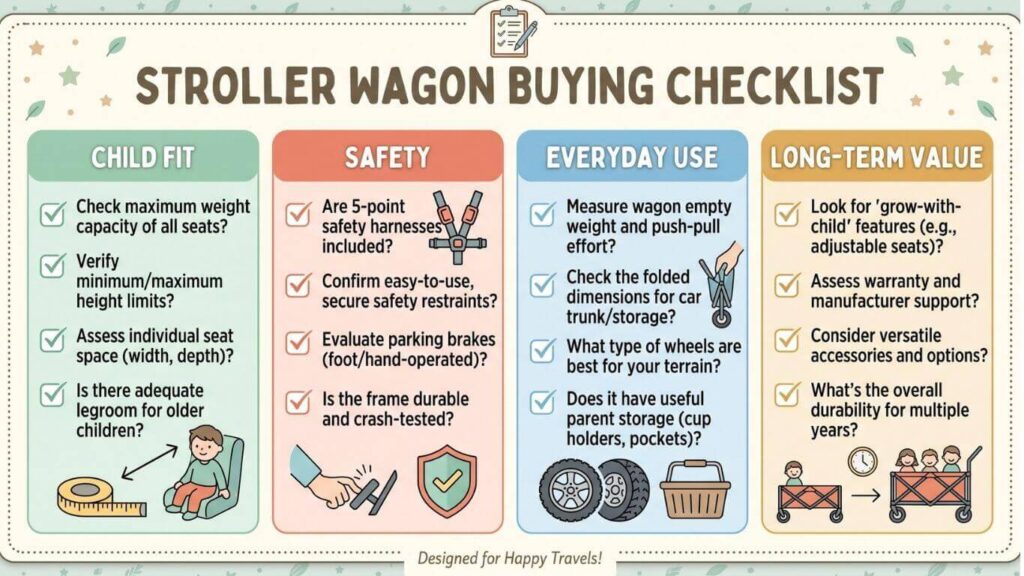
Before buying a wagon for an older child, check these four areas.
Child Fit
- What does my child weigh?
- How tall is my child?
- Is there enough legroom?
- Is the seat wide enough?
- Is there enough headroom?
Safety
- Is it specifically designed for children?
- What is the individual passenger limit?
- What is the total capacity?
- What restraint system does it use?
- Does it have a brake?
- Have I checked current recalls?
Everyday Use
- Can I push it comfortably?
- Can I lift it into my vehicle?
- Will it fit in my trunk?
- Is it easy to fold?
- Are the wheels suitable for my terrain?
Long-Term Value
- Will my child outgrow it soon?
- Can it accommodate another child?
- Are replacement parts available?
- Does the manufacturer provide clear instructions?
- Can I easily find current safety information?
Frequently Asked Questions
What is the best wagon for older kids?
There is no single best wagon for every older child.
The right choice depends on height, weight, interior space, individual passenger limits, number of children, terrain, and how you plan to use the wagon.
For larger families, the Radio Flyer Voya 2.0 XT, WonderFold W4 Luxe, and Keenz XC+ are three options worth comparing.
Can a 6-year-old ride in a wagon?
Potentially, but age alone does not determine whether a child can safely use a particular wagon.
Check the manufacturer’s current age, height, weight, seating, restraint, and usage requirements.
For older children, height and interior space can become just as important as weight.
What is more important: weight capacity or seat size?
Both matter.
A child must remain within the manufacturer’s passenger limit, but the wagon also needs to provide enough usable space for comfortable seating.
What is the difference between total capacity and passenger capacity?
Total capacity refers to the manufacturer’s stated maximum combined load for the wagon.
An individual passenger limit applies to a particular child or seat.
For example, a wagon with a 300-pound total capacity and a 50-pound passenger limit does not allow one 75-pound child simply because the overall number is higher.
What is the best wagon for tall kids?
Look for a clearly stated child-height limit and adequate interior dimensions.
The Keenz XC+ lists a maximum child height of 48 inches, while the Evenflo Pivot Xplore lists 39 inches.
Always verify current specifications before buying.
Are stroller wagons safe for older children?
A child-specific stroller wagon can be appropriate when used according to the manufacturer’s instructions.
Parents should pay attention to restraints, brakes, stability, folding mechanisms, wheels, and weight and height limits. These are among the safety areas addressed by federal stroller requirements.
Can I put a child in a regular utility wagon?
Don’t assume that you can.
Utility wagons are generally designed for cargo, and some may lack restraints or have other hazards. A recent CPSC recall involving a utility wagon highlighted entrapment and fall hazards.
Choose a product specifically designed and labeled for transporting children.
Is a wagon better than a stroller for older kids?
It depends on your family’s needs.
A stroller wagon can provide more space and may be useful for multiple children and long outings. A traditional stroller may be lighter and easier to maneuver.
Consider the child’s size, number of children, terrain, vehicle storage, and how frequently you will use it.
Should I buy a four-seat wagon if I have only two children?
Not necessarily.
A four-seat wagon gives you extra seating and flexibility, but it is usually larger and heavier.
If you normally transport only two children, a two-seat model may be easier to lift, store, and maneuver.
Our Final Recommendation
If you regularly transport three or four children, begin by comparing:
- Radio Flyer Voya 2.0 XT — strong combination of capacity and features
- WonderFold W4 Luxe — attractive when spacious seating is the priority
- Keenz XC+ — particularly useful to compare when child height and interior space matter
If you want a compact four-seat design, consider the Keenz VIVA 4.
If your biggest concern is wagon weight, the Evenflo Pivot Xplore is much lighter, although its 39-inch child-height limit makes it less suitable for taller older children.
For two children, the Jeep Wrangler Deluxe and Radio Flyer Pathfinder are worth considering for different priorities.
But there is one rule that matters more than any ranking:
Choose the wagon that fits your child—not simply the wagon with the biggest number on the box.
Final Thoughts
The best wagon for older kids is not necessarily the largest, most expensive, or highest-capacity model.
For growing children, fit comes first.
Before buying, look at the child’s current:
- Weight
- Height
- Legroom needs
- Seating space
- Passenger limit
- Developmental needs
Then consider the parent’s needs:
- Wagon weight
- Maneuverability
- Terrain
- Folded size
- Vehicle storage
- Frequency of use
Most importantly, don’t confuse total wagon capacity with individual child capacity. That distinction can completely change which wagon is appropriate for a growing child.
A wagon that works beautifully for a 40-pound preschooler may not be the right choice once that child becomes taller or approaches the manufacturer’s passenger limit.
Think about where your child is now and how quickly they are likely to outgrow the wagon. A good purchase should make family outings easier—not create another piece of oversized equipment that becomes difficult to use after a few months.
Affiliate Disclosure
Disclosure: KidGuidance may earn a commission when you purchase a product through certain links on this page, including qualifying Amazon links. This does not increase your purchase price and does not determine our editorial recommendations. Products are discussed based on their published specifications, features, practical considerations, and suitability for different family needs.
Safety & Educational Disclaimer
This article is provided for general educational and informational purposes. It is not a substitute for the manufacturer’s instructions, applicable safety standards, or professional advice.
Product specifications, prices, age recommendations, weight limits, height limits, and safety requirements can change. Always check the manufacturer’s current product information and instructions before using a stroller wagon with a child.
Children grow and develop at different rates, so age should be treated as a starting point rather than the only measure of whether a wagon is appropriate. You can explore more baby development and developmental guidance on KidGuidance.
Sources
- U.S. Consumer Product Safety Commission — Carriages and Strollers — Federal safety requirements and hazards involving strollers and carriages.
- Radio Flyer — Voya 2.0 XT 4-Seat Stroller Wagon — Current capacity, dimensions, weight, seating, and product features.
- Radio Flyer — 2-Seat Stroller Wagon Comparison Chart — Current Pathfinder specifications and comparison information.
- WonderFold — W4 Luxe Stroller Wagon — Seating, capacity, wagon weight, width, and features.
- Keenz — XC+ 4-Passenger Stroller Wagon specifications — Passenger limits, height limit, interior dimensions, wagon weight, and certification information.
- Keenz — VIVA 4 Stroller Wagon — Current passenger capacity, dimensions, weight, harness, and folding specifications.
- Evenflo — Pivot Xplore All-Terrain Stroller Wagon — Current child height and weight limits, product weight, dimensions, harness, and features.
- Delta Children — Jeep Wrangler Deluxe Stroller Wagon — Current capacity, dimensions, weight, tires, suspension, and seating information.
- CPSC — Olympia Tools Pack-N-Stroll Utility Wagon Recall — Example of safety risks associated with a utility wagon not suitable for child transportation.