

[Published: June 2026 | Last updated: June 2026] | 8 min read
TL;DR
- A newborn uses 8-12 diapers per day in the first month, totaling roughly
300-350 diapers in the first four weeks (Cleveland Clinic, 2022). - Diaper output is one of the most reliable signs that a newborn is feeding well –
pediatricians use wet and dirty diaper counts as a key feeding check in the
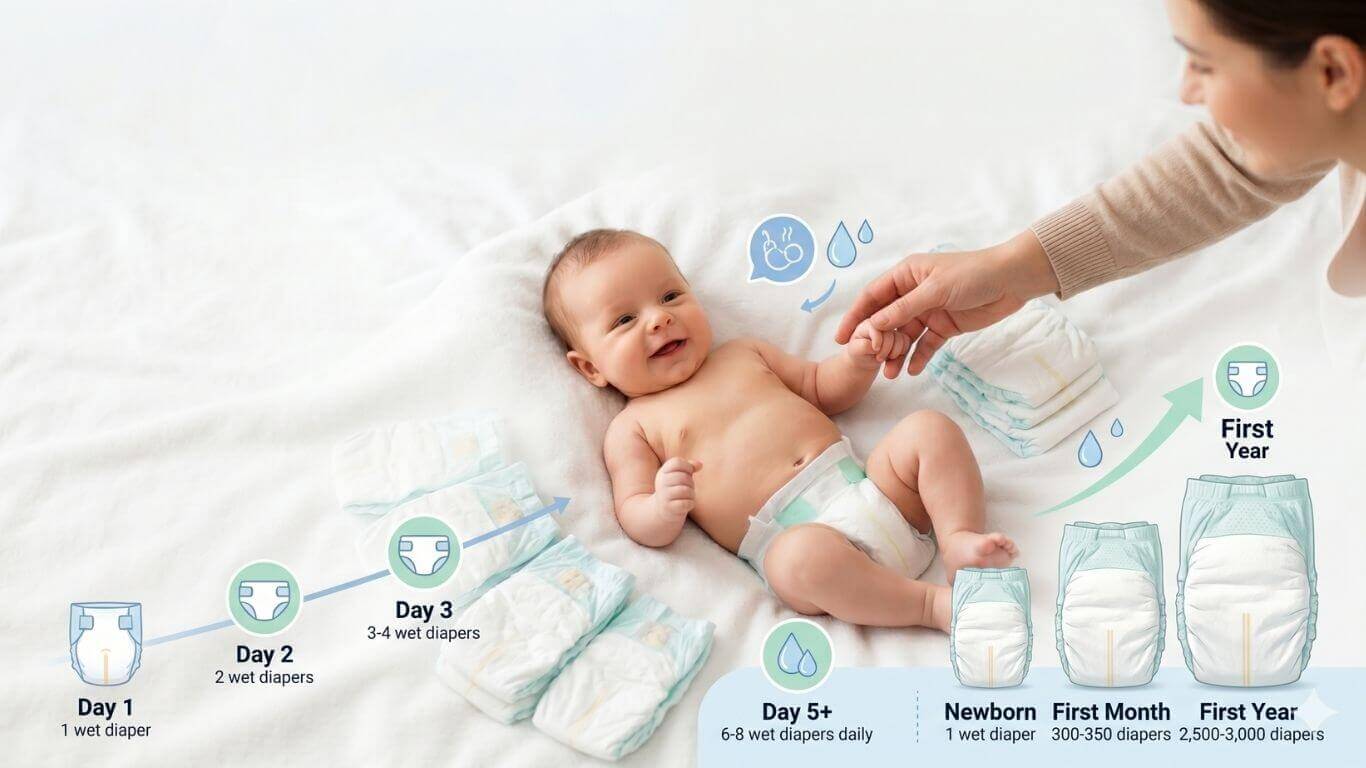
first weeks. - Wet diaper count follows a predictable pattern in the first days: 1 wet diaper
on day 1, rising to 6-8 wet diapers daily by day 5 and beyond (AAP, 2023). - Diaper frequency drops as the baby grows – by 6 months, most babies use 4-6
diapers per day. - Over the full first year, most babies go through 2,500-3,000 diapers across
all sizes (Cleveland Clinic, 2022).
How Many Diapers Does a Newborn Use a Day?
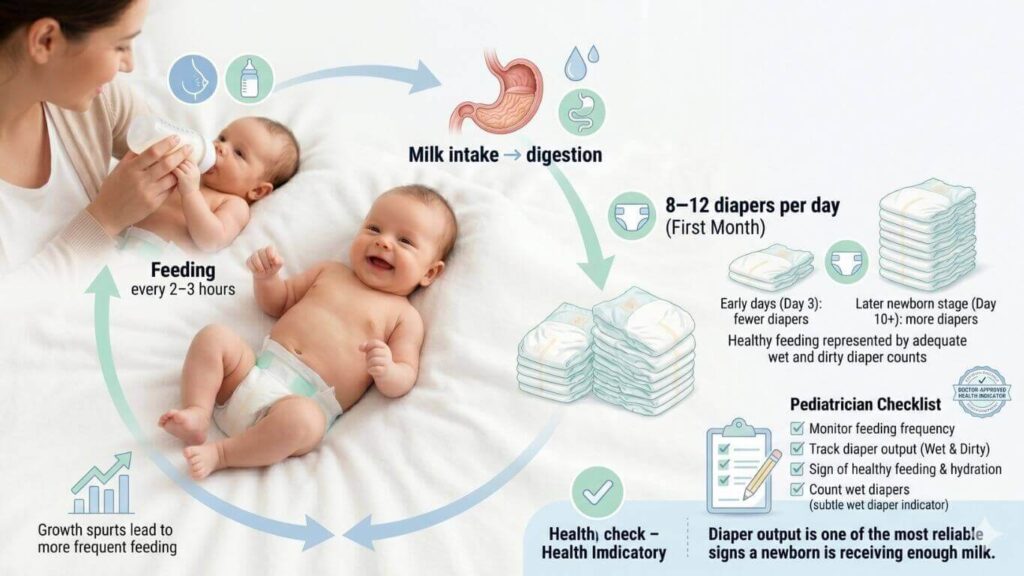
A newborn uses 8-12 diapers per day in the first four weeks of life. This high
frequency is driven by two factors: newborns feed every 2-3 hours around the
clock, and their digestive system processes milk rapidly. Every feed produces
output, and every output requires a change.
The exact number varies day to day and baby to baby. A baby on day 3 uses fewer
diapers than the same baby on day 10. A breastfed baby may dirty more diapers
per day than a formula-fed baby in the early weeks. And a baby going through a
growth spurt feeds more often, which produces more output.
The number matters because it tells you whether feeding is working. A newborn who
is not producing enough wet and dirty diapers is not getting enough milk – and
that is a medical concern that needs prompt attention.
Newborn Diaper Count by Day: The First Week
The first seven days have a specific and predictable diaper output pattern that
pediatricians use as a feeding check. Diaper count rises day by day as milk
volume increases – in breastfed babies, as colostrum transitions to mature milk,
and in formula-fed babies, as feeding volume and frequency establish.
| Day | Expected Wet Diapers | Expected Dirty Diapers |
|---|---|---|
| Day 1 | 1 | 1 (meconium – black, tarry) |
| Day 2 | 2 | 2 (meconium transitioning) |
| Day 3 | 3 | 2-3 (transitioning to yellow) |
| Day 4 | 4 | 2-4 (yellow, seedy for breastfed) |
| Day 5 | 5-6 | 3-4 |
| Day 6-7 | 6-8 | 3-4 |
Source: American Academy of Pediatrics (AAP, 2023)
This day-by-day rise is one of the most useful tools a new parent has. If the
count on day 3 matches day 3’s expected range, feeding is on track. If it falls
short, that is a signal to contact a midwife, lactation consultant, or pediatrician
before a feeding problem becomes a weight problem.
By day 5-6, a well-fed newborn produces 6-8 wet diapers and 3-4 dirty diapers
every 24 hours. This is the benchmark that holds through the first month.
Newborn Diaper Count by Week: Months 1-12
Daily diaper use drops gradually as the baby grows, feeds become more spaced out,
and digestive patterns mature.
| Age | Diapers Per Day | Notes |
|---|---|---|
| Week 1 | 8-12 | Rising through the week as milk comes in |
| Weeks 2-4 | 8-12 | Peak newborn diaper use |
| 1-3 months | 8-10 | Slight reduction as feeds space out |
| 3-6 months | 6-8 | Feeding consolidates; dirty diapers may reduce |
| 6-9 months | 5-6 | Solids begin reducing digestive output frequency |
| 9-12 months | 4-5 | More varied as solid food intake increases |
Sources: Cleveland Clinic (2022); AAP (2023)
The most noticeable drop in dirty diaper frequency happens around 6-8 weeks for
breastfed babies. It is common and normal for a breastfed baby to go from several
dirty diapers per day to one every few days – or even once a week – after this
point. Breast milk is so efficiently absorbed at this stage that there is very
little waste. This is not constipation; it is normal breastfed baby digestion
(AAP, 2023).
Formula-fed babies maintain more regular daily dirty diapers throughout because
formula is less completely absorbed than breast milk.
How Many Diapers to Buy Before the Birth
Most parents overbuy newborn-size diapers. A baby born at or above 8-9 lbs may
skip newborn size entirely and go straight to Size 1. Buying a warehouse supply
of newborn diapers before the birth is one of the most common and most expensive
new parent mistakes.
A practical pre-birth buying plan:
| Size | Weight Range | Buy Before Birth? |
|---|---|---|
| Newborn (NB) | Up to 10 lbs / 4.5 kg | One small pack (40 diapers) only |
| Size 1 | 8-14 lbs / 3.6-6.4 kg | Two to three packs – most babies spend the longest time here |
| Size 2 | 12-18 lbs / 5.4-8.2 kg | Wait until the baby is in Size 1 before buying |
The logic: a small initial pack of newborn diapers covers the first days while you
assess the baby’s size. If the baby fits newborn diapers, buy more then. If the baby
is large at birth, you have not committed to a full supply of a size that will never
be used.
Monthly diaper cost estimate:
At 8-12 diapers per day in the first month, a newborn goes through approximately
300-350 diapers in four weeks. At an average cost of $0.20-$0.35 per diaper for
mid-range brands, the first month of diapers costs roughly $60-$120 depending on
brand and retailer (based on 2026 US retail pricing).
What Normal Newborn Diapers Look Like
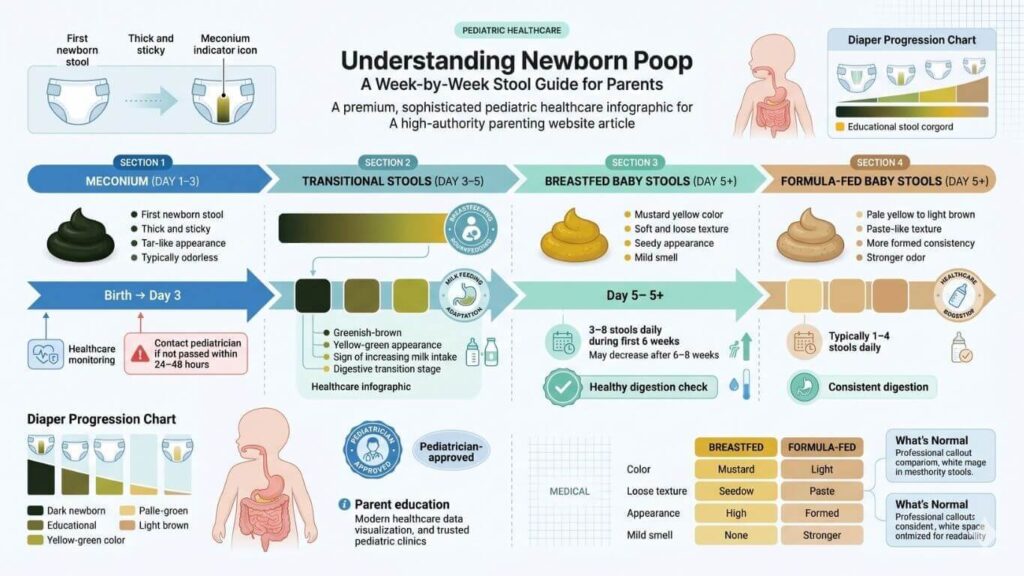
Knowing what to expect inside a diaper is as important as counting them. Diaper
content changes significantly across the first days and weeks, and understanding
what is normal prevents unnecessary alarm.
Meconium (Day 1-3)
The first diapers contain meconium – a thick, dark green or black substance made
up of amniotic fluid, mucus, and other materials ingested in the womb. It is sticky,
tar-like, and does not smell. Meconium should be fully passed by day 3-4. If a
baby has not passed meconium within 24-48 hours of birth, contact a pediatrician.
Transitional Stools (Day 3-5)
As milk intake increases and meconium clears, stools transition to a greenish-brown
or yellowish-green color. This is normal and temporary. It indicates that breast
milk or formula is moving through the digestive system and replacing meconium.
Breastfed Baby Stools (Day 5 Onward)
Breastfed baby stools are typically:
- Yellow to mustard in color
- Soft, loose, and often described as seedy or cottage cheese-like in texture
- Mild or slightly sweet in smell
- Frequent in the first 6 weeks (3-8 per day), then potentially dropping to once
every few days or less from 6-8 weeks onward
Formula-Fed Baby Stools (Day 5 Onward)
Formula-fed baby stools are typically:
- Pale yellow to tan or light brown in color
- Firmer and more paste-like than breastfed stools
- Stronger in smell than breastfed stools
- More regular: 1-4 per day is typical, maintained more consistently than in
breastfed babies
Wet Diapers: What to Check
A wet diaper in the first days can be hard to detect because urine volume is small.
Pour two to three tablespoons of water into a dry diaper – that is what a sufficient
wet diaper from a newborn feels like. If a diaper feels that heavy or more, it counts.
From day 5 onward, urine should be:
- Pale yellow and clear – the sign of adequate hydration
- Not dark yellow or orange – which indicates the baby needs more fluid
- Not pink or red-tinged, which can indicate urate crystals in the first 1-2 days
(normal) or blood, which requires same-day medical review
Diaper Output as a Feeding Check
Wet and dirty diaper count is the primary tool parents and pediatricians use to
assess whether a newborn is getting enough milk in the first weeks before the
first weight check at 5-7 days old.
This matters most for breastfed babies, where feed volume is not directly visible.
A breastfeeding mother cannot see how much milk the baby has taken. Diaper count
provides indirect but reliable evidence of adequate intake.
The minimum acceptable counts from day 5 onward (AAP, 2023):
- 6 or more wet diapers per 24 hours
- 3 or more dirty diapers per 24 hours in the first 4-6 weeks
Falling below these counts on two or more consecutive days is a reason to contact
a midwife or pediatrician promptly. It does not automatically mean something is
seriously wrong, but it does mean feeding needs to be assessed before the next
scheduled appointment.
Signs feeding is going well beyond diaper count:
- The baby regains birth weight by day 10-14 (AAP, 2023)
- The baby seems satisfied after feeds – not crying immediately for more
- Breast tissue feels softer after feeding (for breastfeeding mothers)
- The baby is alert and active during wake windows
How Diaper Output Differs: Breastfed vs Formula-Fed Babies
Breastfed and formula-fed babies have measurably different diaper patterns, and
understanding the difference prevents unnecessary concern.
| Breastfed | Formula-Fed | |
|---|---|---|
| Dirty diapers (weeks 1-6) | 3-8 per day | 1-4 per day |
| Dirty diapers (6 weeks+) | Can drop to 1 per week or less | Stays at 1-3 per day |
| Stool color | Yellow, seedy, mustard | Pale yellow to tan |
| Stool consistency | Loose, watery | Firmer, paste-like |
| Smell | Mild | Stronger |
| Wet diapers | 6-8 per day from day 5 | 6-8 per day from day 5 |
The wet diaper count is consistent between feeding types. The dirty diaper count
is where the significant difference lies – particularly after 6-8 weeks when
breastfed babies often reduce dirty diaper frequency dramatically while remaining
completely healthy and well-fed.
How to Track Diaper Output in the First Weeks
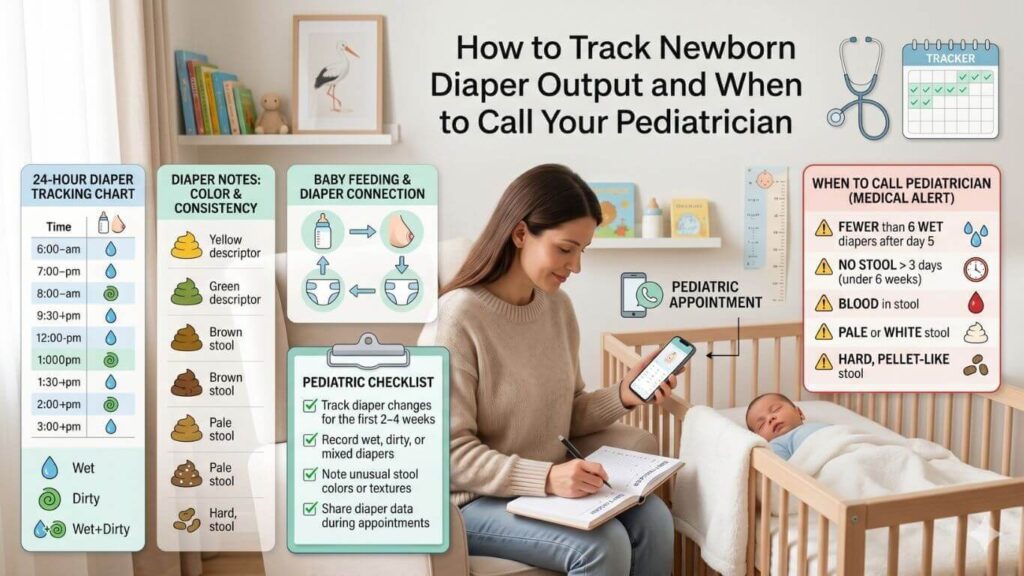
Tracking diaper output in the early weeks is worth the effort. It gives you
objective data to report at pediatric appointments, helps identify feeding issues
early, and removes the anxiety of trying to remember how many diapers were changed
over the last 24 hours at 3 AM.
Simple tracking method:
Keep a small notebook or use a free baby tracking app. Log:
- Time of change
- Wet, dirty, or both
- Any unusual color or consistency
Most parents only need to track this closely for the first 2-4 weeks. Once the
baby is back to birth weight and feeding is clearly established, tracking becomes
optional unless a concern arises.
What to report to your pediatrician:
- Fewer than 6 wet diapers in 24 hours from day 5 onward
- No dirty diaper for more than 3 days in a baby under 6 weeks
- Blood in the stool (red or black streaks after meconium has passed)
- White, chalky, or very pale stools – this can indicate a liver issue and requires
same-day medical review - Stools that are consistently hard and pellet-like – a sign of constipation
Signs a Diaper Change Is Needed
Newborns need changing more often than many parents expect. Leaving a wet or dirty
diaper too long causes diaper rash, which in newborns with sensitive skin can develop
within 1-2 hours of a soiled diaper being left unchanged.
Change the diaper:
- Immediately after every dirty diaper – do not leave stool against newborn skin
- When the wetness indicator strip changes color (present on most newborn diapers)
- Before or after every feed – building changes into the feed routine keeps the
count consistent and prevents the baby from sitting in a wet diaper for extended
periods - If the baby seems uncomfortable and a feed was recent – a wet or dirty diaper
is often the cause of crying that follows a good feed
Diaper rash prevention:
- Change diapers promptly at every soiling
- Apply a thin layer of barrier cream (zinc oxide-based) at every change in the
first weeks - Allow brief air-dry time when possible before closing the new diaper
- Check that the diaper size is correct – a too-tight diaper traps moisture and
increases friction, both of which increase rash risk
Common Mistakes Parents Make About Newborn Diaper Use
- Buying too many newborn-size diapers before the birth. A baby born over
8-9 lbs may never fit into newborn size. Buy one small pack and assess on
the day. - Not tracking diaper output in the first week. Diaper count is the most
accessible feeding check available to parents before the first weight check.
Not tracking it means missing early signs of inadequate intake. - Assuming a breastfed baby is constipated at 6-8 weeks. The dramatic drop
in dirty diaper frequency at 6-8 weeks in breastfed babies is normal and does
not indicate constipation. A breastfed baby who is producing 6+ wet diapers
per day and gaining weight is fine, even without a daily dirty diaper. - Using dark yellow diaper output as a normal baseline. Dark yellow or orange-
tinged urine from day 5 onward indicates the baby needs more fluid. Pale yellow
urine is the target. - Waiting until the next scheduled appointment to report low diaper counts.
If diaper output drops below the minimum thresholds for two consecutive days,
contact a midwife or pediatrician the same day – do not wait for a scheduled visit.
Frequently Asked Questions About Newborn Diaper Use
How many diapers does a newborn use per day?
A newborn uses 8-12 diapers per day in the first four weeks. This translates to
roughly 300-350 diapers in the first month (Cleveland Clinic, 2022). The count is
high because newborns feed every 2-3 hours and their digestive systems process
milk rapidly, producing frequent output.
How many wet diapers should a newborn have per day?
From day 5 onward, a newborn should produce at least 6 wet diapers per 24 hours
(AAP, 2023). In the first four days, the count rises predictably: 1 wet diaper
on day 1, 2 on day 2, 3 on day 3, 4 on day 4, then 6 or more from day 5. Falling
below 6 wet diapers from day 5 onward is a reason to contact your pediatrician.
How many dirty diapers should a newborn have per day?
In the first 6 weeks, a breastfed newborn typically produces 3-8 dirty diapers
per day. A formula-fed baby typically produces 1-4. From 6-8 weeks, breastfed
babies often reduce to 1 per day or less – sometimes as infrequently as once a
week – and this is normal provided wet diaper count and weight gain are on track.
How many diapers does a newborn use in a month?
A newborn uses approximately 300-350 diapers in the first month at a rate of
8-12 per day (Cleveland Clinic, 2022). Over the full first year, total diaper
use across all sizes is approximately 2,500-3,000 diapers.
How do I know if my newborn is using enough diapers?
Use the AAP benchmark: from day 5 onward, 6 or more wet diapers and 3 or more
dirty diapers per 24 hours (AAP, 2023). Track these counts for the first 2-4
weeks. If the baby is consistently meeting these numbers and regaining birth weight
by day 10-14, feeding is working.
Why did my breastfed baby suddenly stop having dirty diapers?
A sharp reduction in dirty diaper frequency around 6-8 weeks is normal for
breastfed babies and does not indicate constipation or a feeding problem. Breast
milk becomes so efficiently absorbed at this stage that very little waste remains.
As long as the baby is producing 6 or more wet diapers per day, feeding well, and
gaining weight, infrequent dirty diapers at this age are not a concern (AAP, 2023).
How many diapers per day by age?
Diaper use drops as the baby grows: 8-12 per day in the first month, 8-10 per
day at 1-3 months, 6-8 per day at 3-6 months, 5-6 per day at 6-9 months, and
4-5 per day at 9-12 months. The reduction reflects longer gaps between feeds,
more efficient digestion, and the introduction of solid foods from 6 months.
Key Takeaways
- A newborn uses 8-12 diapers per day in the first month – plan for 300-350
diapers in the first four weeks. - Wet diaper count rises day by day in the first week: 1 on day 1, reaching
6-8 per day by day 5 – this is the most reliable feeding check available
before the first weight check. - Buy only one small pack of newborn diapers before the birth – stock Size 1
instead, as most babies spend more time there. - A breastfed baby reducing to one dirty diaper per day or less at 6-8 weeks
is normal, not a feeding problem. - Report fewer than 6 wet diapers in 24 hours from day 5 onward to your
pediatrician the same day – do not wait for a scheduled appointment.