

[Published: July 2026 | Last updated: July 2026] | 8 min read
TL;DR
- A lip tie is a thick, tight, or short frenulum – the band of tissue connecting the upper lip to the gum – that restricts how far the upper lip can flange outward during feeding.
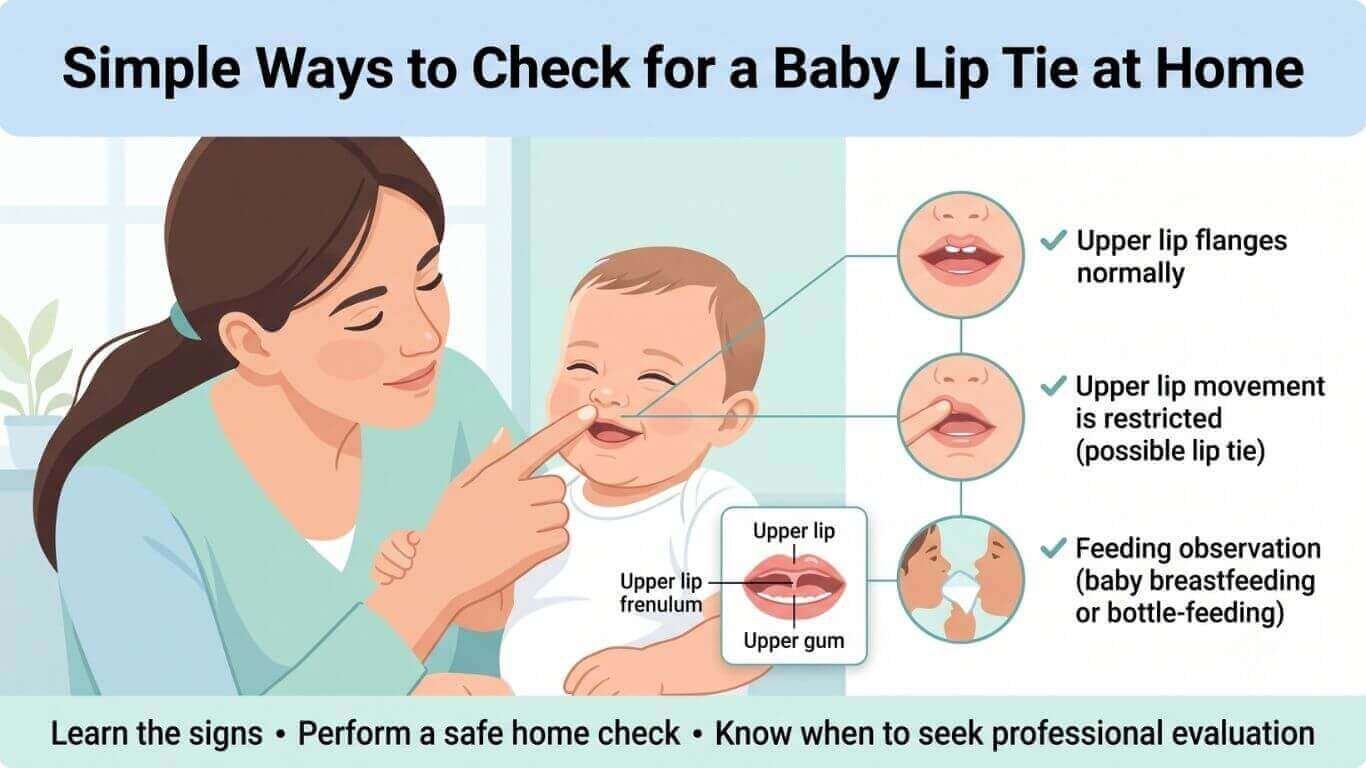
- The simplest home check is the lip lift test: gently lift the baby’s upper lip toward their nose. A lip tie is present if the frenulum is tight, thick, or short enough to restrict the lip from flanging to approximately 90 degrees or beyond.
- A lip tie alone does not require treatment – it only needs addressing if it is causing feeding difficulties, poor weight gain, nipple pain in breastfeeding mothers, or significant dental spacing issues as the child grows.
- A home check can identify the presence of a lip tie but cannot grade its severity or determine whether treatment is needed – that assessment requires a qualified provider such as a lactation consultant, pediatric dentist, or ENT specialist.
- The most common signs a lip tie is affecting feeding are clicking sounds during feeding, excessive air swallowing, milk leaking from the corners of the mouth, poor weight gain, and a baby who feeds for very long periods without appearing satisfied.
Quick Answers About Baby Lip Tie
| Question | Quick Answer |
|---|---|
| Can I check for a lip tie at home? | Yes. You can perform simple home checks, such as the lip lift test, to look for possible signs. |
| Can I diagnose a lip tie myself? | No. A home check cannot confirm a diagnosis or determine whether treatment is needed. |
| What’s the best home check? | The Lip Lift Test. Gently lift your baby’s upper lip to see whether it flanges freely or appears restricted. |
| Does every lip tie need treatment? | No. Many lip ties don’t cause feeding or developmental problems and don’t require treatment. |
| Who should evaluate a suspected lip tie? | An IBCLC, pediatric dentist, ENT specialist, or pediatrician can determine whether a lip tie is affecting your baby’s feeding or oral function. |
💡 Quick Tip: A visible upper lip frenulum is a normal part of your baby’s anatomy. What matters most is how well your baby feeds, gains weight, and moves the upper lip—not simply how the frenulum looks.
Quick Signs of a Baby Lip Tie
Not sure whether your baby may have a lip tie? These are some of the most common signs that may indicate the upper lip isn’t moving freely during feeding.
Quick Signs of a Baby Lip Tie
✅ Upper lip doesn’t flange (curl outward) during feeding
✅ Clicking or smacking sounds while breastfeeding or bottle-feeding
✅ Milk leaking from the corners of the mouth
✅ Difficulty maintaining a deep latch
✅ Persistent nipple pain during breastfeeding
✅ Poor weight gain or long feeding sessions without satisfaction
Important: These signs can also be caused by other feeding problems, such as tongue tie, an incorrect latch, reflux, or an inappropriate bottle nipple flow. A home check can help you recognize possible signs, but only a qualified healthcare professional can diagnose a lip tie.
What Is a Baby Lip Tie?
A lip tie is a condition in which the frenulum labii superioris – the small band of tissue connecting the center of the upper lip to the gum ridge above the upper front teeth – is too thick, too tight, or too short to allow the upper lip to flange outward freely during feeding.
Every baby has a frenulum. The question is not whether one exists but whether its attachment, thickness, or tightness restricts the lip’s movement enough to affect feeding, comfort, or development.
In a feeding baby, the upper lip needs to flange outward
- like a fish mouth – to create a wide, effective seal around the breast or bottle nipple. A lip that cannot flange adequately creates a shallow latch, making it more difficult for your baby to maintain a secure seal during feeding. If you’re unsure whether your baby’s positioning is contributing to the problem, read our guide on breastfeeding latch to learn how a proper latch should look before assuming a lip tie is the cause.
How Common Is Lip Tie in Babies?
Lip tie prevalence estimates vary widely because there is no universally agreed clinical definition of what constitutes a lip tie versus a normal frenulum variant. Studies estimate that clinically significant lip ties affect between 4% and 11% of newborns (Srinivasan et al., International Journal of Oral and Maxillofacial Surgery, 2019).
Lip ties are more common in:
- Babies who also have a tongue tie (ankyloglossia) – the two conditions frequently occur together
- Male babies, who have a slightly higher prevalence than female babies (Ferrés-Amat et al., Brazilian Oral Research, 2016)
- Babies with a family history of lip or tongue tie
The Simple Home Checks for Baby Lip Lip Tie vs. Tongue TieTie
These checks can be performed at home to assess whether a lip tie may be present. They do not replace professional assessment but provide useful information to bring to a medical or lactation appointment.
Can You Diagnose a Lip Tie at Home?
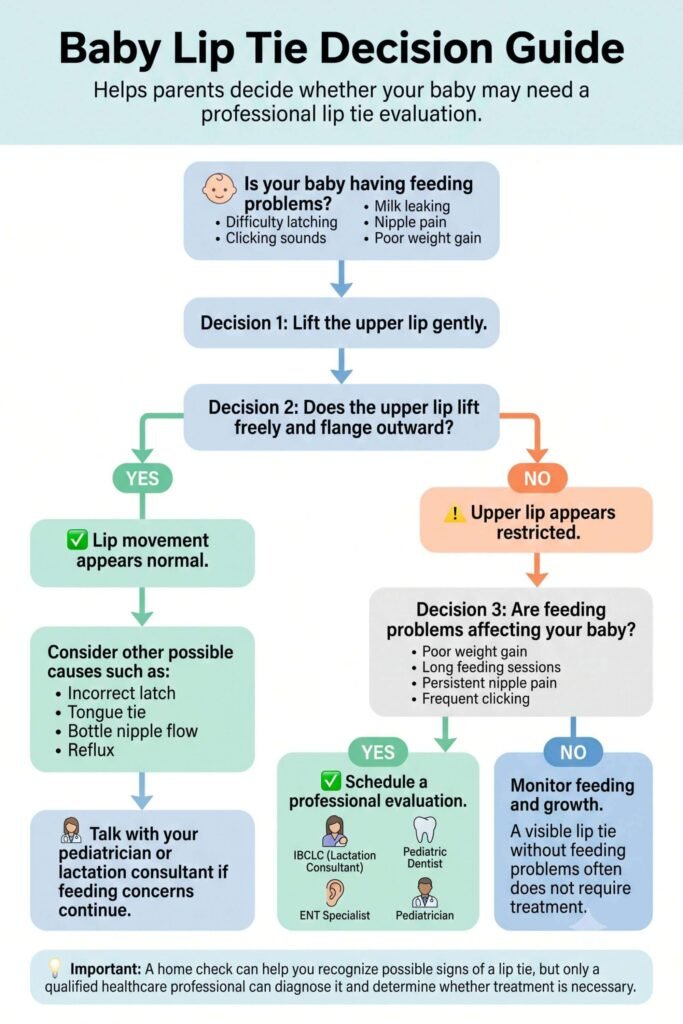
A home check can help you suspect that your baby may have a lip tie, but it cannot confirm the diagnosis or determine whether treatment is necessary. Many babies have a visible upper lip frenulum that is completely normal and does not interfere with feeding or development. Because of this, the appearance of the frenulum alone is not enough to diagnose a clinically significant lip tie.
The purpose of a home assessment is to look for possible signs—such as restricted lip movement, difficulty flanging the upper lip, or feeding problems—that may warrant a professional evaluation. Whether a lip tie requires treatment depends not only on how the frenulum looks but also on whether it causes functional problems, such as poor milk transfer, persistent nipple pain during breastfeeding, or inadequate weight gain.
If you suspect your baby has a lip tie, the next step is to seek an assessment from a qualified healthcare professional. Depending on your baby’s symptoms, this may include:
- An International Board Certified Lactation Consultant (IBCLC): Often the first professional to evaluate breastfeeding difficulties and determine whether a lip tie is affecting your baby’s latch or milk transfer.
- A Pediatric Dentist: Can assess the anatomy of the frenulum, determine the severity of the restriction, and discuss treatment options if needed.
- An Ear, Nose, and Throat (ENT) Specialist: Evaluates lip and tongue ties and performs treatment when appropriate.
- A Pediatrician: Provides an initial examination, monitors your baby’s growth and feeding, and refers you to the appropriate specialist if further assessment is needed.
💡 Editor’s Tip: Think of a home lip tie check as a screening tool rather than a diagnosis. If your baby is feeding well, gaining weight appropriately, and shows no signs of discomfort, a visible frenulum alone usually isn’t a cause for concern. However, if feeding problems or poor weight gain are present, arrange a professional evaluation rather than relying solely on what you see at home.
Before You Check Your Baby for a Lip Tie
Taking a few moments to prepare can make the lip lift test easier, more comfortable for your baby, and more accurate. Before examining your baby’s upper lip, keep these simple tips in mind:
- 🧼 Wash your hands thoroughly with soap and water before touching your baby’s mouth.
- 😊 Choose a time when your baby is calm and alert. Avoid performing the check while your baby is crying, upset, or very sleepy.
- 💡 Use good lighting. Natural daylight or a bright overhead light makes it much easier to see the frenulum and how the upper lip moves.
- ⏳ Wait 15–30 minutes after a feeding, if possible. Babies are often more cooperative once they’ve had a short rest after eating.
- 👆 Lift the upper lip gently. Never pull or force the lip upward, as this can cause discomfort and make the tissue appear tighter than it really is.
- 🧍 Support your baby’s head and neck in a comfortable position so you can examine the upper lip without causing unnecessary movement.
💡 Parent Tip: The goal of a home check is simply to observe your baby’s upper lip movement and feeding function—not to make a diagnosis. If you’re unsure about what you see or your baby has ongoing feeding difficulties, arrange an evaluation with an International Board Certified Lactation Consultant (IBCLC), pediatrician, pediatric dentist, or ENT specialist.
Check 1: The Lip Lift Test
The lip lift test is the most direct and most reliable home check for lip tie.
How to perform:
- Sit in a well-lit area – natural daylight or a bright overhead light that illuminates the mouth clearly.
- Place the baby in your lap facing upward in a comfortable reclined position, or hold them against your chest facing outward.
- Use a clean index finger to gently lift the center of the upper lip upward toward the nose. Apply very gentle pressure – this should not cause discomfort.
- Observe how far the lip moves and whether the frenulum restricts the movement.
What to look for:
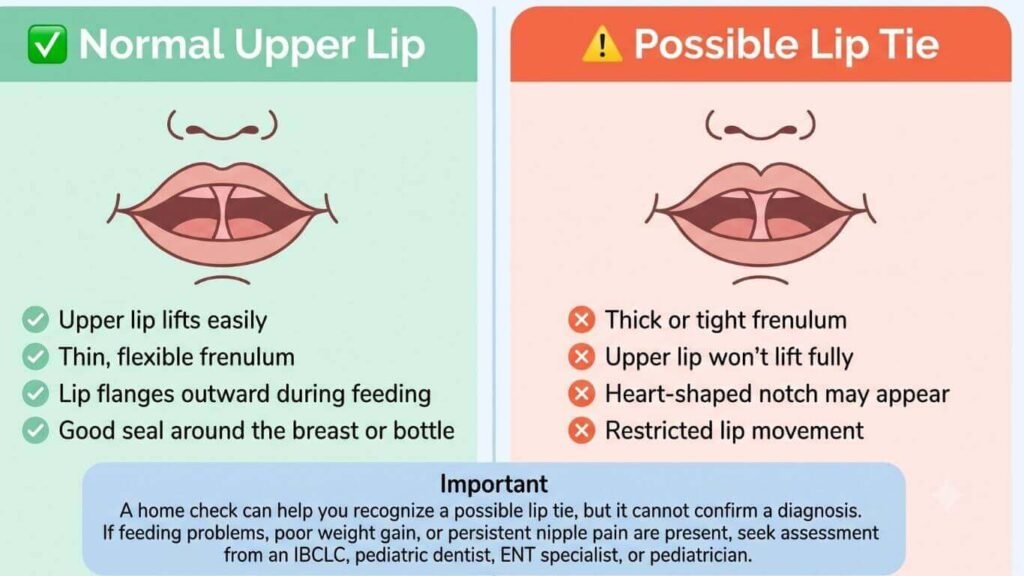
- Normal frenulum: The upper lip lifts freely to approximately 90 degrees or beyond – almost parallel to the nose. The frenulum is thin, stretchy, and does not appear to tether the lip to the gum.
- Possible lip tie: The upper lip does not lift freely. The frenulum appears thick, cord-like, or short, pulling the center of the lip downward even when the lip is being gently lifted. A notch or heart shape may be visible at the center of the upper lip where the frenulum attaches.
- Significant restriction: The lip barely moves when lifted, or the gum blanches (turns white) at the frenulum attachment point when the lip is gently lifted – this blanching indicates the frenulum is tight and under tension.
What this test does and does not tell you:
The lip lift test tells you whether a tight or short frenulum is present. It does not tell you whether that frenulum is causing the baby’s feeding difficulties, or whether it is severe enough to require treatment. A tight frenulum that does not affect feeding may
not need any intervention at all.
Common Mistakes During the Lip Lift Test
Even a simple home lip lift test can produce misleading results if it isn’t performed correctly. Avoid these common mistakes to get the clearest view of your baby’s upper lip and frenulum.
Checking While Your Baby Is Crying
A crying baby naturally tightens the lips and facial muscles, making the frenulum appear tighter than it really is. Whenever possible, perform the lip lift test when your baby is calm, alert, or content after a short rest.
Using Poor Lighting
Dim lighting can make it difficult to see the frenulum’s attachment point, thickness, or whether the gums blanch when the lip is lifted. Natural daylight or a bright overhead light provides the best visibility.
Pulling the Lip Too Hard
The upper lip should be lifted gently toward the nose using a clean finger. Pulling forcefully can cause discomfort, make your baby cry, and temporarily tighten the tissue, leading to an inaccurate impression of restriction.
Checking Immediately After Feeding
Right after feeding, babies are often sleepy, fussy, or unwilling to have their mouths examined. Waiting 15–30 minutes after a feeding usually makes the examination easier and more comfortable for both you and your baby.
Confusing a Normal Frenulum with a Lip Tie
Every baby has an upper lip frenulum. Seeing a visible frenulum alone does not mean your baby has a lip tie. A lip tie becomes clinically important only when the tissue significantly restricts lip movement and contributes to feeding or other functional problems.
💡 Editor’s Tip: If you’re unsure whether what you’re seeing is normal, take clear photos or a short video of your baby’s upper lip during feeding and bring them to your pediatrician, IBCLC, pediatric dentist, or ENT specialist. These can help healthcare professionals assess your baby’s feeding and lip movement more accurately.
Check 2: The Feeding Observation Check
Observing the baby’s feeding behavior provides indirect evidence of whether a lip tie may be affecting the feeding process.
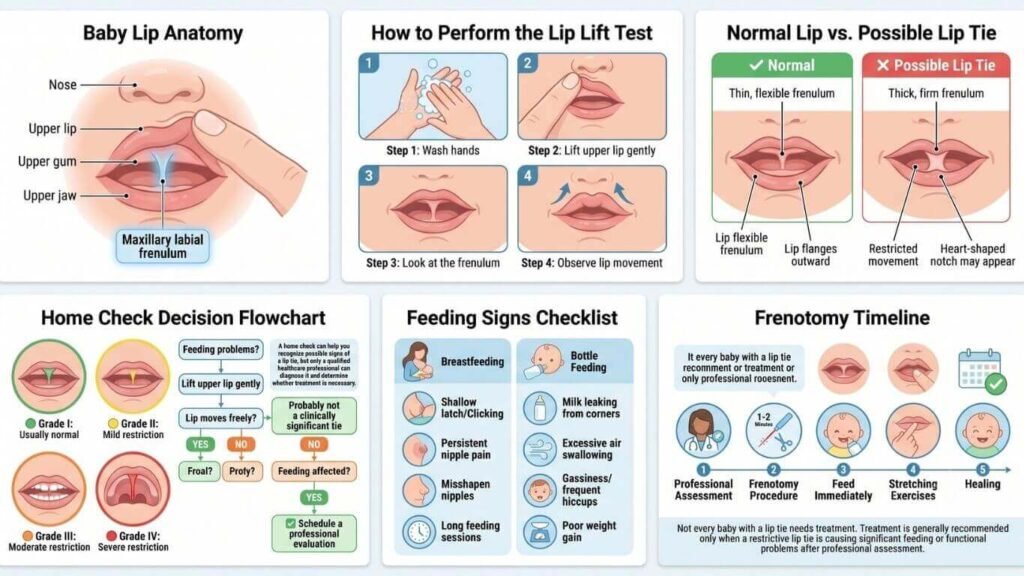
Signs during breastfeeding that suggest possible lip tie involvement:
- The upper lip curls inward toward the gum rather than flanging outward during the latch
- A clicking or smacking sound during feeding – caused by the baby repeatedly breaking and re-establishing suction as the shallow latch fails
- Milk leaking from the corners of the mouth during bottle feeding may also be caused by an inappropriate bottle nipple or flow rate. If you’re choosing a bottle for a newborn, see our guide to the best bottles for newborns to compare different options.
- The breastfeeding mother experiences nipple pain, creasing, or a flattened nipple appearance after the baby comes off the breast
- The baby feeds for extended periods (40+ minutes) without appearing satisfied or gaining weight well
- The baby gulps audibly and appears gassy or uncomfortable during and after feeds
Signs during bottle feeding that suggest possible lip tie involvement:
- Milk leaking from the corners of the mouth during bottle feeding despite the correct nipple size
- A clicking sound during bottle feeding
- The baby appearing to work very hard to maintain suction on the bottle nipple
- Excessive air swallowing can lead to uncomfortable gas and fussiness after feeds. If your baby seems especially uncomfortable after eating, our article on why newborn is gassy explains the most common causes and ways to help.
Important note: These feeding signs are not exclusive to lip tie. Tongue tie, poor latch technique, incorrect nipple flow rate, reflux, and other feeding issues can produce identical symptoms. Feeding observation provides supporting evidence, not a diagnosis.
Can Bottle-Fed Babies Have a Lip Tie?
Yes. A lip tie can affect both breastfed and bottle-fed babies. While lip ties are often discussed in relation to breastfeeding, babies who are bottle-fed may also have difficulty creating a secure seal around the bottle nipple.
During bottle feeding, the upper lip should flare outward to help form a tight seal. If the lip is restricted by a tight or short frenulum, your baby may have to work harder to maintain suction. This can make feeding less efficient and cause your baby to swallow extra air.
Signs a Lip Tie May Affect Bottle Feeding
If your baby is bottle-fed, watch for these common signs:
- 🍼 Clicking or smacking sounds while feeding
- 🍼 Milk leaking from the corners of the mouth
- 🍼 Frequent air swallowing, leading to gas or excessive burping
- 🍼 Long feeding sessions despite using the correct bottle nipple
- 🍼 Difficulty maintaining suction on the bottle
- 🍼 Frustration or frequent breaks during feeds
These signs do not automatically mean your baby has a lip tie. Similar feeding problems can also be caused by an incorrect bottle nipple flow, poor positioning, reflux, tongue tie, or other feeding difficulties.
If your baby continues to have feeding problems despite trying different feeding techniques or bottle nipples, consider discussing your concerns with your pediatrician, an International Board Certified Lactation Consultant (IBCLC), a pediatric dentist, or an ENT specialist.
💡 Editor’s Tip: Before assuming your baby has a lip tie, check that the bottle nipple has the correct flow rate for your baby’s age and that your baby is positioned comfortably during feeds. Small adjustments to feeding technique often solve bottle-feeding problems without any medical treatment.
Check 3: The Visual Inspection
A visual inspection of the upper lip and gum area can identify the physical characteristics associated with lip tie without requiring the baby to be lifted or handled significantly.
How to perform:
- In good lighting, gently smile the baby’s upper lip upward using both thumbs placed at the corners of the mouth – this stretches the lip and makes the frenulum visible.
- Look at the central attachment point of the uppern lip to the gum.
What to look for:
- Location of attachment: A normal frenulum attaches high on the gum – well above the gum line between the teeth. A frenulum that attaches at or below the gum line, between where the upper front teeth will emerge, or that extends to the roof of the mouth (the palate) suggests a higher grade lip tie.
- Thickness and appearance: A normal frenulum is thin and semi-translucent, like a thin piece of tissue paper. A lip tie frenulum is often thicker, more opaque, or cord-like in appearance.
- Heart-shaped notch: A small notch or heart shape visible at the center of the upper lip when it is stretched upward is a common sign of a lip tie. The notch forms where the tight frenulum prevents the lip tissue from filling out evenly.
- Gum blanching: If the gum tissue immediately above the frenulum attachment turns white when the lip is gently stretched, the frenulum is under significant tension – a characteristic of a restrictive lip tie.
Check 4: The Flanging Check During Feeding
This check is performed during an active feeding session rather than between feeds.
How to perform during breastfeeding:
During a feed, gently use a clean finger to nudge the upper lip outward into a flange position. Observe whether the lip stays flanged or immediately returns to the curled-in position.
- Normal: The lip can be guided into a flange and remains there with minimal tendency to curl back.
- Possible lip tie: The lip immediately returns to the curled-inward position as soon as the guiding finger is removed, regardless of repositioning efforts.
How to perform during bottle feeding:
Observe the upper lip position during bottle feeding. The upper lip should flange outward over the bottle nipple in a relaxed, open position. A lip that is tight against the bottle, that shows a visible gap at the top of the nipple seal, or that produces audible clicking sounds is not achieving an adequate seal – which may be related to a lip tie.
The Kotlow Classification System: Understanding
Lip Tie Grades
The Kotlow classification (Kotlow, Journal of Clinical Pediatric Dentistry, 1999) is the most widely used system for grading lip tie severity. Understanding it helps parents interpret what a provider means when they describe a lip tie grade.
| Grade | Description | Clinical Significance |
|---|---|---|
| Class I (Normal) | Frenulum attaches well above the gum line; lip flanges freely | No intervention typically needed |
| Class II (Mild) | Frenulum attaches closer to the gum line; minor restriction | Usually no intervention unless feeding is affected |
| Class III (Moderate) | Frenulum attaches at the gum line; noticeable restriction of lip movement | Assessment recommended if feeding is affected |
| Class IV (Severe) | Frenulum attaches below the gum line or extends to the palate; significant restriction | Assessment and possible treatment recommended |
Source: Kotlow, 1999; adapted from clinical literature
Quick Severity Guide for Parents
The Kotlow classification helps healthcare professionals describe how restrictive a baby’s upper lip frenulum appears. However, the grade alone does not determine whether treatment is needed. A baby with a mild lip tie may have significant feeding problems, while another with a more restrictive appearance may feed normally.
| Kotlow Grade | Does It Usually Need Treatment? |
|---|---|
| Class I (Normal) | Rarely. Treatment is usually not needed. |
| Class II (Mild) | Sometimes. Treatment may be considered if feeding problems are present. |
| Class III (Moderate) | Often, if the lip tie affects breastfeeding, bottle-feeding, or weight gain. |
| Class IV (Severe) | Frequently. A professional assessment is recommended because significant feeding difficulties are more likely. |
💡 Editor’s Tip: The appearance of a lip tie is only one part of the assessment. Healthcare providers also evaluate how well your baby feeds, gains weight, and transfers milk before recommending any treatment.
A home check can suggest the presence of a Class III or IV lip tie through the signs described above. Grading requires professional assessment because it involves specific anatomical measurements and clinical judgment.
Signs a Lip Tie Is Affecting Your Baby
A lip tie that is not affecting feeding, weight gain, or development does not require treatment. The signs that a lip tie is clinically significant are:
Feeding-Related Signs
- Poor weight gain: Poor weight gain may occur when a baby cannot transfer milk efficiently because of a restricted latch. If you’re concerned about your baby’s growth, our guide to baby’s weight gain explains what healthy weight gain looks like during the first year of life.
- Extended feeding sessions: Breastfed babies who feed for more than 40 minutes per session consistently, or who finish a feed and immediately signal hunger again, may be working harder to transfer milk due to lip restriction.
- Nipple pain and damage: Creased, lipstick-shaped, flattened, or blanched nipples after a feed – or nipple pain throughout the feed despite correct positioning – are signs of a compromised latch that lip tie may be contributing to.
- Excessive gas and colic-like symptoms: A baby who swallows significant air due to poor seal during feeding will show more frequent and more severe gas pain, which can contribute to the crying pattern described as colic.
Signs in Older Children
If lip tie is not identified in infancy, the following signs may emerge as the child grows:
- A visible gap between the upper front teeth (diastema) caused by the frenulum inserting between the teeth
- Difficulty achieving a full lip seal when drinking from a cup
- Speech difficulties related to lip mobility, particularly with labial sounds (m, b, p)
- Difficulty breastfeeding being resolved but dental spacing becoming apparent when teeth emerge
Does a Lip Tie Affect Speech?
Many parents wonder whether a lip tie can cause speech problems later in childhood. In most cases, a lip tie by itself does not cause a speech delay. Current research suggests that the connection between an isolated upper lip tie and speech difficulties is limited, and many children with a lip tie develop normal speech without treatment.
However, a more restrictive lip tie may affect how the upper lip moves during certain speech sounds in some children. If a lip tie occurs together with a tongue tie, the combined restriction is more likely to interfere with oral movement and speech development than a lip tie alone.
Signs That May Warrant an Evaluation
Consider discussing your child’s speech with a healthcare professional if they have:
- Difficulty pronouncing sounds that require normal lip movement, such as “p,” “b,” “m,” or “w.”
- Ongoing speech that is difficult for others to understand beyond the expected age.
- A restrictive lip tie along with feeding, dental, or tongue mobility concerns.
- Concerns raised by a speech-language pathologist, dentist, or pediatrician.
Most children do not need treatment solely because they have a lip tie. Decisions about treatment should be based on your child’s overall symptoms, oral function, and professional assessment—not on the appearance of the frenulum alone.
💡 Editor’s Tip: If your child has speech concerns, an evaluation by a speech-language pathologist (SLP) is often the best first step. The SLP can determine whether speech difficulties are related to a lip tie or another developmental or anatomical factor.
Conditions That Can Mimic a Lip Tie
Not every baby who has feeding difficulties has a lip tie. Many common newborn feeding problems can cause symptoms that look very similar, even when the upper lip frenulum is completely normal. For this reason, healthcare professionals assess your baby’s feeding function, growth, and overall health rather than relying on the appearance of the frenulum alone.
Some conditions that may mimic the signs of a lip tie include:
Tongue Tie (Ankyloglossia)
A tongue tie restricts the movement of the tongue rather than the upper lip. It can cause poor milk transfer, clicking sounds during feeding, prolonged feeding sessions, nipple pain during breastfeeding, and poor weight gain. Because lip tie and tongue tie frequently occur together, healthcare providers usually evaluate both during the same examination.
Incorrect Latch or Positioning
A shallow latch or poor breastfeeding position can lead to many of the same problems seen with a lip tie, including nipple pain, milk leaking from the baby’s mouth, and frequent loss of suction. In many cases, improving positioning and latch technique with the help of a lactation consultant resolves these issues without any medical procedure.
Low Milk Supply
When milk production is lower than your baby’s needs, babies may feed for long periods, seem unsatisfied after feeding, or gain weight slowly. These signs can sometimes be mistaken for a lip tie, even though the underlying problem is insufficient milk intake rather than restricted lip movement.
Fast Milk Flow or Overactive Letdown
Some breastfeeding mothers have a very fast milk flow. Babies may click, cough, pull away from the breast, gulp rapidly, or swallow excess air while trying to manage the milk flow. Although these symptoms resemble those seen with a lip tie, they are caused by the speed of milk delivery rather than the baby’s upper lip.
Bottle Nipple Flow Rate
For bottle-fed babies, using a nipple with a flow rate that is too fast or too slow can lead to leaking milk, excessive air swallowing, clicking sounds, or prolonged feeding sessions. Choosing the appropriate nipple flow often improves feeding without changing anything about the baby’s mouth.
Gastroesophageal Reflux (GER)
Babies with reflux may arch their backs, pull away during feeding, cry while eating, spit up frequently, or seem uncomfortable after feeds. These behaviors can overlap with feeding difficulties associated with a lip tie, making a professional assessment important to identify the true cause.
💡 Editor’s Tip: A visible upper lip frenulum does not automatically mean your baby has a clinically significant lip tie. If feeding problems persist, focus on how your baby feeds and gains weight, not just how the frenulum looks. A comprehensive evaluation by an IBCLC, pediatrician, pediatric dentist, or ENT specialist can help determine the underlying cause and the most appropriate treatment.
When to Seek Immediate Medical Care
Although a lip tie is not usually a medical emergency, feeding difficulties can sometimes become serious if your baby isn’t getting enough milk or becomes dehydrated. Seek immediate medical care or contact your healthcare provider promptly if your baby has any of the following signs:
- 🚨 Refuses to breastfeed or bottle-feed repeatedly
- 🚨 Has fewer wet diapers than expected for their age
- 🚨 Shows signs of dehydration, such as a dry mouth, crying with few or no tears, or a sunken soft spot (fontanelle)
- 🚨 Loses weight or is not gaining weight as expected
- 🚨 Becomes unusually sleepy, difficult to wake, or lethargic
- 🚨 Has persistent vomiting or difficulty swallowing during feeds
These symptoms may be caused by a lip tie, another feeding problem, or an underlying medical condition. Prompt evaluation by a healthcare professional is important to identify the cause and ensure your baby receives appropriate care.
💡 Editor’s Note: Most babies with a lip tie do not require emergency treatment. However, if feeding difficulties are affecting your baby’s hydration, growth, or overall well-being, don’t wait for a routine appointment—seek medical advice as soon as possible.
Lip Tie vs Tongue Tie: Key Differences
Lip tie and tongue tie are separate conditions that frequently occur together. Understanding the difference helps parents identify which check is relevant.
| Feature | Lip Tie | Tongue Tie |
|---|---|---|
| Location | Frenulum connecting upper lip to gum | Frenulum connecting underside of tongue to floor of mouth |
| Home check | Lift upper lip; observe frenulum | Lift tongue; observe how far it elevates and whether it heart-shapes at the tip |
| Primary feeding effect | Poor lip seal; air swallowing; milk leaking from corners | Reduced tongue mobility; ineffective milk transfer; clicking |
| Nipple effect | Nipple pain from shallow latch | Nipple compression and pain |
| How often they occur together | Approximately 50-85% of tongue tie cases also have a lip tie (O’Callahan et al., 2013) | – |
If a home check for lip tie is positive, check for tongue tie as well – the two conditions should be assessed simultaneously by a professional because their combined effect on feeding is greater than either condition alone.
When to See a Professional
A home check is a starting point, not a conclusion. Seek professional assessment from a lactation consultant, pediatric dentist, or ENT specialist if:
- The lip lift test shows clear restriction or gum blanching
- Feeding is painful for the breastfeeding mother despite correct positioning and latch support
- The baby is not gaining weight at the expected rate
- The baby shows consistent signs of feeding difficulty
- clicking, gulping, milk spillage, extended feeds
- The home check is inconclusive and feeding concerns remain
Who Can Diagnose and Assess a Lip Tie?
- International Board Certified Lactation Consultant (IBCLC): The first referral for breastfeeding-related lip tie concerns. An IBCLC assesses both the anatomical restriction and its functional impact on feeding before recommending a referral for treatment.
- Pediatric dentist with frenuloplasty experience: Can assess and treat lip tie using laser or scissor frenuloplasty. Look for a dentist with specific training in infant frenuloplasty.
- ENT (Ear, Nose, and Throat) specialist: Frequently the referral pathway for lip and tongue tie assessment in many health systems.
- Pediatrician: Can provide an initial assessment and referral but may not have specialist frenuloplasty training.
How Long Does a Lip Tie Assessment Take?
Most lip tie assessments are quick, non-invasive, and completed within 10–30 minutes, although the exact length depends on your baby’s age, feeding concerns, and the healthcare professional performing the evaluation.
During the appointment, the provider will usually:
- Review your baby’s feeding history and any symptoms you’ve noticed.
- Observe a breastfeeding or bottle-feeding session, when possible.
- Examine your baby’s upper lip, frenulum, tongue, and overall oral anatomy.
- Check your baby’s latch, lip movement, and ability to create an effective seal during feeding.
- Discuss whether the frenulum is likely contributing to feeding difficulties or whether another issue may be responsible.
If the provider determines that the lip tie is not causing functional problems, no treatment may be needed. If a restrictive lip tie is affecting feeding or growth, they will explain the available treatment options and answer any questions before recommending the next steps.
💡 Editor’s Tip: Bring a list of your baby’s feeding symptoms—such as clicking sounds, milk leaking from the mouth, prolonged feeds, or poor weight gain—and, if possible, short videos of a typical feeding session. These details can help the healthcare provider better understand your baby’s feeding challenges.
What Happens If a Lip Tie Is Confirmed
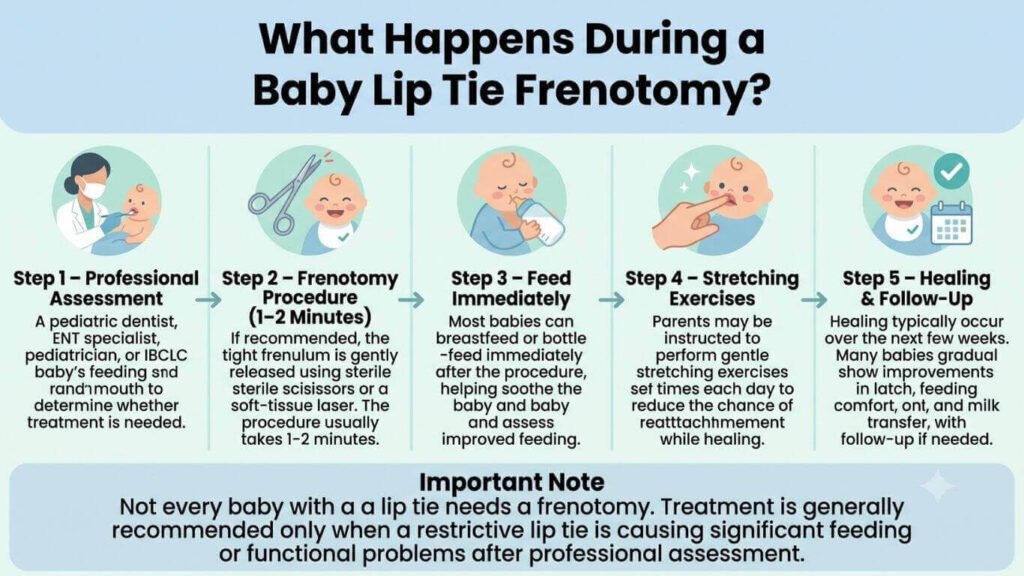
If a professional recommends a frenotomy or frenuloplasty, you may also want to understand how a similar procedure is performed for tongue tie. Our guide to tongue tie release explains what to expect before, during, and after treatment.
- Laser frenuloplasty: A soft tissue laser divides the frenulum with minimal bleeding and no sutures required. The procedure takes 1-2 minutes and the baby can feed immediately afterward.
- Scissor frenotomy: The frenulum is divided with surgical scissors under topical anesthetic. Also very brief in duration with minimal recovery.
After the procedure, stretching exercises are typically recommended to prevent the frenulum from reattaching as it heals. These exercises involve gently lifting the upper lip and stretching the healing site 4-6 times per day for 3-4 weeks.
Most families notice an improvement in feeding within 24-48 hours of the procedure as the baby adapts to the increased lip mobility. Some improvement is more gradual – particularly in breastfeeding situations where the mother’s supply and the baby’s latch technique both need time to adjust.
When Lip Tie Does Not Need Treatment
Not every lip tie requires intervention. Treatment is recommended only when the lip tie is causing a functional problem – most commonly a feeding difficulty, nipple damage, or in older children, a dental spacing or speech issue.
A lip tie that is identified on home check or professional assessment but is not causing any of these problems does not require treatment. The presence of a tight frenulum alone is not an indication for frenuloplasty (NICE Guidelines, 2022).
Over-treatment of lip ties – particularly in babies whose feeding difficulties have other causes – is a recognized concern in the clinical literature. A second opinion from a different provider is entirely appropriate when treatment is recommended and the parent is uncertain.
Common Mistakes Parents Make When Checking for
Lip Tie at Home
- Performing the check in poor lighting. The lip lift test requires clear illumination of the frenulum and gum tissue. A dim room makes it impossible to see the attachment point, thickness, or blanching that indicate restriction.
- Applying too much pressure during the lip lift. The check requires very gentle upward pressure. Forcing the lip upward aggressively causes discomfort and may produce a crying response that closes the mouth before the frenulum can be clearly observed.
- Concluding a lip tie is present from the home check alone. A home check identifies the possibility of lip tie. Confirmation, grading, and treatment decisions require professional assessment.
- Assuming a lip tie is causing all feeding difficulties. Feeding problems in newborns have multiple causes. Tongue tie, poor latch technique, low milk supply, overactive letdown, reflux, and incorrect bottle nipple flow rate all produce symptoms that overlap with lip tie. Professional assessment distinguishes between these causes.
- Delaying professional help while repeatedly performing home checks. If feeding is painful, weight gain is poor, or the baby shows consistent feeding difficulty, seek professional assessment promptly. Repeated home checking does not resolve
the underlying problem and delays effective support.
FAQs
How do I check my baby for a lip tie at home?
The simplest home check is the lip lift test: gently lift the baby’s upper lip toward their nose using a clean index finger in good lighting. A lip tie may be present if the frenulum appears thick, cord-like, or short; if the lip does not flange to approximately
90 degrees; if a heart-shaped notch is visible at the center of the lip; or if the gum blanches (turns white) at the frenulum attachment point when the lip is gently lifted.
What does a lip tie look like in a baby?
A lip tie frenulum is typically thicker, shorter, or more cord-like than a normal frenulum. It may attach low on the gum – at or below the gum line between the upper front teeth – rather than high on the gum. When the upper lip is gently lifted, a notch or heart shape may be visible at the center of the lip, and the frenulum may appear taut rather than loose.
Can Babies Outgrow a Lip Tie?
Some babies with mild lip ties experience improved lip mobility as they grow and the tissues of the mouth naturally stretch during infancy and early childhood. In many cases, a lip tie that does not interfere with feeding, weight gain, speech, or dental development never requires treatment.
However, a moderate or severe lip tie is unlikely to resolve completely on its own. If the frenulum significantly restricts the upper lip and causes persistent feeding difficulties, poor weight gain, nipple pain during breastfeeding, or later dental concerns, a healthcare professional may recommend treatment.
The decision to treat a lip tie should always be based on how it affects your baby’s function, not simply on how the frenulum looks. Many babies have a visible upper lip frenulum that is completely normal and never causes problems.
💡 Editor’s Tip: A visible lip tie alone isn’t a reason for treatment. If your baby is feeding well, gaining weight appropriately, and has no related symptoms, regular monitoring is often all that’s needed.
Can a lip tie fix itself?
Some mild lip ties loosen naturally as the baby grows and the gum changes shape during teething and tooth eruption. Class I and Class II lip ties that are not causing feeding difficulties frequently require no intervention and do not cause long-term problems.
Class III and Class IV lip ties that are causing feeding or dental issues are unlikely to resolve without treatment.
Does every baby with a lip tie need treatment?
No. A lip tie only requires treatment if it is causing a functional problem – most commonly feeding difficulty, nipple pain in breastfeeding mothers, or dental spacing or speech issues as the child grows. A lip tie confirmed on assessment that is not causing any of these problems does not need intervention (NICE Guidelines, 2022).
What is the difference between a lip tie and a tongue tie?
A lip tie is a restricted frenulum connecting the upper lip to the gum. A tongue tie is a restricted frenulum connecting the underside of the tongue to the floor of the mouth. Both can affect feeding and frequently occur together. A lip tie primarily
affects lip seal and air swallowing during feeding; a tongue tie primarily affects tongue mobility and milk transfer.
How do I know if my baby’s feeding problems are caused by a lip tie?
Signs that lip tie may be contributing to feeding problems include: upper lip curling inward during feeding rather than flanging outward, clicking sounds during feeding, milk leaking from the corners of the mouth, nipple pain or damage in breastfeeding mothers, poor weight gain, and extended feeds without satisfaction. These signs overlap with other causes of feeding difficulty, so professional assessment is needed to identify the specific cause.
At what age can a lip tie be treated?
Lip tie treatment (frenuloplasty) can be performed at any age from the newborn period onward. In infants, it is typically performed as early as the first weeks of life when feeding difficulties are significant. In older children, it is often performed when dental spacing or speech concerns emerge. There is no age at which treatment is no longer possible, though the procedure and recovery differ between infants and older children.
Is a lip tie check painful for the baby?
The lip lift test and visual inspection, when performed gently with clean hands and good lighting, should not cause pain. The baby may show mild discomfort or startle briefly when the lip is lifted. If the baby shows significant distress during the check, stop
and attempt the check again when the baby is calm and in a different position.
Final Thoughts
A home lip tie check can help you recognize signs that your baby may have a restrictive upper lip frenulum, but it should never replace a professional evaluation. Many babies have a visible upper lip frenulum that is completely normal and does not interfere with feeding, growth, or development.
Rather than focusing only on how the frenulum looks, pay close attention to your baby’s overall feeding experience. Signs such as poor latch, clicking sounds during feeding, milk leaking from the mouth, persistent nipple pain during breastfeeding, or poor weight gain deserve further assessment.
If you suspect your baby has a lip tie or feeding difficulties continue despite proper positioning and latch support, consult an International Board Certified Lactation Consultant (IBCLC), pediatrician, pediatric dentist, or ENT specialist. Early evaluation can help identify the underlying cause and ensure your baby receives the most appropriate care—whether that involves reassurance, feeding support, or treatment when truly needed.
Key Takeaways
- The simplest home check for baby lip tie is the lip lift test: gently lift the upper lip toward the nose and observe whether the frenulum restricts movement, appears thick or cord-like, or causes gum blanching at the attachment point.
- A heart-shaped notch at the center of the upper lip when stretched upward is a common visual sign of lip tie.
- The most telling feeding signs of lip tie involvement are: upper lip curling inward during feeding, clicking sounds, milk leaking from the corners of the mouth, nipple pain in breastfeeding mothers, and poor weight gain.
- A home check identifies the presence of a possible lip tie but cannot grade its severity or determine whether treatment is needed – professional assessment is required for those determinations.
- Lip tie only requires treatment when it is causing a functional problem. A confirmed lip tie with no feeding, dental, or speech impact does not need intervention.
References
- American Academy of Pediatrics (AAP). Breastfeeding and the Use of Human Milk. Clinical guidance and recommendations on infant feeding and breastfeeding support. https://publications.aap.org
- Academy of Breastfeeding Medicine (ABM). Clinical Protocols. Evidence-based protocols for breastfeeding management and infant feeding challenges. https://www.bfmed.org
- Cleveland Clinic. Lip Tie in Babies: Symptoms, Diagnosis, and Treatment. https://my.clevelandclinic.org
- Kotlow LA. Ankyloglossia (Tongue-Tie) and Maxillary Frenum (Lip-Tie) in Infants and Children: Diagnosis and Treatment. Journal of Clinical Pediatric Dentistry. 1999.
- National Institute for Health and Care Excellence (NICE). Division of Ankyloglossia (Tongue-Tie) for Breastfeeding. Updated clinical guidance. https://www.nice.org.uk
- Srinivasan A, et al. Research on the prevalence and clinical significance of lip tie in newborns. International Journal of Oral and Maxillofacial Surgery. 2019.
- Ferrés-Amat E, et al. Clinical characteristics and prevalence of lip tie in infants. Brazilian Oral Research. 2016.
- O’Callahan C, et al. Relationship between tongue tie, lip tie, and breastfeeding difficulties. International Journal of Pediatric Otorhinolaryngology. 2013.
Medical Disclaimer
This article is intended for educational and informational purposes only and should not be considered medical advice, diagnosis, or treatment. It does not replace an evaluation by a qualified healthcare professional.
A visible upper lip frenulum is a normal part of a baby’s anatomy, and the appearance of the frenulum alone cannot determine whether a lip tie is present or whether treatment is needed. A home lip tie check may help you recognize possible signs of a restrictive frenulum, but only a qualified healthcare provider can diagnose a clinically significant lip tie and determine whether it is affecting feeding or development.
If your baby has persistent feeding difficulties, poor weight gain, signs of dehydration, ongoing nipple pain during breastfeeding, or any concerns about growth or oral development, seek advice from your pediatrician, an International Board Certified Lactation Consultant (IBCLC), a pediatric dentist, or an ear, nose, and throat (ENT) specialist. If your baby refuses feeds, becomes unusually sleepy, has significantly fewer wet diapers, or shows other signs of dehydration or illness, seek immediate medical care.
Medical knowledge and clinical guidelines may change over time. While we strive to keep this content accurate and up to date, always follow the advice of your healthcare provider regarding your baby’s individual needs.