

[Published: June 2026 | Last updated: June 2026] | 9 min read
TL;DR
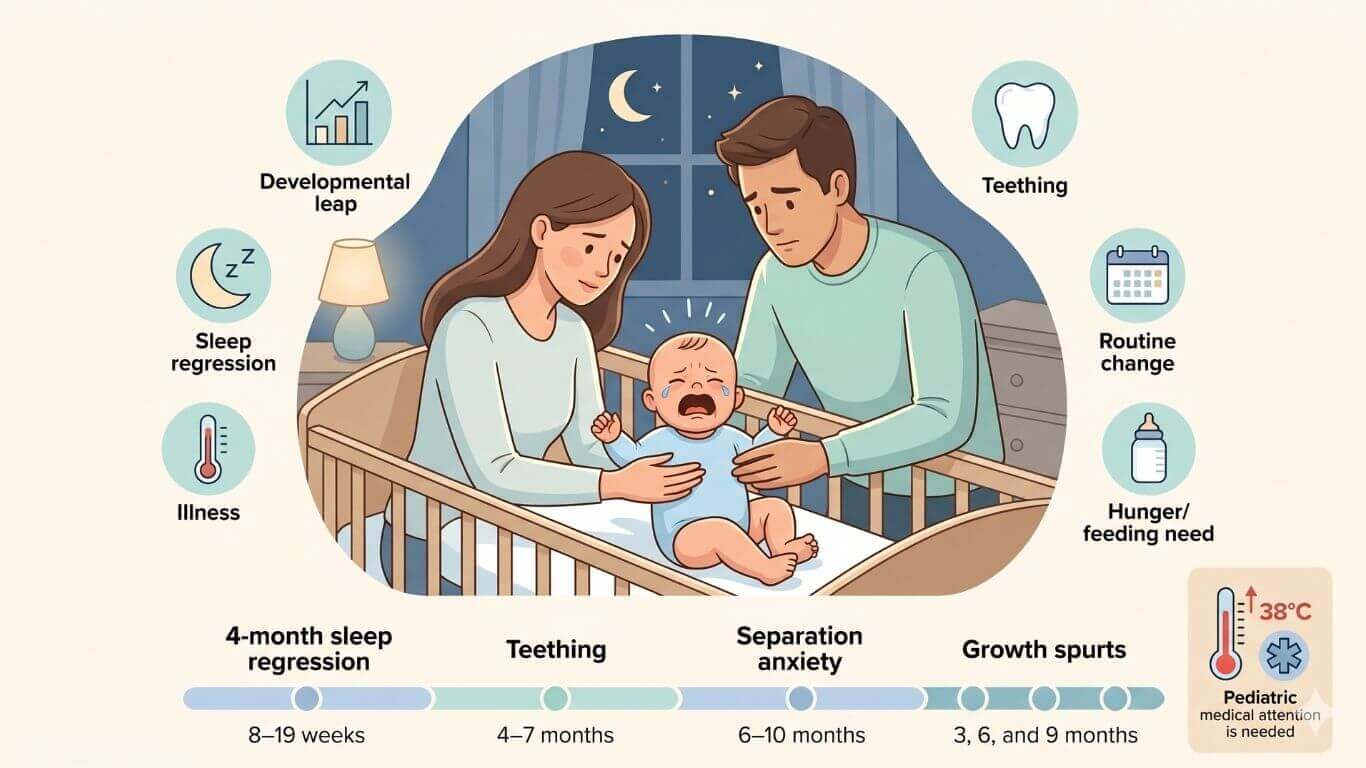
- Sudden night crying in a baby who was previously settled is almost always caused
by one of six things: a developmental leap, a sleep regression, illness, teething,
a change in routine, or an unmet feeding need. - The most common age-linked causes are the 4-month sleep regression (8-19 weeks),
teething (4-7 months), separation anxiety (6-10 months), and growth spurts at
3, 6, and 9 months. - A fever above 38°C (100.4°F) in a baby under 3 months is a medical emergency
requiring same-day evaluation (AAP, 2023). - Most sudden night crying resolves within 1-3 weeks once the underlying cause
passes – it is a phase, not a permanent change. - If the crying is high-pitched, inconsolable, or accompanied by physical symptoms,
contact a pediatrician the same day.
Why Is My Baby Crying at Night All of a Sudden?
Sudden night crying in a baby who was previously settled is one of the most disorienting
experiences of early parenthood. One week the baby is sleeping in predictable stretches;
the next, they are waking every hour and nothing is working. The change feels abrupt
because it often is – triggered by a specific developmental shift, physical discomfort,
or environmental change rather than a gradual drift.
The key word is “suddenly.” A baby who has always woken frequently at night is a
different situation from a baby whose sleep has changed noticeably in the last few
days or weeks. Sudden change signals that something specific has shifted – and
identifying what that is points directly to the solution.
This guide covers every major cause of sudden night crying by age, how to tell them
apart, and what to do about each one.
The 6 Most Common Causes of Sudden Night Crying
Before breaking down causes by age, these six categories cover the vast majority of
sudden night crying cases at any age in the first year.
1. Developmental Leaps
A developmental leap is a period of rapid brain growth during which the baby is
learning a new skill or processing a new level of understanding about the world.
During a leap, the brain is working intensely – and this cognitive activity disrupts
sleep, increases fussiness, and makes babies more clingy and harder to settle.
The Wonder Weeks research by Frans Plooij (2019) identified 10 major developmental
leaps in the first 20 months of life, with the most sleep-disruptive occurring at
around 5 weeks, 8 weeks, 12 weeks, 19 weeks, and 26 weeks. Each leap lasts
approximately 1-4 weeks before the baby settles into the new skill.
Signs a leap is causing the crying:
- The baby is fussier during the day as well as at night
- Increased clinginess and wanting to be held more than usual
- The timing matches a known leap window
- No physical symptoms are present
2. Sleep Regressions
A sleep regression is a period when a baby who was sleeping well suddenly begins
waking more frequently, resisting sleep, or taking shorter naps. Regressions are
caused by neurological development – the brain reorganizes its sleep architecture
at certain ages, temporarily disrupting established patterns.
The most well-documented regressions occur at 4 months, 8-10 months, and 12 months,
with the 4-month regression being the most significant because it is permanent – the
baby’s sleep cycles change to a more adult-like pattern and do not revert (Mindell
et al., Sleep Medicine Reviews, 2006).
Signs a sleep regression is causing the crying:
- The baby was sleeping well for several weeks before the change
- Night waking has increased significantly and suddenly
- The baby seems developmentally well during the day
- The timing matches a known regression window
3. Illness and Physical Discomfort
Any physical illness – an ear infection, cold, urinary tract infection, or viral
illness – will disrupt sleep and cause sudden increased crying at night. Pain and
discomfort are worse when the baby is lying flat and less distracted by daytime
activity, which is why sick babies who seem manageable during the day often cry
significantly more at night.
Signs illness is causing the crying:
- Fever, runny nose, cough, or unusual skin color
- Pulling at ears (ear infection)
- Feeding less than usual or refusing feeds
- More unsettled than usual during the day as well as at night
- Crying sounds higher-pitched or more urgent than usual
4. Teething
Teething pain is worse at night for the same reason as illness pain – there are
fewer distractions, and lying flat increases blood pressure to the gums, intensifying
the discomfort. Most babies begin teething between 4 and 7 months, with the first
teeth typically being the lower central incisors (AAP, 2023).
Signs teething is causing the crying:
- Increased drooling during the day
- Chewing on hands, toys, and anything within reach
- Red, swollen gum line where a tooth is emerging
- Fussiness that is worse in the evening and at night
- Crying that calms when the baby chews on something cold or firm
5. Hunger and Growth Spurts
Babies go through growth spurts at approximately 2-3 weeks, 6 weeks, 3 months,
6 months, and 9 months (Cleveland Clinic, 2022). During a growth spurt, caloric
demand increases rapidly – sometimes faster than a feeding routine can keep pace
with. A baby who was comfortably sleeping through a longer stretch may suddenly
wake hungry because their caloric needs have outpaced their previous intake.
Signs a growth spurt is causing the crying:
- The baby feeds more eagerly and for longer than usual
- Night waking coincides with the known growth spurt windows
- The baby seems satisfied after a feed and resettles quickly
- The pattern lasts 3-7 days before returning to baseline
6. Environmental and Routine Changes
Babies are highly sensitive to changes in their environment and caregiving routine.
Starting daycare, a parent returning to work, a house move, a change in the primary
caregiver, or even a change in the room temperature or sleep environment can trigger
a period of unsettled nights. This is not behavioral manipulation – it is a stress
response in an immature nervous system that depends on predictability for regulation.
Signs an environmental change is causing the crying:
- The timing of the change correlates directly with the start of the night crying
- The baby is also more clingy or fussy during the day
- No physical symptoms are present
- The baby settles more easily when held by the primary caregiver
Sudden Night Crying by Age: What Is Most Likely at Each Stage
0-6 Weeks: Hunger, Wind, and the Witching Hour
In the first six weeks, sudden changes in night crying are almost always physical.
The most common causes are hunger (the baby is going through a growth spurt and
needs more frequent feeds), unresolved wind, and the witching hour – a period of
intense, difficult-to-soothe evening and night crying that peaks at 3-6 weeks and
resolves by 12 weeks for most babies (Zero to Three, 2023).
A baby who was feeding every 3 hours and is now crying at the 2-hour mark is likely
in a growth spurt. Feed more frequently for 3-5 days and the pattern usually resets.
What to check first:
- When did the baby last feed? If over 2 hours, feed first before anything else.
- Has the baby been burped thoroughly after every recent feed?
- Is the room temperature between 16-20°C (61-68°F)?
When to call a doctor: Any fever above 38°C (100.4°F) in a baby under 3 months
is a medical emergency. Call immediately (AAP, 2023).
6-12 Weeks: Developmental Leap and Colic Peak
The 6-12 week window contains the peak of colic (if present), the first major
developmental leap, and the beginning of circadian rhythm development. All three
can cause sudden increases in night crying simultaneously, which is part of why
this period is often the hardest stretch of the first year for parents.
Colic is defined as crying for more than 3 hours per day, more than 3 days
per week, for more than 3 weeks in an otherwise healthy baby (Wessel criteria,
as cited in AAP, 2023). It typically peaks at 6 weeks and resolves by 12-16 weeks.
The cause is not fully understood, but it is neurological rather than digestive
in most cases.
Signs colic rather than illness is the cause:
- Crying follows a predictable daily pattern, usually worse in the evening
- The baby is growing and feeding normally between crying episodes
- No fever or other physical symptoms
- The crying began around 2-3 weeks and has been escalating
What to do: The 5 S’s method – Swaddle, Side/stomach position while held,
Shush (white noise), Swing, and Suck – is the most evidence-supported approach
for colic crying (Karp, 2002). Simethicone drops have not been shown to reduce
colic crying in controlled trials (AAP, 2023).
3-4 Months: The 4-Month Sleep Regression
The 4-month sleep regression is the most significant sleep disruption of the
first year. Between 8 and 19 weeks, the brain permanently reorganizes sleep
architecture from a simple two-stage newborn pattern to a more complex four-stage
adult-like pattern (Mindell et al., Sleep Medicine Reviews, 2006).
This means the baby now cycles through light sleep stages between each sleep
cycle – approximately every 45 minutes. If the baby does not know how to transition
through light sleep independently, they fully wake and cry at each cycle boundary.
A baby who was sleeping one 4-5 hour stretch may suddenly wake every 45-90 minutes.
This regression is permanent in the sense that the sleep architecture change does
not reverse. The solution is not to wait it out – it is to help the baby develop
independent sleep onset skills, which can begin from around 4-6 months.
What helps during the 4-month regression:
- Keep the bedtime routine consistent: same sequence, same time, every night
- Put the baby down drowsy but awake at the start of the night to practice
independent sleep onset - Avoid creating new sleep associations (feeding to sleep, rocking to sleep) that
the baby will then need to replicate at every wake-up throughout the night - Be patient – this regression typically lasts 2-6 weeks before stabilizing
4-7 Months: Teething and Developmental Milestones
Between 4 and 7 months, teething begins for most babies, developmental leaps
accelerate, and motor milestones (rolling, sitting, reaching) are actively forming.
Any or all of these can cause sudden night crying in a baby who was previously settled.
Rolling in sleep is a specific and common cause of sudden night waking at this stage.
A baby who has recently learned to roll may roll onto their front during sleep,
find themselves unable to roll back, and cry from frustration or discomfort. This
resolves naturally within a few weeks once rolling in both directions is established.
Teething pain management that is evidence-supported:
- Cold (not frozen) teething ring pressed against the gum before bedtime
- Chilled washcloth for chewing
- Age-appropriate pain relief (infant acetaminophen or ibuprofen from 6 months)
at the correct weight-based dose, discussed with a pediatrician before first use
What does not work for teething pain: Teething gels containing lidocaine or
benzocaine are not safe for babies and are not recommended by the AAP (AAP, 2023).
6-10 Months: Separation Anxiety
Separation anxiety is a normal and healthy developmental stage that typically
emerges between 6 and 10 months when the baby develops object permanence –
the understanding that people and things continue to exist when out of sight.
Once the baby understands that a caregiver exists when not present, they also
understand that the caregiver is absent – and this causes genuine distress.
At night, separation anxiety shows as sudden crying when the baby wakes between
sleep cycles and finds themselves alone. A baby who previously resettled
independently may now cry immediately on waking because the awareness of being
alone has become distressing in a way it was not before.
Signs separation anxiety is causing the night crying:
- The baby cries immediately on waking and calms quickly when a caregiver appears
- The baby is also clingier during the day, crying when the caregiver leaves the room
- The timing falls in the 6-10 month window
- The baby was previously able to resettle more independently
What helps with separation anxiety at night:
- Consistent, predictable responses to night waking – knowing a caregiver will
come reduces the distress of waking alone - A comfort object such as a small soft toy or muslin the baby associates with
the caregiver’s scent (safe from around 7 months when rolling is established) - Brief, calm check-ins rather than extended nighttime interaction that stimulates
the baby further - Peek-a-boo and short separation games during the day build the understanding
that caregivers return, which reduces nighttime separation distress over time
9-12 Months: The 9-Month Sleep Regression and Developmental Surge
The 9-12 month period contains a sleep regression linked to a major developmental
leap – the baby is working on crawling, pulling to stand, early walking, and the
explosion of language comprehension that precedes first words. Brain activity during
this period is intense, and night sleep often suffers as a result.
This regression typically lasts 3-6 weeks. It coincides with significant separation
anxiety (still active at this age) and often with the transition from two naps to
one, which can temporarily increase nighttime waking due to accumulated overtiredness.
Signs the 9-month regression rather than illness is the cause:
- The baby is reaching new motor or language milestones during the same period
- Daytime naps are also disrupted or shorter
- The baby is otherwise healthy, feeding well, and growing normally
- Crying reduces quickly when a caregiver responds
How to Tell the Difference Between Developmental Crying and Illness
This distinction matters more than any other when sudden night crying begins.
Developmental and behavioral causes require patience and consistency. Illness
requires medical attention.
| Sign | Developmental / Behavioral | Illness |
|---|---|---|
| Temperature | Normal | Fever above 38°C (100.4°F) |
| Feeding | Normal or increased (growth spurt) | Reduced or refused |
| Cry sound | Familiar pitch, calms with comfort | High-pitched, urgent, unusual |
| Daytime behavior | Fussy but alert and interactive | Lethargic, unusually quiet |
| Physical symptoms | None | Runny nose, cough, pulling at ears |
| Response to soothing | Calms with holding, feeding, motion | Inconsolable despite all techniques |
| Duration | Follows a pattern, improves over days | Worsens or does not improve |
When in doubt, call your pediatrician. A brief phone consultation to rule out illness
is always the right call when sudden crying is accompanied by any physical symptoms
or when the crying sounds or feels different from the baby’s normal distress.
What Not to Do When a Baby Starts Crying at Night Suddenly
- Do not assume it is permanent. Sudden night crying almost always has a
defined cause and a defined end. Most episodes resolve within 1-4 weeks. - Do not start sleep training during a regression, leap, or illness. Sleep
training requires a stable baseline. Attempting it during a disruption extends
the disruption and reduces the chance of success. - Do not change multiple things at once. If you change the feeding schedule,
the bedtime routine, and the sleep environment simultaneously, you cannot identify
what is working. Change one variable at a time. - Do not reduce daytime feeds to force night hunger. This strategy does not
reliably extend night sleep and can cause feeding problems during a growth spurt
when caloric needs are genuinely elevated. - Do not ignore a cry that sounds different. A sudden change in the pitch,
intensity, or character of a baby’s cry is a signal worth taking seriously.
High-pitched, inconsolable crying that does not respond to any soothing is a
reason to call a doctor, not wait until morning.
Common Mistakes to Avoid
- Blaming the last thing that changed. Parents naturally attribute sudden night
crying to the most recent change – a new food, a vaccination, starting daycare.
Sometimes this is correct. Often the real cause is a developmental leap or
regression that happens to coincide with the change. - Introducing new sleep associations under pressure. Feeding or rocking a baby
to sleep during a regression feels like the obvious solution. It works in the
short term but creates a dependency that makes the regression harder to exit. - Comparing to other babies. One baby sails through the 4-month regression in
two weeks; another takes six. Both are normal. Comparing timelines creates anxiety
without providing useful information. - Waiting too long to see a doctor. Developmental causes are far more common
than illness causes, but illness causes are more urgent. When in doubt, call.
Frequently Asked Questions About Why Babies Cry at Night Suddenly
Why did my baby suddenly start waking up crying at night?
The most likely causes are a developmental leap, a sleep regression, teething,
a growth spurt, illness, or a change in routine or environment. The age of the baby
narrows down the most probable cause significantly – the 4-month regression at
8-19 weeks, teething at 4-7 months, and separation anxiety at 6-10 months are
the three most common triggers of sudden sleep disruption in the first year.
Is it normal for a baby to suddenly cry more at night?
Yes. Sudden increases in night crying are one of the most common experiences of
the first year and are almost always linked to a specific developmental or physical
cause. A baby whose night sleep suddenly worsens after a period of relative
predictability is usually going through a leap, regression, or growth spurt – all
of which are normal and temporary.
How long does sudden night crying last?
Most causes of sudden night crying last between 1 and 4 weeks. Growth spurts
resolve in 3-7 days. Developmental leaps last 1-4 weeks. The 4-month sleep
regression is the longest, typically lasting 2-6 weeks. Teething pain fluctuates
with each tooth and can recur across several months. Illness-related crying
resolves when the illness does.
Could my baby be in pain if they are suddenly crying more at night?
Yes, and this should always be considered. Ear infections, urinary tract infections,
reflux, and teething all cause pain that worsens at night. Signs that pain rather
than a developmental cause is responsible include a change in the sound or intensity
of the cry, pulling at ears, feeding refusal, fever, or a baby who cannot be
consoled by any soothing technique. Contact your pediatrician if pain is suspected.
Should I let my baby cry it out if they suddenly start waking at night?
Not during a developmental leap, regression, illness, or teething episode. Cry-it-out
and graduated extinction methods work best from around 4-6 months in a stable baseline
period – not during a disruption. Attempting sleep training during a regression or
illness extends the disruption and is not recommended by the AAP for babies showing
signs of distress from a specific cause (AAP, 2023).
Why does my baby cry at night but sleep fine during the day?
Pain and discomfort are typically worse at night because there are fewer distractions
and lying flat increases pressure in certain areas (ears, gums, stomach). Separation
anxiety also expresses more at night when the baby is alone in a dark room between
sleep cycles. If the baby is fine during the day but significantly distressed at
night, illness – particularly ear infection or reflux – is worth ruling out with
a pediatrician.
When should I see a doctor about sudden night crying?
See a doctor the same day if: the baby has a fever above 38°C (100.4°F) and is under
3 months old; the cry sounds high-pitched or unusual; the baby is difficult to wake
or unusually lethargic; feeding is significantly reduced; or the crying is completely
inconsolable despite all soothing attempts. For babies over 3 months, contact your
pediatrician if sudden night crying is accompanied by any physical symptoms or if
you feel something is wrong beyond a developmental cause.
Key Takeaways
- Sudden night crying in a previously settled baby is almost always caused by one
of six things: a developmental leap, a sleep regression, illness, teething, a
growth spurt, or an environmental change. - The baby’s age is the fastest way to narrow down the most likely cause – each
age window has a dominant trigger. - The 4-month sleep regression is the most significant sleep disruption of the
first year and requires a different response from other regressions because
the underlying sleep architecture change is permanent. - Illness causes require medical attention; developmental causes require patience
and consistency. - Most episodes of sudden night crying resolve within 1-4 weeks once the
underlying cause passes.