

TL;DR
- A newborn in stroller without car seat is safe only when the manufacturer approves a newborn setup for that exact model, such as a lie-flat seat, a bassinet, or a carriage mode.
- Sitting upright usually starts around 6 months, once your baby holds their head steady, sits with little or no help, and meets the seat’s minimum age (Raising Children Network).
- Age, weight, height, and recline limits differ by brand and model, so your manual has the final say.
- A stroller is not a car seat. Every car ride needs an appropriate car seat (NHTSA).
- Strollers are not safe places for unsupervised sleep. Move a sleeping baby to a firm, flat surface (American Academy of Pediatrics, 2022).
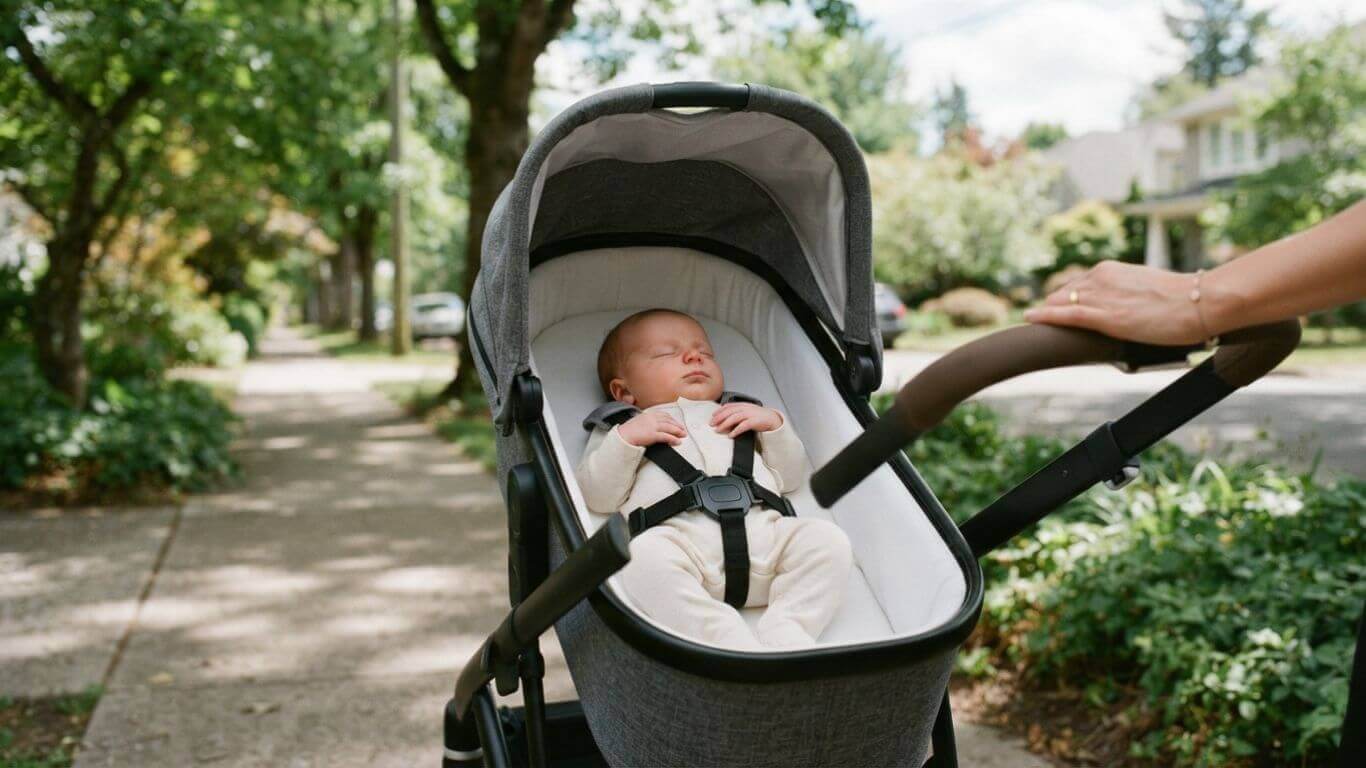
Newborn in stroller without car seat, lying flat in a manufacturer-approved bassinet mode
Newborn in Stroller Without Car Seat: Which Stage Is Your Baby In?
Most babies move through three stroller stages: a newborn setup from birth, a building-strength period around 3 to 5 months, and upright seating from about 6 months. These ages are general guides. The seat’s own limits and your baby’s skills decide the real answer.
| Stage | Typical age | What the stroller needs |
|---|---|---|
| Newborn | From birth | A maker-approved newborn setup: flat or deeply reclined seat, bassinet, or infant carrier |
| Building strength | About 3-5 months | The same approved reclined setup, plus a manual check for the next step |
| Upright ready | About 6 months or later | Steady head control, sitting with little or no help, and the seat’s minimum age met |
Start with the stroller you already own. A Graco Modes Pramette converts for newborn walks. A Chicco Bravo also reclines, but Chicco lists six months as the starting age for its regular seat. Two strollers can look alike in a store and follow different rules for a first walk.
Still sorting out what your baby can do at each stage? Our guide to newborn development and milestones shows what changes in the first months. The CDC’s developmental milestones are a useful second reference.
What Does “Suitable From Birth” Mean for a Stroller?
“From birth” means the manufacturer has approved that specific setup for a newborn’s body, and it can mean three different things. Read the exact manual page for the seat you plan to use before your first walk.
- A full-recline seat lies nearly flat and is rated for newborns on its own.
- A bassinet or carriage mode uses the seat or an add-on to create a flat surface.
- A travel system with an infant carrier applies “from birth” only when a compatible infant car seat is attached, on some models.
In the manual, look for the minimum age or weight, the required recline, any buckle or harness slot rules, and the limit for leaving that mode.
A stroller-rated newborn setup is not a car seat. For driving, your baby needs an appropriate car seat. See our guide to choosing an infant car seat and the NHTSA car seat guidance.
Can a Newborn Ride in a Stroller Without a Car Seat?
Yes, but only in a setup the manufacturer approves for newborns. A flat or deeply reclined position supports a newborn’s head, neck, and airway better than an upright seat, which is why makers set minimum ages for upright modes (Raising Children Network).
Putting a newborn in stroller without car seat works when the model has a lie-flat seat, a bassinet, or a carriage mode. If yours has none of these, attach a compatible infant car seat to the frame, or wait until your baby meets the regular seat’s minimum age. Do not prop a newborn in a seat that is not rated for them.
For very new babies, also read our guide on when a newborn can go outside for timing and weather basics.
Newborn in Stroller Without Car Seat: When Can Babies Sit Upright?
A baby is ready for an upright stroller seat when three things are true together: they meet the seat’s minimum age, they hold their head steady, and they sit upright with little or no help. Around 6 months is a good time to check, but it is not a deadline to switch seats (Raising Children Network).
Baby sitting upright in a stroller seat with steady head control and a snug harness
Readiness checklist
- Your baby holds their head steady when upright, without bobbing.
- They keep their back and trunk straight when seated with light support.
- They sit with little or no help during floor play.
- They meet the minimum age and weight for the upright seat.
- They stay upright without folding forward or slumping once buckled.
During floor play, notice whether your baby still needs your hand at their ribs to stay seated. Lifting the head during tummy time is an earlier skill that builds toward sitting. Our tummy time guide shows how to build that strength.
What should you do if your baby slumps?
Stop and reposition your baby. If their chin drops toward their chest or they fold forward, switch to an approved setup that supports them, and talk to their clinician if the slumping continues (NICHD).
A useful question to ask in a store: “Can you show me how my baby would ride today, and which manual page tells me when to change that setup?”
Five Strollers and What They Allow for a Newborn
These five U.S. models answer different versions of the same question: what can a baby use today, and when does that setup end? Start with the row that matches your child and stroller. Check each manual for current limits, since manufacturers update specifications.
| Stroller | Best for | Main trade-off |
|---|---|---|
| Graco Modes Pramette | Newborn walks with a convertible seat | Pramette mode has an early stop rule |
| UPPAbaby Minu V3 | A compact stroller from birth | Newborns need a specific recline and buckle setting |
| Nuna MIXX next | Parent-facing walks from home | Carriage mode needs several setup steps |
| Chicco Bravo Quick-Fold | Families who already own a Bravo | Regular seat starts at six months |
| UPPAbaby Minu Duo | Twins at different stages | Both seats suit newborns, but only one accepts a car seat |
Stroller newborn setup comparison showing a flat bassinet mode and a reclined seat
Graco Modes Pramette: One Stroller From Newborn to Toddler
The Pramette’s seat converts from an infant pramette to a toddler stroller seat, so you can leave the infant car seat in the car and still take your newborn for a walk (Graco). It is the simplest way to have a newborn in stroller without car seat on a short walk, as long as you stay inside its limits.
Graco says to stop pramette mode when the baby starts pushing up on hands and knees or exceeds 15 pounds, whichever comes first. A baby can reach that limit before they are ready to sit upright, so plan the next step early.
| Feature | Pro | Con |
|---|---|---|
| Convertible seat | Covers two stages | Takes practice to convert |
| Pramette mode | Supports early walks | Has its own use limits |
| Reversible seat | Baby can face you | Baby must be out to change direction |
| Storage basket | Deep space for supplies | Harder to reach when reclined |
Convert the empty seat before the first outing, then reach into the basket with the seat reclined to see whether access works for you.
Best for: families wanting one stroller for newborn and toddler walks. Not ideal for: caregivers who dislike changing seat configurations.
UPPAbaby Minu V3: Travel and Stairs
The Minu V3 is a compact stroller rated from birth, listed at about 16.7 pounds. The U.S. manual calls for the deepest recline and the rear crotch-buckle slot until the baby has strong head and neck control and can sit with bent knees (UPPAbaby).
The buckle setting is easy to miss when you focus on the backrest. If you buy secondhand, confirm the V3 marking before following these instructions.
| Feature | Pro | Con |
|---|---|---|
| Newborn setup | Built into the seat | Buckle position matters |
| Frame | Relatively light to lift | Still about 16.7 lb |
| Fold | Compact for travel | Check your storage space |
| Capacity | One seat from birth | One passenger only |
Fold it and lift it to the height you face each day, such as a trunk or the first stair.
Best for: families who carry their stroller often. Not ideal for: two children riding together.
Nuna MIXX next: Parent-Facing Walks
The MIXX next lets you watch your newborn throughout a walk. The seat can face the handle, and the approved carriage setup gives a flat recline. Nuna’s instructions also require you to close the opening at the foot of the seat (Nuna).
For carriage mode, fully recline the seat, raise the calf support, and secure the fabric flaps as the manual shows. Lowering the backrest alone leaves the setup incomplete.
| Feature | Pro | Con |
|---|---|---|
| Carriage mode | Uses the stroller seat | Enclosure must be fastened |
| Seat direction | Faces parent or street | Requires repositioning |
| Recline | Five settings | Newborns need carriage setup |
| Full-size frame | Suspension for daily walks | Heavier on stairs |
At roughly 28.3 pounds before accessories, it is a harder choice if every outing starts with a flight of stairs.
Best for: parent-facing neighborhood walks. Not ideal for: frequent carries up long staircases.
Chicco Bravo Quick-Fold: Why Seat Age Matters
The Bravo is not a car-seat-free option for newborns. Chicco lists its regular seat for babies from six months, and before then it specifies a compatible infant car seat for the travel-system setup (Chicco).
That makes it a useful lesson in the difference between a frame and a seat. If you own a Bravo, you may already have the frame you need, but the regular seat has to wait.
| Feature | Pro | Con |
|---|---|---|
| Existing frame | Keep using familiar gear | Seat has a minimum age |
| Regular seat | Reclines for comfort | Recline does not lower the minimum age |
| Carrier option | Supports early travel | Separate carrier to handle |
| Quick fold | One-hand fold design | Remove infant carrier first |
If your five-month-old wants a better view, keep using the approved setup and reassess at six months. For cold-weather outings that start in the car, see how to dress a newborn for winter.
Best for: families moving from a Chicco carrier. Not ideal for: car-seat-free walks from birth.
UPPAbaby Minu Duo: Twins
Both Minu Duo seats are rated from birth, and each twin gets their own recline. That helps when one baby sits steadily while the other still needs more support. Follow the manual’s recline and buckle instructions for each child separately (UPPAbaby).
| Feature | Pro | Con |
|---|---|---|
| Two newborn seats | Both twins can ride | Two harnesses to fit |
| Separate reclines | Supports different stages | Check both settings |
| Side-by-side frame | Both babies within reach | Measure your narrowest door |
| Carrier option | One carrier can attach | Two carriers cannot attach |
If you drive first, practice the unloading routine before buying. At least one baby has to move from the car seat into a stroller seat.
Best for: twins who need different seat positions. Not ideal for: parents who want to mount two carriers at once.
[Embed a short manufacturer setup video here, for example a bassinet or carriage mode how-to from the brand’s official channel.]
Stroller Safety Checklist for a Newborn in Stroller Without Car Seat
Run through these eight checks every time you change modes or settings.
- Use only a newborn mode your manual approves.
- Fit the harness in the correct slot, keep the straps snug, and keep the baby’s chin clear of the chest.
- Buckle the harness on every ride, even short ones.
- Check the age, weight, and height limits in the manual.
- Look for a JPMA certification seal, or confirm the model meets current U.S. safety standards.
- Keep the baby in view. Parent-facing seats make this easier.
- Check the temperature. Skip heavy covers that trap heat or block airflow.
- Keep hot drinks and heavy bags off the handlebar unless the manual allows it.
If you buy or borrow a used stroller, also search the model on the U.S. Consumer Product Safety Commission recall list (CPSC, [year]).
Can a Baby Sleep in a Stroller?
A baby should not sleep unsupervised in a stroller. Strollers are not designed as sleep spaces, and the American Academy of Pediatrics recommends a firm, flat surface with no soft bedding, and always on the baby’s back (American Academy of Pediatrics, 2022).
If your baby falls asleep on a walk, keep them in view and move them to a crib or bassinet as soon as you get home. For a full routine, read our safe sleep guide. Parents can also review the AAP’s parent guide to safe sleep and the Safe to Sleep campaign.
Common Buying Mistakes
- Moving straight from pramette to upright. A baby can reach a pramette’s stop limit before they can sit upright. If that happens, ask the maker which setup is approved for the gap.
- Changing the car seat at the same time. Stroller readiness does not decide when to change car seats. When your child outgrows the infant seat, the next step is a larger rear-facing car seat.
- Assuming “from birth” applies to every seat. On some travel systems it applies only with a compatible infant carrier.
- Buying for the child and ignoring daily life. Stairs, trunk size, and door widths matter as much as features.
- Using a secondhand stroller without checking it. Confirm the model, recalls, and missing parts first.
How We Compared These Strollers
We compared the U.S. manuals and manufacturer pages for each model, asking two questions: what can a parent use without a car seat today, and what signals the end of that stage? We did not run lab tests. Handling notes, such as folding and stairs, rely on manufacturer specifications. Features and limits change, so confirm details in your current manual.
This article is general information and does not replace advice from your baby’s clinician. KidGuidance may earn a commission from links on this page at no extra cost to you. This never changes our recommendations. (Delete this sentence if the page has no affiliate links.)
Frequently Asked Questions About a Newborn in Stroller Without Car Seat
Can my three-month-old ride without an infant carrier?
Yes, if your exact stroller has an approved setup for that age and your baby fits it. Use the recline and harness settings the manual specifies.
Does my baby have to sit alone before every stroller ride?
No. A newborn can ride in an approved newborn setup. For an upright seat, look for steady head control, sitting with little or no help, and the maker’s minimum age (Raising Children Network).
Is it safe to use a stroller seat on its own for a newborn?
It can be, if the manual approves it for newborns. Look for a lie-flat or deep-recline mode and follow the buckle and harness rules.
What if my baby slumps even with the harness fastened?
Stop and check your baby’s position. Switch to an approved setup that supports them, and ask their clinician if the slumping continues.
Do both twins have to move upright at the same time?
No. Each twin can move when they meet the seat rules and show enough head and trunk control. Separate reclines let you adjust one seat at a time.
Can I use a stroller instead of a car seat in the car?
No. A stroller seat is not a car seat. Always use an appropriate car seat when driving, and see our infant car seat guide for how to choose one.
What is the safest stroller position for a newborn?
The safest position is the one your manual approves for newborns, usually a fully reclined or flat setup with the harness correctly fitted. Avoid upright positions until your baby meets the seat’s minimum age and has steady head control.
Summary: Setting Up a Newborn in Stroller Without Car Seat
Check your stroller’s newborn setup before shopping for another one. If you are starting from scratch, the Graco Modes Pramette is a practical everyday option, and the Minu V3 makes more sense if carrying weight is your main concern.
Before your next walk, bookmark two pages in your manual: the setup your baby can use now and the rule for leaving it. Together with how your baby holds their head and body, those pages give you a clearer answer than a birthday alone.