


How to bottle feed twins is a common question for parents who are caring for two newborns at once. The good news is that many parents can learn to bottle feed twins at the same time with the right preparation, safe positioning, and practice.
Tandem bottle feeding can make a busy twin-feeding routine more manageable, especially when one adult is caring for both babies. A large twin-feeding pillow can provide useful support, while another caregiver can make early attempts easier. The most important rule, however, is that safety and each baby’s individual feeding cues should always come before speed or convenience.
Quick answer: Yes, one adult can often bottle feed twins simultaneously. Prepare both bottles first, position both babies safely, hold both bottles throughout the feed, supervise both babies closely, and allow each baby to feed at their own pace.
TL;DR:
- How to bottle feed twins at the same time: Prepare both bottles and supplies before picking up either baby.
- A twin feeding pillow can make simultaneous bottle feeding easier for many parents.
- Keep both babies supported and semi-upright, with their heads and necks aligned.
- Hold both bottles yourself and never prop a bottle with a pillow, blanket, towel, or other object.
- Watch both babies throughout the entire feed.
- Let each baby pause, slow down, or stop according to their own feeding cues.
- Twins do not have to drink exactly the same amount or finish at the same time.
- If one baby coughs, chokes, becomes exhausted, or needs immediate attention, stop the other feed if necessary and help the baby who needs you first.
- Premature babies, babies with swallowing difficulties, poor weight gain, or an individualized medical feeding plan may need professional guidance before tandem feeding.
- Track each baby’s feeding and growth separately when your healthcare provider recommends monitoring intake.
- The goal is safe, responsive, comfortable feeding—not feeding both babies as quickly as possible.
Can You Bottle Feed Twins at the Same Time?
Yes. Many parents learn how to bottle feed twins simultaneously, either alone or with help from another caregiver.
The American Academy of Pediatrics discusses feeding twins together as a practical strategy for families who want to coordinate their babies’ feeding routines. A large twin-feeding pillow can provide support while the caregiver holds a bottle for each baby.
However, simultaneous feeding is an option, not a requirement. Some families feed their twins together most of the time, while others feed them separately when one baby needs additional attention.
The goal is not for every feed to be identical. The goal is to make feeding safe, comfortable, responsive, and manageable.
Who Is This Guide to Bottle Feeding Twins For?
This guide can be helpful for:
- Parents of newborn twins learning how to bottle feed twins.
- Parents using formula, expressed breast milk, or a combination.
- Caregivers who regularly feed two babies at the same time.
- Parents who want to make twin feeding more manageable.
- Families trying to coordinate their twins’ feeding routine.
- Parents learning how to bottle feed twins without another adult present.
If your twins were premature, spent time in the NICU, have swallowing problems, require special bottles or thickened feeds, or have an individualized feeding plan, follow the instructions provided by your healthcare team rather than relying on a general tandem-feeding technique.
Why Bottle Feed Twins at the Same Time?
Feeding two babies separately can create a frustrating cycle: one baby finishes just as the other becomes hungry.
For some families, simultaneous feeding creates longer stretches between feeding sessions and makes it easier to organize sleep, diaper changes, pumping, meals, and rest.
The American Academy of Pediatrics notes that waking both twins when one wakes to eat can be a practical strategy for some families.
However, do not wake a sleeping twin simply to maintain a schedule if your pediatrician has given you different instructions, particularly if either baby was premature or has weight-gain concerns.
The practical benefit
If each baby normally takes about 20 minutes to feed:
- Feeding separately may require roughly 40 minutes of active feeding time.
- Feeding simultaneously may allow both feeds to happen during approximately the same period.
The actual time saved varies considerably between families. There is no universal amount of time that every parent will save.
Think of tandem feeding as a way to create flexibility and a more manageable routine, rather than a guaranteed time-saving technique.
What You Need to Bottle Feed Twins Together
Before learning how to bottle feed twins simultaneously, prepare everything you need before picking up either baby.
Basic feeding supplies
- Two clean bottles
- Correctly prepared formula or expressed breast milk
- Appropriate bottle nipples for each baby
- Twin feeding pillow or suitable infant seats, if needed
- Two burp cloths
- Comfortable chair with good back support
- Small table or safe nearby surface for supplies
- Feeding tracker or notebook, if your healthcare provider recommends monitoring intake
Helpful extras
Some families also find these useful:
- Bottle labels or colored bands
- Extra bottles
- Feeding app
- Bottle-cleaning basket
- Water and a snack for the caregiver
- Extra bibs and wipes
The most important preparation is simple: have the bottles, babies’ feeding area, burp cloths, and anything else you may need within easy reach before the feed begins.
How to Bottle Feed Twins: Prepare the Feeding Station
A few minutes of preparation can make a major difference when both babies are hungry.
Before picking up your twins:
- Wash your hands.
- Prepare both bottles according to the formula manufacturer’s or healthcare professional’s instructions.
- Check that the bottles are at a suitable temperature.
- Put both bottles within reach.
- Place burp cloths nearby.
- Set up your twin feeding pillow or infant seats.
- Sit in a stable, supportive chair.
- Make sure you can remain seated and supervise both babies throughout the feed.
- Have a plan for what you will do if one baby suddenly needs your full attention.
For nighttime feeds, prepare as much as safely possible before you become exhausted. You can also read our guide to how often to feed a newborn at night.
Step 1: Decide Whether Both Twins Should Feed Together
If both twins wake hungry at roughly the same time, simultaneous feeding can be convenient.
When one twin wakes before the other, some parents choose to wake the sleeping twin so both can feed together. The AAP describes this as one practical approach for families who want a synchronized routine.
But individual feeding needs come first.
Speak with your pediatrician before intentionally waking a twin for scheduled feeding if your baby:
- Was premature.
- Has poor weight gain.
- Has been diagnosed with a feeding problem.
- Was discharged from the NICU with a specific feeding plan.
- Has difficulty waking for feeds.
- Has another medical condition affecting feeding.
A synchronized routine should make your life easier—not override a baby’s medical needs.
Step 2: Position Both Babies Safely
When learning how to bottle feed twins, safe positioning should be your first priority.
The exact position depends on your babies’ age, size, head control, equipment, and feeding needs.
As a general principle, keep each baby supported and comfortably semi-upright, with the head and neck aligned and the baby’s face visible to you.
Avoid feeding babies flat on a bed, sofa, or cushion.
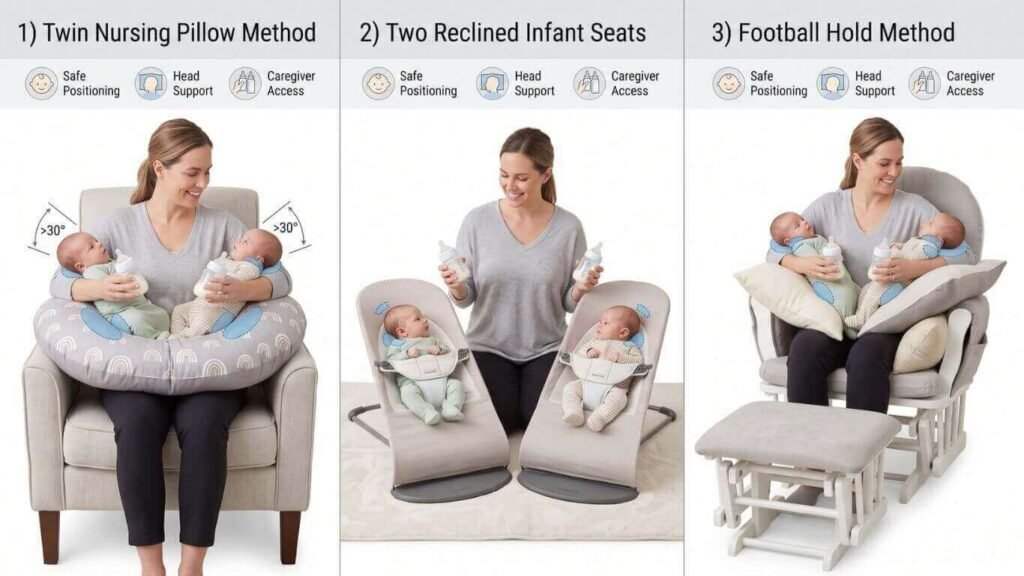
Position 1: Use a Twin Feeding Pillow
A large twin feeding pillow is one of the most practical options for simultaneous feeding.
It can provide body support while allowing you to remain close to both babies.
How to use a twin feeding pillow
- Sit in a stable chair with good back support.
- Position the pillow securely around your body.
- Place one baby on each side.
- Support each baby’s head and neck.
- Make sure both babies’ faces remain visible.
- Check that neither baby is slipping, sinking, or lying flat.
- Once both babies are safely positioned, hold one bottle in each hand.
Why parents like this method
- It supports much of each baby’s body weight.
- It can reduce arm and shoulder strain.
- Both babies remain close to the caregiver.
- It can be practical when feeding alone.
Important safety point
A feeding pillow is support equipment—not a substitute for your hands or supervision.
Never use a pillow to hold a bottle in place while you walk away or attend to something else.
Position 2: Use Two Infant Seats
Some parents find it easier to place each baby in a suitable reclined infant seat and sit between or in front of them.
This may work for some families when the seats are appropriate for the babies and used according to the manufacturer’s instructions.
How to set up
- Place the seats according to the manufacturer’s safety instructions.
- Secure each baby appropriately.
- Make sure you can clearly see both babies’ faces.
- Sit close enough to hold both bottles.
- Keep your attention on both babies throughout the feed.
Never treat an infant seat as a hands-free bottle holder.
Position 3: One Baby on Your Lap and One in a Seat
You do not always need two identical setups.
If one baby prefers being held while the other is comfortable in an appropriate infant seat, you may sometimes feed one in your arms while maintaining safe support and supervision of the other.
This can be useful when twins have different preferences.
The important rule remains the same: you must be able to hold both bottles and monitor both babies.
What About the Football Hold?
The football hold is commonly associated with breastfeeding twins, where one baby is supported under each arm.
It can provide a useful reference for positioning, but bottle feeding requires you to maintain control of the bottle, the baby’s head, and the feeding angle.
If you are new to simultaneous feeding, start with a well-supported setup rather than attempting a physically demanding unsupported hold.
Step 3: Offer Both Bottles
Once both babies are safely positioned, offer the bottles.
Do not force both babies to begin drinking at exactly the same moment.
One baby may be ready immediately while the other needs a few seconds to settle.
Use responsive bottle feeding
Hold each bottle so milk is available to the nipple without creating an unnecessarily fast flow.
Watch each baby’s cues.
A baby may need a pause if they:
- Stop sucking.
- Turn their head away.
- Spill milk from the mouth.
- Push the bottle away.
- Change their breathing pattern.
- Become tense or unsettled.
Responsive bottle-feeding guidance recommends following these cues rather than forcing a baby to finish a bottle.
For additional information about responsive feeding, see the UNICEF Baby Friendly Initiative guidance on responsive bottle feeding.
Step 4: Let Each Twin Set Their Own Pace
One of the biggest mistakes when learning how to bottle feed twins is trying to make both babies finish together.
They don’t have to.
One twin may drink faster while the other takes more pauses.
If one baby finishes first:
- Stop feeding that baby.
- Keep the baby safely supported.
- Hold the baby upright if they need to burp.
- Continue monitoring the second twin.
- Never leave the finished baby unattended simply because the other twin is still feeding.
Twins are individuals, even when they are the same age and size.
Step 5: Watch Both Babies’ Feeding Cues
During the entire feed, watch both babies.
Signs the feed is going well
You may see:
- Rhythmic sucking.
- Regular pauses.
- Comfortable breathing.
- A secure seal around the nipple.
- Relaxed body posture.
- Calm behavior.
- Normal swallowing.
Signs to pause the feed
Pay attention if a baby:
- Turns away repeatedly.
- Stops sucking.
- Pushes the bottle away.
- Spills milk repeatedly.
- Becomes unusually tense.
- Coughs or gags.
- Appears tired or overwhelmed.
If these problems happen repeatedly, discuss them with your pediatrician or feeding specialist.
What If One Twin Chokes or Needs Help?
Safety takes priority over keeping the two feeds synchronized.
If one baby coughs, chokes, has difficulty breathing, or otherwise needs your immediate attention:
- Stop that baby’s feed.
- Attend to that baby first.
- Put the other bottle down safely if necessary.
- Reassess both babies before continuing.
If a baby has repeated choking, significant breathing difficulty, blue or gray coloration, or another emergency symptom, seek urgent medical attention.
Do not try to manage persistent feeding difficulties simply by changing the bottle or buying a faster nipple.
Bottle Propping: Why You Should Never Do It
Never prop a bottle against a pillow, blanket, rolled towel, or another object and leave the baby to feed.
Bottle propping prevents the caregiver from responding immediately if the baby coughs, chokes, needs a pause, or stops feeding.
A twin feeding pillow should support the babies—not become a substitute for the adult holding the bottles.
The safer alternative
Use the pillow or infant seat to support the babies while you continue holding the bottles and supervising both babies.
Step 6: Burp the Twins
You do not need to make every baby burp for exactly the same amount of time.
Some babies need frequent burping. Others may need less.
With two adults
Each caregiver can hold and burp one baby.
This is often the easiest arrangement during the first few weeks.
When bottle feeding twins alone
If one baby finishes first, you can attend to that baby while the second twin finishes, provided the second baby remains safely supported and you continue supervising them.
Common burping positions include:
- Over your shoulder.
- Upright against your chest.
- Supported sitting on your lap.
Keep the baby’s head and neck supported and use gentle rubbing or patting.
If your baby was premature or has a medical feeding plan, follow the technique taught by your healthcare team.
Step 7: Track Each Twin’s Intake
When two babies drink at the same time, it can be surprisingly easy to forget who drank what.
A simple tracking system can help.
Record:
- Feeding time.
- Baby’s name or identifier.
- Amount offered.
- Amount consumed, when measurable.
- Any coughing, choking, vomiting, or unusual difficulty.
- Any other concern you want to discuss with your pediatrician.
You can use:
- A feeding app.
- A notebook.
- A phone note.
- Colored bottle bands.
The purpose is not to make every feed perfectly equal. It is to help you identify meaningful changes in an individual baby’s intake or feeding behavior.
How Much Formula Do Twins Need?
There is no single amount of formula that is correct for every twin.
The amount each baby needs depends on factors such as:
- Age.
- Weight.
- Growth.
- Appetite.
- Feeding frequency.
- Whether the baby was premature.
- Medical conditions.
Do not calculate one combined amount for both twins. Each baby’s intake should be considered individually.
If you are concerned that one twin consistently drinks less than the other, focus on that baby’s growth and feeding pattern rather than trying to make both bottles identical.
Your pediatrician can provide an individualized feeding plan when needed.
How Do You Know Your Twins Are Getting Enough Milk?
For young infants, feeding adequacy is best assessed using several pieces of information together.
These may include:
- Appropriate weight gain.
- Wet diaper output.
- Feeding behavior.
- Alertness when awake.
- Whether the baby appears satisfied after feeds.
- Your pediatrician’s assessment of growth.
For newborns, wet diaper patterns can provide useful information about intake. You can also read our guide to how many diapers a newborn uses each day.
Do not assume that both twins should consume exactly the same volume.
How Long Should Bottle Feeding Twins Take?
There is no universal “correct” feeding time.
Some babies feed efficiently while others need more pauses.
Instead of trying to make both twins finish within a specific number of minutes, focus on:
- Comfortable sucking and swallowing.
- Normal breathing.
- Appropriate pauses.
- Baby-led stopping.
- Good growth.
If a baby regularly takes an unusually long time to finish, becomes exhausted during feeds, coughs frequently, or struggles to maintain suction, discuss the feeding pattern with your pediatrician or feeding specialist.
Should Both Twins Use the Same Nipple Flow?
Not necessarily.
If both babies feed comfortably with the same nipple flow, using the same flow can simplify simultaneous feeding.
But twins are individuals.
One baby may need a different nipple flow because of:
- Different feeding ability.
- Different developmental stage.
- Prematurity.
- Oral-motor difficulties.
- A medical feeding plan.
Do not change nipple flow simply to make the twins finish at the same time.
If one baby repeatedly coughs, chokes, leaks milk, becomes exhausted, or struggles during feeds, ask your pediatrician or feeding specialist whether the nipple flow is appropriate.
Common Mistakes When Bottle Feeding Twins
1. Preparing Bottles After Both Babies Are Crying
Better approach: Prepare the feeding station before the twins become extremely hungry.
2. Trying to Make Both Babies Finish Together
Better approach: Let each baby feed according to their own hunger and fullness cues.
3. Using the Feeding Pillow as a Bottle Holder
Better approach: Use the pillow to support the babies while you continue holding both bottles.
4. Feeding Both Babies Flat
Better approach: Keep each baby comfortably supported and semi-upright.
5. Ignoring One Baby While Helping the Other
Better approach: If one baby needs your full attention, pause the other feed if necessary.
6. Assuming Twins Need Identical Feeding Plans
Better approach: Treat each baby as an individual while using simultaneous feeding as a practical routine.
7. Changing Nipple Flow Too Quickly
Better approach: Look at the baby’s feeding behavior and discuss persistent problems with a healthcare professional.
8. Measuring Success Only by Speed
Better approach: Safe, comfortable, effective feeding matters more than finishing both bottles quickly.
Can Premature Twins Be Bottle Fed at the Same Time?
Sometimes—but this should be decided with the babies’ medical team.
Premature babies may have immature suck-swallow-breathe coordination and may tire more easily during feeds.
If your twins were premature or spent time in the NICU, they may have received individualized instructions for:
- Bottle position.
- Nipple flow.
- Pacing.
- Feeding duration.
- Oxygen monitoring.
- Burping.
- Feeding frequency.
Follow those instructions rather than using a standard tandem-feeding technique.
Once your healthcare team confirms that both babies can feed safely, simultaneous feeding may become an option.
What If One Twin Has Reflux?
Reflux can make simultaneous feeding more complicated because one baby may need more individualized positioning or post-feed care.
Rather than forcing both twins into exactly the same position, prioritize the needs of the baby with reflux.
Ask your pediatrician about:
- Feeding position.
- Feeding volume.
- Feeding frequency.
- Nipple flow.
- Whether pacing is appropriate.
- How long the baby should remain upright after feeding.
Do not independently thicken feeds or make other feeding modifications without medical guidance.
What If One Twin Breastfeeds and the Other Takes a Bottle?
This is possible, although the setup may be more complicated.
For example, one baby may breastfeed while the other receives expressed breast milk or formula.
A twin feeding pillow can sometimes help position both babies, but the caregiver still needs to maintain safe support and supervision.
If one twin is struggling with breastfeeding or bottle feeding, address that baby’s individual feeding needs rather than trying to make both feeding methods identical.
How to Bottle Feed Twins at Night
Night feeds can be especially challenging because you are tired and both babies may wake at once.
Before bedtime, prepare your feeding area as much as safely possible:
- Keep clean bottles ready according to safe preparation and storage guidance.
- Have burp cloths nearby.
- Keep the feeding area clear.
- Keep the room comfortably dim.
- Keep necessary supplies within reach.
- Avoid unnecessary distractions.
During the feed, stay awake and supervise both babies.
After feeding, follow your normal safe-sleep routine and place each baby in their own safe sleep space.
For more guidance, see how often to feed a newborn at night.
When to Feed Twins Separately
Tandem feeding is convenient, but there are times when feeding separately is the better option.
Consider individual feeding when:
- One baby is choking or coughing repeatedly.
- One baby has swallowing difficulties.
- One baby becomes exhausted during feeds.
- One baby needs specialized equipment.
- One baby has a medical feeding plan.
- One baby requires close monitoring.
- One baby needs more one-to-one attention.
- Your healthcare professional recommends separate feeding.
Feeding both babies together is a convenience—not a requirement.
When to Contact Your Pediatrician
Contact your healthcare provider if either twin:
- Consistently refuses feeds.
- Drinks substantially less than usual.
- Has persistent coughing or choking during feeds.
- Has repeated vomiting.
- Becomes unusually tired during feeding.
- Takes unusually long to finish feeds.
- Has persistent milk leakage or difficulty maintaining suction.
- Has concerning changes in wet diaper output.
- Is not gaining weight as expected.
Seek urgent medical care if a baby develops significant breathing difficulty, turns blue or gray, becomes difficult to wake, or has another emergency symptom.
A Simple Routine for Bottle Feeding Twins
If you are learning how to bottle feed twins, this seven-step routine can make the process easier to remember.
1. Prepare
Get both bottles, burp cloths, feeding pillow or seats, and other supplies ready.
2. Position
Safely position both babies so you can clearly see their faces.
3. Hold
Hold one bottle for each baby.
4. Pace
Allow each baby to pause and feed according to their own cues.
5. Monitor
Watch both babies throughout the entire feed.
6. Burp
Burp each baby as needed.
7. Record
Track individual intake when your pediatrician recommends monitoring it.
FAQs
Can I bottle feed twins simultaneously?
Yes. Many parents can safely bottle feed twins at the same time when both babies can feed safely and the caregiver can hold both bottles and supervise both babies.
A twin feeding pillow or two appropriately positioned infant seats may make the process easier.
How do I bottle feed twins by myself?
Prepare everything before picking up either baby. Position both babies safely, keep both bottles in your hands, and remain close enough to monitor both babies throughout the feed.
A twin feeding pillow can be a practical option for many parents, particularly when the babies are small and need substantial physical support.
Should twins eat at the same time?
They can, if it works for your family.
Feeding twins together can make the daily routine easier. Some parents choose to wake both twins when one wakes so they can feed together.
However, medical needs and individual feeding cues should take priority over synchronization.
Can twins drink from the same bottle?
No. Each baby should have their own bottle during a feed.
Using separate bottles makes it easier to monitor each baby’s intake and feeding behavior.
How do I carry newborn twins at the same time?
Newborn twins require careful head and neck support.
For feeding, a twin feeding pillow can reduce the amount of weight you need to support with your arms. For carrying outside a feeding session, use an appropriate twin-carrying method or carrier designed for your babies’ age, size, and developmental stage.
If you are unsure how to safely lift or carry both newborns, ask a healthcare professional to demonstrate the technique.
How do I breastfeed twins simultaneously?
Breastfeeding twins simultaneously is possible, and common positions include the double-football hold, double-cradle hold, and other tandem positions.
A twin feeding pillow can provide additional support. The best position depends on the babies’ size, development, your comfort, and latch.
If you are primarily breastfeeding while also pumping or bottle feeding, a lactation consultant can help you develop a routine that works for both babies.
Is bottle propping safe?
No.
Do not rest a bottle against a pillow, blanket, rolled towel, or another object and leave the baby to feed.
The caregiver should remain with the baby and hold the bottle throughout the feed.
Should both twins use the same nipple flow?
Not automatically.
If both babies feed comfortably with the same flow, using the same nipple can simplify simultaneous feeding. But one twin may need a different flow because of individual feeding ability or medical needs.
If either baby repeatedly coughs, chokes, leaks milk, or struggles during feeds, ask your pediatrician or feeding specialist about nipple flow.
What should I do if one twin finishes before the other?
Let the faster baby finish.
Hold that baby safely and burp them if needed while continuing to monitor the second baby.
Do not try to make the second baby finish faster just to keep the twins synchronized.
Can I feed one twin while the other is in a bouncer?
This depends on the specific product, its safety instructions, and your babies’ developmental stage.
If you use an infant seat, follow the manufacturer’s instructions and remain close enough to hold the bottle and supervise the baby.
An infant seat should never be used as an unattended bottle-propping device.
How long does it take to learn simultaneous bottle feeding?
There is no reliable universal timeline.
Some parents become comfortable quickly, while others need more practice. Having another adult help during the first few attempts can make positioning easier and provide confidence.
Focus on learning a safe, repeatable routine rather than reaching a specific number of practice sessions.
Final Verdict:
For many parents, learning how to bottle feed twins at the same time can make the newborn routine more manageable.
A twin feeding pillow can be one of the most useful tools for supported tandem feeding, particularly when one caregiver is feeding both babies.
However, simultaneous feeding should never come at the expense of safety.
For premature, NICU, or medically complex twins, ask your pediatrician, neonatologist, or feeding specialist whether simultaneous feeding is appropriate.
The best setup is one that allows you to:
- Maintain safe positioning.
- Hold both bottles.
- See both babies clearly.
- Respond to each baby’s feeding cues.
- Pause immediately if either baby needs help.
- Keep both babies supervised throughout the feed.
The best way to bottle feed twins isn’t the fastest method. It’s the method that keeps both babies safe, comfortable, well-supported, and responsive to their individual feeding cues while remaining practical enough for you to use consistently.
If either baby has persistent coughing or choking, poor weight gain, repeated vomiting, feeding fatigue, breathing difficulties, or another ongoing feeding concern, seek professional medical or feeding support rather than simply switching to a faster nipple or changing the feeding position.
Medical Disclaimer
This article is for general educational purposes only and is not a substitute for medical advice, diagnosis, or treatment.
Every baby has different nutritional, developmental, and medical needs. Premature babies, babies with swallowing difficulties, babies with poor weight gain, and babies with other medical conditions may require individualized feeding plans.
Always follow your pediatrician, neonatologist, lactation consultant, speech-language pathologist, or feeding specialist when your baby has a specific feeding concern.
Sources and Further Reading
- American Academy of Pediatrics / HealthyChildren.org — Information and guidance for infant feeding and twins.
- UNICEF UK Baby Friendly Initiative — Responsive bottle-feeding resources.
- CDC — Guidance on infant feeding and breast milk safety.
- Twins Trust — Practical resources for families raising twins.
- Pregnancy, Birth and Baby — Information about feeding twins and newborn care.