


How to Measure Your Breast Pump Flange Size correctly starts with one simple measurement: the width of your nipple, not your areola. But the number you measure is only a starting point. Your nipple needs enough room to move freely inside the tunnel without rubbing, excessive areola being pulled in, or pain developing during pumping.
The good news is that you can measure your breast pump flange size at home in just a few minutes and then confirm the fit during an actual pumping session.
If you are pumping for a newborn, it can also help to understand how often to feed a newborn at night, especially when planning overnight pumping and feeding sessions.
TL;DR
- Measure the widest part of your nipple at its base, excluding the areola.
- Record the measurement in millimeters (mm).
- A common starting point is to add 2–4 mm to your nipple measurement, but the exact amount varies by pump brand and individual fit.
- Measure both nipples separately because the two sides may need different flange sizes.
- If possible, measure when your nipple is in a relatively neutral state rather than immediately after a pumping session.
- Test the flange while pumping. Your nipple should move freely without rubbing, excessive areola should not be pulled into the tunnel, and pumping should not be painful.
- Your flange size can change during your pumping journey, so reassess if comfort, nipple appearance, or milk removal changes.
Quick answer: Measure your nipple diameter in millimeters, add your pump manufacturer’s recommended allowance, choose the closest available flange or insert, and then confirm the fit during pumping.
What Is a Breast Pump Flange?
A breast pump flange, also called a breast shield, is the funnel-shaped part of a breast pump that rests against your breast. The narrow tunnel in the middle is where your nipple moves during pumping.
Flanges come in different tunnel diameters because nipple size varies considerably from person to person. A standard flange supplied with a pump is not automatically the right size for you.
Your breast size does not determine your flange size. Someone with larger breasts can have smaller nipples and need a smaller flange, while someone with smaller breasts may need a larger flange.
What You Need to Measure Your Breast Pump Flange Size
You do not need special equipment.
Have these items ready:
- A millimeter ruler or soft measuring tape
- A printable flange-sizing ruler, if your pump manufacturer provides one
- A mirror
- Your current flange, if you already have one
- A few quiet minutes when you are not rushed
A printable sizing tool can make the measurement easier, but check that it is printed at the correct scale before using it.
How to Measure Your Breast Pump Flange Size Step by Step
Step 1: Choose the Right Time to Measure
If you are pregnant, you can take a rough measurement, but do not assume it will remain your final postpartum size.
Pregnancy and hormonal changes after birth can change nipple size and shape. Cleveland Clinic recommends reassessing after birth because an early measurement may not accurately represent your pumping size later.
If you are already pumping, avoid relying on a measurement taken immediately after a session as your only reference. Nipple tissue can change during pumping, so the important thing is to measure consistently and then confirm the fit during pumping.
Step 2: Gently Stimulate Your Nipple
Some sizing guides recommend gently rolling or stimulating the nipple for a few seconds before measuring.
The goal is to identify the nipple clearly without squeezing or stretching it. Do not pull the nipple outward while measuring because this can change the measurement.
Use a mirror if it helps you see where the nipple base ends and the areola begins.
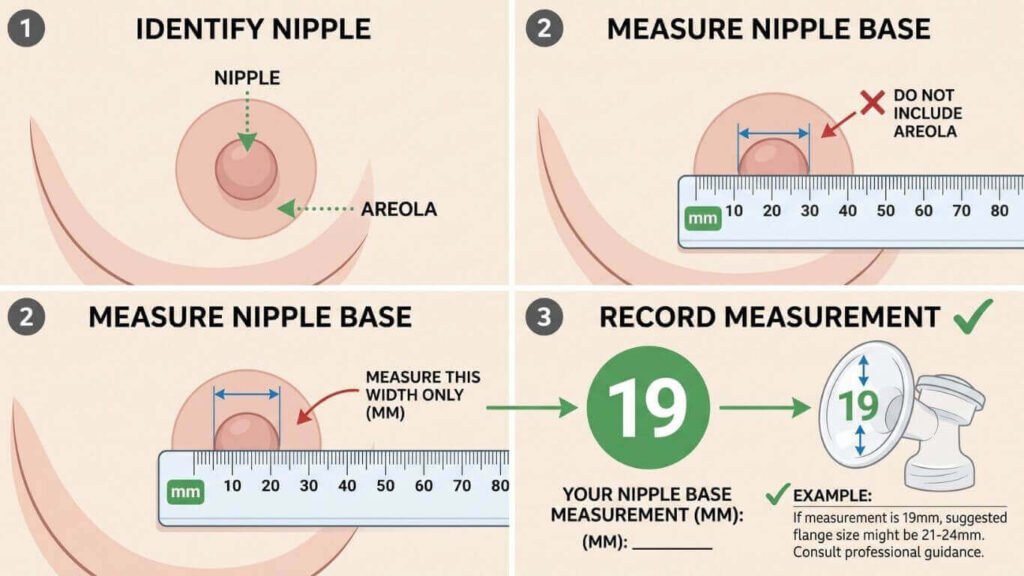
Step 3: Measure the Nipple, Not the Areola
This is the most important part of how to measure your breast pump flange size.
Place the ruler across the widest part of the nipple at its base. Measure the nipple diameter in millimeters and do not include the areola.
For example:
If your nipple measures 16 mm, record 16 mm. Do not include the surrounding darker areola in the measurement.
If your nipple is not perfectly round, measure across its widest dimension rather than trying to force it into a circular shape. Medela’s professional guidance notes that nipple shape and size can vary, so measuring each breast separately is important.
Step 4: Measure Both Nipples Separately
Do not assume your left and right nipples are exactly the same size.
Measure each side independently:
| Breast | Nipple measurement | Starting flange range |
|---|---|---|
| Left | 16 mm | About 18–20 mm |
| Right | 18 mm | About 20–22 mm |
These are starting ranges, not guaranteed final sizes. Your pump brand’s sizing system and your response during pumping determine the final fit.
Step 5: Add the Manufacturer’s Recommended Allowance
A common starting method is to add approximately 2–4 mm to the measured nipple diameter.
However, this is not a universal rule.
For example:
- Spectra recommends adding 2–3 mm to the nipple measurement.
- Medela recommends adding 4 mm to create a starting breast-shield size.
- Cleveland Clinic explains that adding 2–4 mm can be a useful starting point but emphasizes that there is no single evidence-based formula that works for everyone.
Example:
If your nipple measures 16 mm:
- Add 2 mm → 18 mm
- Add 3 mm → 19 mm
- Add 4 mm → 20 mm
Your pump may not offer all three sizes. Choose the closest compatible size or use an appropriately sized insert if your pump system supports one.
Step 6: Match the Measurement to Your Pump
Your calculated number may not match an available flange exactly.
For example, if your measurement suggests approximately 19 mm but your pump offers 18 mm and 21 mm options, you need to compare the available sizes and then test the fit during pumping.
Some pumps also use inserts that fit inside a larger flange. This can give you more sizing options without replacing the entire flange.
For example, Medela offers smaller inserts that can be used with a larger breast shield, while Spectra provides several flange sizes across its product range.
Important: Do not choose a flange simply because it is the size that came with your pump.
Breast Pump Flange Size Chart: Quick Starting Guide
Use this as a starting reference, not a universal sizing chart.
| Nipple diameter | Common starting range |
|---|---|
| 13 mm | 15–17 mm |
| 14 mm | 16–18 mm |
| 15 mm | 17–19 mm |
| 16 mm | 18–20 mm |
| 17 mm | 19–21 mm |
| 18 mm | 20–22 mm |
| 19 mm | 21–23 mm |
| 20 mm | 22–24 mm |
| 21 mm | 23–25 mm |
| 22 mm | 24–26 mm |
| 23 mm | 25–27 mm |
| 24 mm | 26–28 mm |
The exact flange available to you may differ by manufacturer. Some brands use different sizing increments, and inserts can provide additional options.
Use the chart to narrow your choices, then judge the final size by how your nipple moves and feels during pumping.
Step 7: Test Your Flange Size During Pumping
Measuring gives you a starting size. The pumping session tells you whether that size actually works for you.
Center your nipple in the tunnel and begin pumping at a comfortable suction level. Do not increase suction simply because you think stronger suction will compensate for an imperfect flange fit.
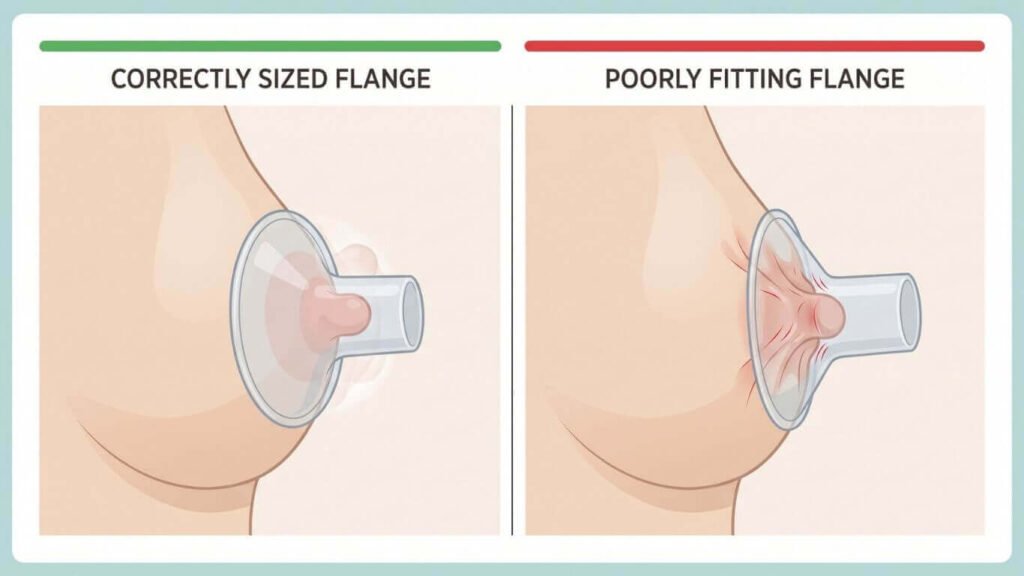
A properly fitting flange should allow your nipple to move freely through the tunnel without painful rubbing. Only a limited amount of surrounding areola should be drawn into the tunnel.
What a Good Flange Fit Looks Like
Look for these signs:
- Your nipple moves freely inside the tunnel.
- Your nipple remains reasonably centered.
- There is little or limited areola pulled into the tunnel.
- Pumping feels comfortable rather than painful.
- Your nipple does not become increasingly swollen during the session.
- Milk flows effectively after letdown.
- Your nipple and surrounding tissue do not show ongoing trauma such as cracking or bleeding.
How to Tell If Your Flange Is Too Small
A flange may be too small if:
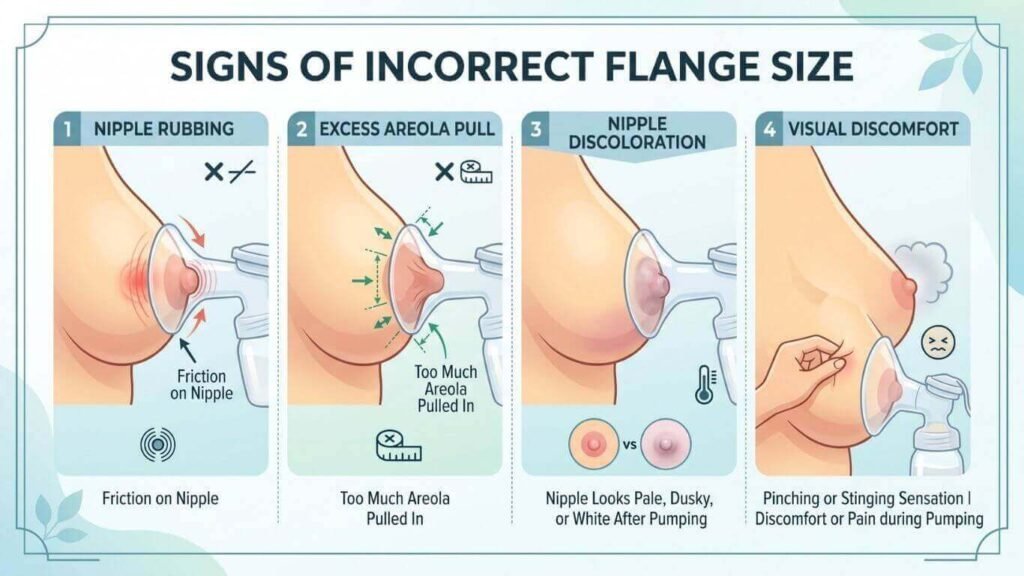
- Your nipple rubs against the tunnel wall.
- Your nipple has very little room to move.
- Pumping causes pain or tenderness.
- Your nipple becomes pale or develops a purple or unusual color.
- You develop cracking, blisters, or other nipple trauma.
- Milk removal seems lower than expected.
If these signs continue, try a larger size or ask a lactation professional to assess your fit.
How to Tell If Your Flange Is Too Large
A flange may be too large if:
- A large amount of areola is pulled into the tunnel.
- You feel excessive tugging.
- Your areola becomes swollen or sore.
- You notice a gap between the breast and flange.
- Pumping is uncomfortable.
- Milk removal is not improving despite appropriate pumping technique.
A larger flange is not automatically better. The goal is enough room for comfortable nipple movement—not as much space as possible.
What If Your Nipple Changes Size While Pumping?
This is normal.
Nipples can expand, lengthen, and change shape during pumping. That is one reason why a measurement taken before pumping cannot always determine your final flange size by itself.
If your nipple fits comfortably at the beginning but becomes swollen, sore, or restricted during the session, reassess the size and the overall pumping setup.
Can Your Breast Pump Flange Size Change Over Time?
Yes.
Your nipple size can change during pregnancy, the early postpartum period, and your longer-term pumping journey. Spectra also notes that flange needs may change after milk supply becomes established.
Consider rechecking your flange if:
- Pumping suddenly becomes painful.
- Your nipple begins rubbing the tunnel.
- Your nipple looks more swollen after pumping.
- More areola is being pulled into the tunnel.
- Your milk removal changes unexpectedly.
- You change breast pumps.
- You notice a change in nipple size or shape.
You do not need to remeasure on a fixed schedule if everything feels comfortable and is working well. Reassess when something changes.
Wet diapers are another useful part of the overall picture when assessing whether a newborn is getting enough milk. See our guide to how many diapers a newborn uses each day for age-based expectations.
Do You Need the Same Flange Size for Both Breasts?
Not necessarily.
It is completely possible for one breast to need a different flange size from the other.
Measure both nipples separately and use the size that fits each side best.
For example, you might find that:
- Left nipple = 16 mm → 18–20 mm starting size
- Right nipple = 19 mm → 21–23 mm starting size
There is no need to force both sides into the same flange size simply because your pump came with matching flanges.
What If No Flange Size Fits Perfectly?
You may need to experiment.
Flange fit is influenced by more than nipple diameter. Nipple elasticity, tissue swelling, flange shape, material, suction level, and individual comfort can all affect how a flange performs.
If you are between sizes:
- Start with the closest available size.
- Center your nipple carefully.
- Pump at a comfortable suction level.
- Watch nipple and areola movement.
- Compare comfort and milk removal.
- Try another size or flange style if necessary.
A recent pilot study found that individualized flange fitting can improve comfort and milk output compared with a standard fitting approach, reinforcing the idea that sizing should be individualized rather than based on one universal formula.
Does a 24mm Flange Fit Most People?
Not necessarily.
A 24 mm flange is commonly supplied with breast pumps, but it is only a standard starting option—not proof that 24 mm is the correct size for you.
For example, Spectra supplies 24 mm and 28 mm flanges with some pumps while offering additional sizes separately.
If your nipple is smaller or larger than the size the manufacturer supplied, do not continue using the standard flange simply because it came in the box.
Can You Measure Your Flange Size During Pregnancy?
You can measure during pregnancy to get a rough estimate, but it is better to reassess after birth.
Hormonal changes during pregnancy and after delivery can change nipple size and shape. Cleveland Clinic specifically recommends reassessing postpartum rather than relying on a pregnancy measurement as your final size.
If you are buying pump accessories before your baby arrives, treat your pregnancy measurement as an estimate and be prepared to reassess later.
Is Pumping Supposed to Hurt?
No.
Some people notice pulling or pressure when pumping, but persistent pain is not something you should simply accept as part of pumping.
Pain can have several causes, including an incorrect flange size, excessive suction, nipple trauma, or another breastfeeding or pumping problem. Cleveland Clinic recommends assessing flange fit and seeking professional help when problems persist.
If changing the flange does not resolve persistent pain, contact a lactation consultant, breastfeeding medicine specialist, or healthcare professional.
If you are also experiencing persistent nipple pain, clicking during feeds, milk leakage, or latch problems, see our guide to baby lip tie and feeding difficulties to learn when these symptoms may need further evaluation.
When Should You Contact a Lactation Consultant?
Consider getting professional help if:
- You cannot find a comfortable flange size.
- Your nipples repeatedly crack or bleed.
- Pumping remains painful despite changing flange size.
- You consistently have poor milk removal.
- Your nipples repeatedly change color during pumping.
- You are unsure how to center your nipple.
- Your baby is not gaining weight as expected.
- You are exclusively pumping and are concerned about milk supply.
An International Board Certified Lactation Consultant (IBCLC) can observe your pumping technique and help assess flange size, suction, positioning, and other factors that may affect comfort and milk removal.
FAQs
How do I measure my breast pump flange size at home?
Measure the widest part of your nipple at its base in millimeters without including the areola. Add approximately 2–4 mm as a starting point, then confirm the fit during pumping. The exact allowance varies by manufacturer.
Should I measure my nipple before or after pumping?
There is no single approach that works for every person and pump. Measuring before pumping provides a useful starting reference, while observing the nipple during pumping is essential because the nipple can expand and change shape under suction.
Should I include the areola when measuring for a flange?
No. Measure the nipple itself, generally at its widest point at the base. Do not include the surrounding areola.
What is the most common breast pump flange size?
Many breast pumps are supplied with a standard flange around 24 mm, but that does not mean 24 mm is the correct size for every person.
Can I use different flange sizes on each breast?
Yes. If your nipples have different diameters, each breast may need a different flange size. Measure and test each side independently.
What happens if my breast pump flange is too small?
A flange that is too small can cause nipple rubbing, pain, restricted nipple movement, discoloration, swelling, and sometimes nipple trauma or reduced milk removal.
What happens if my breast pump flange is too large?
A flange that is too large can pull excessive areola into the tunnel and may cause tugging, swelling, soreness, or poor milk removal.
Can the correct flange size change?
Yes. Nipple size and shape can change over time, particularly during pregnancy, early postpartum, and ongoing pumping. Recheck your fit when comfort or milk removal changes.
Is a smaller flange always better?
No. The goal is not to choose the smallest possible flange. The goal is to find a size that allows comfortable nipple movement without excessive areola entering the tunnel or the nipple rubbing against the sides.
How do I know when I have found the right flange size?
During pumping, your nipple should move freely, pumping should be comfortable, and excessive areola should not be drawn into the tunnel. Your nipple should also avoid obvious trauma, swelling, or persistent discoloration.
A Simple Breast Pump Flange Sizing Checklist
Before your next pumping session, remember:
Measure
- Measure the nipple, not the areola.
- Record the diameter in millimeters.
- Measure both breasts.
Choose
- Add your pump manufacturer’s recommended allowance.
- Select the closest compatible flange or insert.
Test
- Center your nipple.
- Use comfortable suction.
- Watch how the nipple moves.
- Check how much areola enters the tunnel.
Reassess
- Stop and reassess if pumping hurts.
- Try another size if your nipple rubs or excessive areola enters.
- Recheck your size when your body or pumping experience changes.
Final Takeaway
How to Measure Your Breast Pump Flange Size is straightforward: measure the nipple at its widest point, exclude the areola, record the measurement in millimeters, and use your pump manufacturer’s sizing guidance to choose a starting flange.
But the number on the ruler is only the beginning.
The best flange size is the one that fits your individual anatomy and works comfortably during pumping. Your nipple should move freely, excessive areola should not be pulled into the tunnel, and pumping should not cause persistent pain or tissue damage.
If you have tried different sizes and still experience pain, nipple trauma, unusual discoloration, or difficulty removing milk, ask an IBCLC or healthcare professional to assess your pumping setup.
The goal isn’t simply to find a number. It’s to find a flange that gives your nipple enough room to move comfortably while allowing effective milk removal.
Medical Disclaimer
This article is for general educational purposes and is not a substitute for individualized medical advice, diagnosis, or treatment.
Breastfeeding and pumping experiences vary from person to person. If you have persistent nipple pain, bleeding, significant swelling, recurrent discoloration, concerns about milk supply, or difficulty feeding your baby, contact a qualified healthcare professional or lactation consultant.
Sources and Further Reading
- Cleveland Clinic — How To Find Your Breast Pump Flange Size
- Medela — Room to Move: A Step-by-Step Guide to Breast Shield Size
- Spectra Baby USA — Flange Sizing Guide
- PubMed — Comparative Pilot Study of Flange Fitting Methods
- Medela — Finding the Right Breast Shield for Comfortable and Effective Pumping